Quick Facts
| Detail | Information |
| Teams | Dallas Cowboys (NFC East) vs New York Jets (AFC East) |
| Most Recent Meeting | Week 5, October 5, 2025 — MetLife Stadium, East Rutherford, NJ |
| Result | Dallas Cowboys 37, New York Jets 22 |
| Cowboys Head Coach | Mike McCarthy (2025 season) |
| Jets Head Coach | Aaron Glenn (2025 season) |
| Cowboys Starting QB | Dak Prescott |
| Jets Starting QB | Justin Fields |
| Cowboys Home Stadium | AT&T Stadium, Arlington, Texas |
| Jets Home Stadium | MetLife Stadium, East Rutherford, New Jersey |
| Game Venue | MetLife Stadium (Jets home game) |
| Key Performers | Dak Prescott (DAL), Javonte Williams (DAL), Jake Ferguson (DAL), Ryan Flournoy (DAL) |
Introduction: America’s Team Delivers a Statement Road Win
Sunday afternoons in the NFL have a particular electricity when the Dallas Cowboys come to town. The Cowboys travel better than almost any franchise in professional football — their fan base fills opposing stadiums and the cameras linger on them whether they’re winning or losing. When they’re winning on the road, it feels like they’ve taken something that belonged to the other team.
That’s exactly what happened at MetLife Stadium on October 5, 2025. The Cowboys arrived in East Rutherford as slight underdogs, without their defensive star Micah Parsons, against a Jets team that had reason for optimism with Justin Fields under center. When the final whistle blew, Dak Prescott was hearing MVP chants from Cowboys faithful inside a stadium built for New York fans, and Dallas had walked away with a convincing 37–22 victory.
This article covers every dimension of that game — the quarterback battle, the explosive running back performance, the tight end who scored twice, the receiver that nobody saw coming, and the broader story of what this matchup reveals about two franchises trying to find their footing in the same NFL season.
Setting the Scene: Week 5 Context
By the time the Cowboys and Jets kicked off in Week 5 of the 2025 season, both teams carried meaningful narratives into the game.
Dallas had opened the year with mixed signals. They’d stumbled early in a loss to the Giants before rebounding with a win over Washington. The Cowboys were still searching for the kind of consistent performance that separates playoff teams from pretenders, and this road trip to New Jersey represented exactly the kind of character-testing moment that shapes seasons.
The Jets, meanwhile, had made an intriguing quarterback decision by committing to Justin Fields. The mobile, scrambling quarterback presented a different kind of challenge for opposing defenses — one that could win football games on pure athleticism when the system clicked. MetLife Stadium was set up for a genuinely competitive afternoon.
The Cowboys didn’t just win. They controlled the narrative from the second quarter onward, building a lead that never seriously felt threatened despite a late Jets flurry that made the final score look tighter than the game actually was.
Dak Prescott: The Quiet Masterpiece
If you were writing a script for a quarterback performance that wins road games without taking unnecessary risks, you’d produce something very close to what Dak Prescott delivered on October 5th.
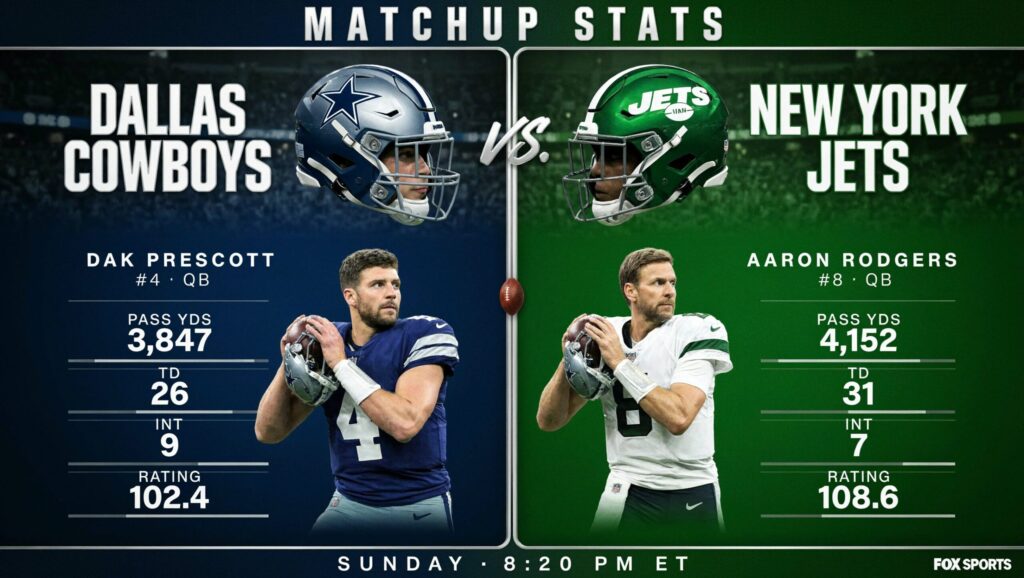
Prescott completed 18 of 29 pass attempts — a 62.1 percent completion rate — for 237 yards, four touchdowns, and zero interceptions. That passer rating of 127.4 tells the story of a quarterback who made every critical throw when Dallas needed it and refused to give the Jets anything for free.
Four touchdown passes in a road game, with no turnovers and minimal sacks allowed, is the kind of performance that championship-caliber teams rely on. Prescott wasn’t spectacular in the conventional highlight-reel sense. He was precise, calm, and devastatingly efficient. He also added seven carries for 28 rushing yards, showing the dual-threat dimension that makes defending the Cowboys so difficult when their quarterback is operating at this level.
After the game, Prescott addressed the confidence his team carried into the hostile environment. His observation that Dallas rotated four players who weren’t starters into the game and still won comfortably wasn’t arrogance — it was an accurate assessment of the depth the Cowboys had developed heading into Week 5. When MVP chants rolled down from the MetLife stands, Prescott absorbed them with the ease of someone who had expected nothing less from himself.
Javonte Williams: The Running Game That Broke the Game Open
If Prescott was the composed conductor, Javonte Williams was the instrument that set the volume. The running back had one of the best individual performances of his season on this particular Sunday, and his work fundamentally shaped the game’s outcome.
Williams carried the ball 16 times for 135 rushing yards — an average of 8.4 yards per carry that reflects both his individual brilliance and the Cowboys’ offensive line dominance throughout the afternoon. He added a rushing touchdown and caught one pass for four receiving yards and an additional touchdown, giving him a two-score game that any running back in the league would celebrate.
The longest rush of the game — 66 yards — came from Williams and represented the kind of explosive play that destroys defensive game plans. When a running back can take a carry two-thirds of the way down the field, the entire defensive structure collapses, and suddenly every subsequent play call becomes simpler for the offense.
His 135 yards on the ground were the foundation upon which Dallas’s offense operated. The Cowboys ran 41 total times for 202 rushing yards as a team, averaging just under five yards per attempt — the kind of ground game dominance that chews clock, drains defensive energy, and sets up the play-action passes that Prescott converted into touchdowns.
Jake Ferguson: The Tight End Who Owned the Red Zone
Tight ends win football games in tight spaces. Jake Ferguson demonstrated why Dallas made him a focal point of their passing attack by producing arguably the most important individual receiving performance of the afternoon.
Ferguson recorded seven catches for 49 yards and two touchdowns. Those aren’t enormous yardage numbers, but tight end production in the red zone is measured differently than wide receiver work in the open field. His 26-yard touchdown catch converted one of Dallas’s longest second-quarter drives into seven points. His one-yard score just before halftime gave the Cowboys a 23–3 advantage that effectively ended the game as a competitive contest before the third quarter began.
That sequence of two Ferguson scores in the closing minute and a half of the second quarter was the defining moment of the afternoon. Dallas entered the locker room with a twenty-point lead, and the game’s outcome was never genuinely in doubt from that point forward.
Ferguson’s ability to work between the hashes, find soft spots in zone coverage, and make catches in traffic made him the Cowboys’ most reliable possession target on this particular afternoon, and his two-score contribution was the difference between a comfortable win and a genuinely decisive one.
Ryan Flournoy: The Unexpected Star
Here’s where this game gets interesting in a way that didn’t show up in many pre-game narratives. Ryan Flournoy wasn’t the name anyone circled on their fantasy lineup going into Week 5. But he left MetLife Stadium having produced the longest individual reception of the afternoon and finished as Dallas’s leading receiver by yardage.
Flournoy caught six passes for 114 yards. His longest reception covered 46 yards and demonstrated the kind of vertical ability that Cowboys quarterback Dak Prescott was willing to trust in a road game against a Jets secondary that had struggled with speed at certain points of the season.
114 receiving yards as a Cowboys wide receiver not named CeeDee Lamb is a notable performance by any measure. It reflected both Flournoy’s development and the broader depth of Dallas’s receiving options — a depth that made the Jets’ defensive assignment extraordinarily difficult, particularly given the threat Williams posed in the running game simultaneously.
George Pickens added two catches for 57 yards, including a 43-yard touchdown catch in the third quarter that pushed the lead to 30–6. That reception — a deep connection that showcased Prescott’s willingness to take shots downfield with appropriate timing — was the kind of play that makes defending the Cowboys exhausting.
Justin Fields and the Jets: Too Little, Too Late
Justin Fields had a genuinely difficult afternoon in the first three quarters but showed resilience in the fourth quarter when the game was already decided. His final numbers — 32 of 46 for 283 yards with two touchdowns and no interceptions — look serviceable on the surface. The story was more complicated in real time.
Fields was unable to generate anything meaningful through three quarters of football. The Cowboys’ defense, despite operating without Micah Parsons, made the Jets quarterback uncomfortable and unable to execute the kind of rhythm-passing that his offense needed to stay competitive. The two-point conversion after the fourth-quarter touchdown showed creativity from the Jets coaching staff — but it came when the deficit was insurmountable.
The Jets’ rushing attack added 66 yards on 26 carries — just 2.5 yards per attempt — a figure that reflected a team unable to establish any ground-game presence against Dallas’s defensive front. Without a consistent run game, Fields was forced into obvious passing situations that the Cowboys could prepare for more directly.
The final-quarter flurry — including an Andrew Beck one-yard touchdown and a Garrett Wilson nine-yard score — reduced the deficit from 37–6 to 37–22 and put some respectability on a final score that didn’t reflect how thoroughly Dallas controlled the game’s first three quarters.
Team Statistics: The Complete Picture
The numbers tell a fuller story than the final score alone.
Dallas generated 416 total yards to the Jets’ 378 — a lead in total yardage that feels modest until you account for the game-script context. Much of New York’s yardage came in the fourth quarter against a Dallas defense comfortable sitting in coverage with a massive lead. The Cowboys’ efficiency — their ability to convert yards into points in the game’s critical first three quarters — far outpaced the Jets’ ability to do the same.
The time of possession split was dramatic in both directions. The Jets held the ball for 34:36 to Dallas’s 25:24 — over nine minutes more in possession. Yet Dallas scored 37 points to New York’s 22, which demonstrates that efficiency and explosiveness matter more than raw possession time when touchdowns rather than field goals result from drives.
Third-down conversion was an area where the Jets actually outperformed Dallas — New York converted 7 of 16 third-down opportunities while Dallas managed 6 of 13. What Dallas did better was convert third-down success into touchdowns rather than field goal attempts, maximizing the value of each extended drive.
The penalty disparity was notable: the Jets drew 11 penalties for 91 yards to Dallas’s 10 for 61 yards. Discipline on the road is a marker of team maturity, and while neither team was exemplary in this area, Dallas’s lower penalty yardage reflected slightly better execution under road conditions.
What This Game Says About Both Teams
Dallas Cowboys: Road Warriors With Depth
The Cowboys’ ability to win this game without Micah Parsons — their best defensive player — while rotating in multiple non-starters at meaningful positions tells you something important about their squad-building philosophy. This wasn’t a one-man victory. Prescott orchestrated. Williams ran. Ferguson scored. Flournoy emerged. The offensive line dominated.
Road wins like this one, against a team with a legitimate quarterback and home-crowd advantage, are the building blocks of playoff caliber. The Cowboys’ confidence — audible in Prescott’s post-game comments, visible in the MVP chants from their traveling support — reflected a team that believed in itself regardless of geography.
New York Jets: Searching for Consistency
The Jets’ inability to generate consistent offense for three full quarters against a defense missing its best player represents a troubling pattern. Justin Fields’s raw numbers improved dramatically in the fourth quarter, which demonstrates his capability — but also raises questions about why that level of execution wasn’t present earlier.
The ground game averaging 2.5 yards per carry for the game is a structural problem. When a team cannot run the ball effectively, every other offensive intention becomes more predictable and more difficult to execute. The Jets had moments of promise, but converting moments into sustained drives proved beyond them in this particular contest.
Final Words
The Cowboys and Jets don’t play every year — the scheduling mathematics of different conferences mean these games come around every four years in the regular season rotation. When they do play, the contrast between the franchises’ cultural weight and their current competitive standing makes for compelling watching.
October 5, 2025 delivered a game that validated Dallas’s offensive system in a way that road victories consistently do — by demonstrating that the Cowboys can execute against opposition defense, in a hostile environment, without their defensive centerpiece, and still find multiple players contributing meaningfully to a convincing victory.
Dak Prescott heard MVP chants in a building that wasn’t built for him. Javonte Williams found 66-yard runways through a defense trying to stop him. Jake Ferguson converted red zone trips into touchdowns with the efficiency of a veteran. Ryan Flournoy announced himself to the broader NFL world.
For the Jets, the work of rebuilding around Justin Fields continued with the knowledge that one-sided losses to Dallas in Week 5 don’t define seasons — but that the patterns they expose need addressing.
FAQs
1. What was the final score of the most recent Cowboys vs Jets game?
Dallas won 37–22 at MetLife Stadium in East Rutherford, New Jersey on October 5, 2025, in Week 5 of the NFL season.
2. How did Dak Prescott perform against the Jets in 2025?
Prescott completed 18 of 29 passes for 237 yards with four touchdowns and zero interceptions, posting a passer rating of 127.4. He ran seven times, gaining 28 yards overall.
3. Who was the Cowboys’ top rusher against the Jets?
Javonte Williams dominated the ground game with 16 carries for 135 yards and one rushing touchdown. He also caught one pass for four yards and an additional touchdown, finishing with two total scores.
4. Which Cowboys receiver led the team in receiving yards?
Ryan Flournoy led all Dallas receivers with six catches for 114 yards, including a 46-yard gain. His production surprised many observers who expected CeeDee Lamb or George Pickens to lead the receiving corps.
5. How did Justin Fields play for the Jets against Dallas?
Fields finished with 32 completions on 46 attempts for 283 yards and two touchdowns with no interceptions. However, much of his production came in garbage time during the fourth quarter when the game was already decided by a large margin.
6. What made Jake Ferguson so important to Dallas’s offense in this game?
Ferguson caught seven passes for 49 yards and two touchdowns, both in the red zone during the second quarter. His ability to find space and make catches in traffic in critical scoring situations gave Dallas a 23–3 halftime advantage that effectively decided the game.
7. Did Dallas play this game without a key defensive player?
Yes. Micah Parsons — the Cowboys’ best defensive player — did not play. Dallas’s defense still held the Jets to just six points through three quarters of play despite his absence.
8. What was the time of possession split in this game?
The Jets held the ball for 34:36 compared to Dallas’s 25:24 — a significant possession advantage for New York. Despite controlling the clock more, the Jets scored fewer points, reflecting Dallas’s superior efficiency in converting possessions into touchdowns.
9. How did the Jets’ rushing attack perform against Dallas?
Poorly. New York generated just 66 rushing yards on 26 carries — a 2.5-yard average that reflects the Cowboys’ ability to control the line of scrimmage even without Parsons. The lack of a ground game forced Fields into predictable passing situations throughout the afternoon.
10. What was the game’s biggest play?
Javonte Williams’s 66-yard rushing gain was the most explosive individual play of the afternoon, representing the longest run of the game and demonstrating the Cowboys’ ability to break a game open in a single carry.
11. Do the Cowboys and Jets play each other every year?
No. Because the Cowboys are in the NFC East and the Jets are in the AFC East, they play each other only when their conference schedules align — typically once every four years in the regular season scheduling rotation. They are not on each other’s 2026 schedule.
12. What records did both teams hold after this Week 5 result?
The specific win-loss records for each team after Week 5 of the 2025 season would have been determined by their earlier games that season. Dallas’s victory improved their record while New York’s defeat dropped theirs, with both teams continuing their respective seasonal campaigns in the weeks that followed.
Explore ideas that elevate your thinking with The Elevate Magazine.