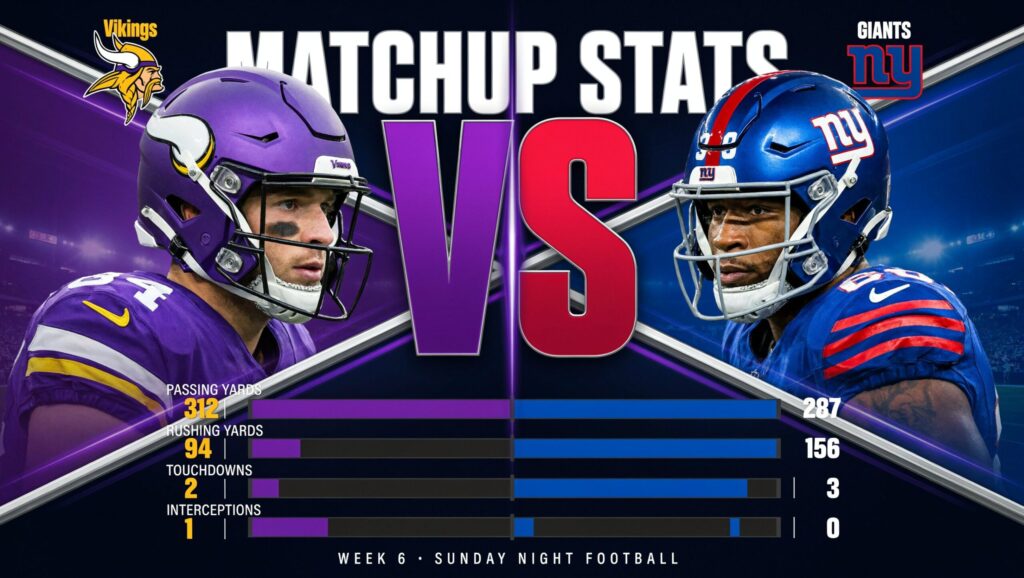
Note: The Minnesota Vikings and New York Giants are not scheduled to meet in the 2026 NFL season. This article covers the Vikings’ most recent game — their Sunday Night Football matchup against San Francisco on November 22, 2026 — with full player stats and analysis.
Quick Facts
| Game | Minnesota Vikings @ San Francisco 49ers — Week 11, NFL 2026 |
| Broadcast | Sunday Night Football |
| Date | Sunday, November 22, 2026 |
| Venue | Levi’s Stadium, Santa Clara, California |
| Final score | Minnesota Vikings 10–San Francisco 49ers 35 |
| Vikings record (after) | 6-5 (2026 season) |
| SF QB | Brock Purdy — 22/27, 260 yards, 3 TDs, passer rating 143.8 |
| MIN QB | Kirk Cousins — 29/43, 264 yards, 0 TDs, 1 INT, passer rating 74.2 |
| SF top receiver | George Kittle — 2 TD catches |
| MIN top rusher | Aaron Jones — 11-yard rushing TD |
| MIN field goals | Will Reichard — 1/3 (48 yards made; two 50+ misses) |
| SF total yards | 343 |
| MIN total yards | 324 |
| MIN turnovers | 2 (1 INT returned for TD, 1 fumble lost) |
Introduction: A Second Half That Never Came
Minnesota arrived at Levi’s Stadium on Sunday Night Football as a team with real playoff credentials — a 6-4 record, wins in five of their last six games, and the kind of confidence that comes from beating division rivals like Green Bay twice already in 2026.
San Francisco had different ideas.
The 49ers dominated Minnesota in the second quarter in ways that made a close game feel impossible. By halftime, San Francisco led 28-10 and had already delivered the kind of blow that changes what a team is playing for. The second half became about managing an uncomfortable scoreline rather than contesting a game.
The final score — San Francisco 35, Minnesota 10 — was a lopsided result that the raw total yard comparison (343 to 324) doesn’t fully capture. Turnovers were the story. San Francisco scored zero turnover touchdowns in Week 1 through 10 of their season; they got one of the most critical ones of their year tonight, when Kirk Cousins’ interception was returned 18 yards for a score. Combined with a lost fumble, Minnesota’s two turnovers produced 10 points for San Francisco — the entire margin between a game and a blowout.
First Quarter: Perfectly Balanced — Then Quickly Not
The first quarter set up false expectations.
San Francisco scored first. At 11:21, Brock Purdy connected with George Kittle on a short middle route for 17 yards and a touchdown — Kittle’s first score of the night and an early signal that Minnesota’s linebacker coverage would be tested all evening. Evan Pinheiro converted the extra point. San Francisco led 7-0.
Minnesota responded. At 1:18 of the first quarter, Aaron Jones took a handoff and burst through left end for 11 yards and a touchdown — a clean, well-executed rushing score that brought the visitors level. Will Reichard’s extra point made it 7-7.
After one quarter, the score was tied. Minnesota’s possession time was actually higher. The game looked genuinely competitive.
Then the second quarter happened.

Second Quarter: Where the Game Was Decided
The second quarter of this game is what will be studied in Minnesota’s film sessions for weeks. San Francisco outscored the Vikings 21-3 in the period and produced two of the three most damaging plays of the entire night within a span of twelve minutes.
14:18 — San Francisco 14-7: Purdy found Kittle again, this time for 8 yards in the short middle for his second touchdown of the first half. Minnesota’s linebackers were repeatedly beaten over the middle in a pattern that the 49ers had clearly identified in their preparation.
6:52 — San Francisco 14-10: Minnesota’s best moment of the half. Will Reichard’s 48-yard field goal cut the deficit to four. It was the last score Minnesota would manage in the game.
2:14 — San Francisco 21-10: Purdy threw short right to Mike Evans for 4 yards and a touchdown. This was a methodical, well-executed drive that Minnesota’s defence couldn’t stop despite having the numbers on the field.
2:05 — San Francisco 28-10 — The Defining Moment: Kirk Cousins threw a short middle pass. San Francisco’s J. Brown was there first. He intercepted it at the Minnesota 18-yard line, turned upfield, and returned it 18 yards for a touchdown. The pick-six came with under two minutes left in the first half and was the decisive blow of the game.
A Minnesota team that had been within four points at the 7-minute mark of the second quarter trailed by 18 points going into the locker room. The pick-six didn’t just change the score — it changed what the second half was going to be about.
Halftime Stat Check
| Statistic | San Francisco | Minnesota |
| Score | 28 | 10 |
| Possession time | 27:37 total | 32:23 total |
| Passing yards | 196 | 198 |
| Rushing yards | 60 | 42 |
| Turnovers | 0 | 2 |
| Kirk Cousins passer rating | — | 55.4 (halftime) |
| Brock Purdy passer rating | 143.8 | — |
The possession numbers are striking. Minnesota held the ball longer at halftime than San Francisco — but had 18 fewer points to show for it. The turnovers tell the full story. Minnesota’s two first-half turnovers directly generated 10 San Francisco points. Without them, this was a much tighter game.
Third Quarter: Scoreless and Grinding
The third quarter produced nothing on the scoreboard for either team — a shutout period that represented Minnesota fighting back without being able to score.
The Vikings ran 24 plays in the third quarter and managed positive yardage but couldn’t convert inside San Francisco’s redzone. Field goal attempts were part of the problem — Reichard missed two attempts beyond 50 yards in the second half, leaving Minnesota with 3 points from 3 field goal attempts on the night where two successful kicks would have made the final score more respectable.
San Francisco’s defence held Minnesota to zero third-quarter points, sticking with the game plan that had worked so effectively in the second quarter — pressuring Cousins off his spots, taking away his deeper options, and forcing the kind of quick throws that don’t move the chains.
Fourth Quarter: Final Dagger
Christian McCaffrey delivered the final score at 13:30 of the fourth quarter, rushing up the middle for 6 yards. His touchdown made it 35-10. Pinheiro converted for the final time, and the game was effectively over.
Minnesota held San Francisco scoreless for the game’s final 13-plus minutes, but couldn’t score themselves. The final 10-minute stretch of the game was characterised by clock management from San Francisco and desperation passing from Minnesota that produced volume (43 attempts on the game) without results (zero passing touchdowns, passer rating of 74.2).
Kirk Cousins: The Statistical Story
Kirk Cousins finished 29 of 43 for 264 yards, zero touchdowns, one interception, and a passer rating of 74.2. Those numbers sit in an uncomfortable middle ground — not the disastrous performance the final score implies, but clearly not good enough against a San Francisco defence operating at full capacity.
The completion percentage of 67.4% and 264 passing yards look decent in isolation. The context strips away the respectability. Cousins threw 43 passes — a number that reflects how often Minnesota was in catch-up mode. He was blitzed 13 times, absorbing one sack and being hurried on five more. He threw 8 poor throws, including the interception that was returned for a score.
The pick-six was the game’s decisive play. It came at the worst possible moment — with Minnesota trailing by only 4 and apparently capable of making a half-ending drive to cut it to 1. Instead of trailing 14-10 at halftime with momentum, the Vikings trailed 28-10 and faced a mountain.
Brock Purdy: A Clinical Performance
Brock Purdy’s statline reads like a highlight reel: 22 completions from 27 attempts (81.5% completion rate), 260 yards, 3 touchdowns, 0 interceptions, and a 143.8 passer rating.
A passer rating of 143.8 is elite by any standard — the maximum possible is 158.3, reserved for perfection. Purdy achieved it tonight through extraordinary efficiency: he targeted 27 receivers, completed 22 of them, took only one sack, and threw no interceptions despite Minnesota blitzing 53 times across the game. That blitz number is extraordinary — Minnesota essentially decided that their best path to pressure was sending extra rushers, and Purdy handled it by getting the ball out quickly and accurately.
The two Kittle touchdowns were defining moments of Purdy’s night. Both came on short middle routes that Minnesota’s linebackers couldn’t defend. Purdy read the coverage, made the throw, and Kittle did the rest. It was a simple plan executed at a high level.
George Kittle: Owned the Middle of the Field
George Kittle finished with two touchdown catches and was clearly San Francisco’s primary weapon against Minnesota’s coverage. His availability in the short-to-medium middle zones was something Minnesota’s defence couldn’t solve all night.
Kittle’s work after the catch was also important — San Francisco recorded 131 yards after the catch as a team, reflecting how often their receivers caught short passes and turned them into meaningful gains. Kittle’s willingness to run through contact after the reception is a defining feature of his game, and it was on full display.
Minnesota’s Receiving Game: Volume Without Results
Minnesota’s receiving corps amassed 264 yards — more than San Francisco’s 260 — but scored zero receiving touchdowns. With 43 targets spread across the Vikings’ receivers, Minnesota was moving the ball but not punching it in. The 29 receptions came on 43 targets, which isn’t terrible, but the zero touchdowns on 4 redzone targets tells the story of an offence that couldn’t convert when it mattered.
The longest Minnesota reception of the night went for 29 yards — a respectful gain but not the kind of explosive play that can swing a game. San Francisco’s coverage, while not generating turnovers on its own, kept the Vikings from hitting the deep passes that can quickly close a scoring deficit.
Special Teams: Reichard’s Difficult Night
Will Reichard had the kind of special teams performance that gets discussed quietly in the film room. His 48-yard field goal in the second quarter was his only make on three attempts. The two misses both came from beyond 50 yards in the second half — attempts that, had they converted, would have made the score 35-16 rather than 35-10. Neither is a game-changer at that point, but misses from that range compound the difficulty of a team trying to show fight in a losing effort.
His punting counterpart on the other side had no comparison to make — Minnesota punted only twice all night, reflecting how often they had the ball and tried to drive rather than punt.
Season Context: What This Loss Means for Minnesota
Minnesota’s loss drops their record to 6-5 heading into Week 12. The 2026 NFC playoff picture is competitive, and a 6-5 record keeps Minnesota in the hunt but requires consistent performance through the final six games to secure a postseason berth.
Their remaining schedule includes Atlanta Falcons (at home, Week 12), Carolina Panthers (at home, Week 13), New England Patriots (away, Week 14), Detroit Lions (at home, Week 15 SNF), Washington Commanders (home, Week 16), and Chicago Bears (Week 18). That schedule is manageable. The Detroit game — a rematch of a loss on November 1 — looms as the season’s most significant remaining regular-season test.
For San Francisco, the win moves them in the right direction after earlier-season struggles. Purdy’s performance was one of the best of his 2026 season and reinforces that when this offence is operating at full capacity, it’s as difficult to defend as any in the NFL.
Final Words
The box score says Minnesota 10, San Francisco 35. The honest account of what happened says Minnesota had a game before the second quarter ran away from them.
A tied game after one quarter. A four-point deficit with seven minutes left in the first half. And then — a pick-six, another touchdown, and a halftime deficit that required the kind of comeback the 2026 Vikings simply couldn’t mount against a Purdy-to-Kittle connection that was working too smoothly to interrupt.
The turnovers were the difference. Remove the interception return for a touchdown and the lost fumble, and the final score looks significantly different. Minnesota can’t take those back, but they can study the film, understand the blitz packages San Francisco used to generate them, and go into Week 12 against Atlanta with a corrected approach.
A 6-5 team with a difficult loss on the road against an elite opponent on Sunday Night Football isn’t a team in crisis. It’s a team with something to prove over the final six weeks.
FAQs
1. Do the Minnesota Vikings play the New York Giants in the 2026 NFL season?
No. The Vikings and Giants are not scheduled to meet in the 2026 regular season. They are in different conferences — NFC North and NFC East — and the scheduling rotation does not bring them together this year. This article instead covers Minnesota’s most recent game, their November 22 Sunday Night Football matchup against San Francisco.
2. What was the final score of Vikings vs 49ers on November 22, 2026?
San Francisco 49ers 35, Minnesota Vikings 10. The game was not competitive in the second half after San Francisco built a 28-10 halftime lead, capped by a pick-six in the final two minutes of the second quarter.
3. What were Kirk Cousins’ stats?
Cousins finished 29 of 43 for 264 yards, zero touchdowns, one interception, and a passer rating of 74.2. He was blitzed 13 times and took one sack.
4. What were Brock Purdy’s stats?
Purdy was exceptional — 22 of 27 for 260 yards, three touchdowns, zero interceptions, and a passer rating of 143.8. He handled 53 Minnesota blitzes with composure, getting the ball out quickly and accurately throughout.
5. Who scored Minnesota’s points?
In the first quarter, Aaron Jones ran for 11 yards to score Minnesota’s lone touchdown. Will Reichard added a 48-yard field goal in the second quarter. Minnesota managed no additional scoring despite having the ball more than San Francisco.
6. What was the game-defining play?
J. Brown’s interception of a Kirk Cousins pass, returned 18 yards for a touchdown with 2:05 remaining in the second quarter. Minnesota had been trailing only 14-10 moments earlier. The pick-six made it 28-10 and effectively ended the game’s competitive phase.
7. How did George Kittle perform?
Kittle caught two touchdown passes from Purdy — both on short middle routes that Minnesota’s linebackers couldn’t cover. He was San Francisco’s most dangerous weapon and the receiver Minnesota’s defence had the most trouble with all evening.
8. What happened with Minnesota’s field goals?
Will Reichard went 1-for-3 on field goal attempts. He made a 48-yarder in the second quarter. He missed two attempts beyond 50 yards in the second half. The misses left Minnesota with 3 points from 3 attempts when two makes would have added 6 more points.
9. How many times did Minnesota blitz San Francisco?
53 times — a remarkable number that reflects Minnesota’s defensive game plan of trying to pressure Purdy with extra rushers. Purdy handled the blitzes by getting the ball out quickly. San Francisco scored on 5 touchdowns despite the pressure volume.
10. What is Minnesota’s record after this game?
6-5. The loss dropped them from their previous position but keeps them in NFC playoff contention with six games remaining.
11. What was the total yards comparison?
Minnesota actually outgained San Francisco in total yards — 324 to 343. The turnovers tell the more accurate story: Minnesota’s 2 turnovers directly resulted in 10 San Francisco points through a pick-six and lost possession at critical moments.
12. What are Minnesota’s remaining games in 2026?
Atlanta Falcons (Week 12, home), Carolina Panthers (Week 13, home), New England Patriots (Week 14, away), Detroit Lions (Week 15, home — Sunday Night Football), Washington Commanders (Week 16), and Chicago Bears (Week 18). The Detroit rematch is the most significant game remaining.