Quick Facts
| Detail | Info |
| Game | San Francisco 49ers vs. Los Angeles Chargers |
| Date | Thursday, December 17, 2026 |
| Broadcast | Thursday Night Football |
| Venue | SoFi Stadium, Inglewood, CA |
| 49ers 2026 Record | 9–2 (as of Week 12) |
| Chargers 2026 Record | TBD |
| Division | NFC West (SF) vs. AFC West (LAC) |
| Series History | Inter-conference matchup |
Introduction: Why This Game Actually Matters
There are games on the NFL schedule that feel like filler — mid-season clashes between teams going nowhere, played on a cold afternoon with nothing riding on the result. There are also games like this one.
When the San Francisco 49ers travel down to SoFi Stadium to face the Los Angeles Chargers on a December Thursday night, it carries real weight. The 49ers are on a roll — nine wins through eleven games, surging into the postseason picture with the kind of dominant football that reminds you why this franchise has always been dangerous. The Chargers, playing in one of the most glamorous stadiums in the country, are fighting to prove they belong in the same conversation.
This is a matchup of two organizations with legendary histories, elite talent at key positions, and fan bases that are passionate in very different ways. It’s also a game that could have playoff seeding implications for one team and a turning-point moment for the other.
Let’s break it all down.
See also “minnesota vikings vs new york giants match player stats: Complete Match Report and Player Stats“
The 49ers in 2026: Rolling with Purpose
San Francisco has looked like a machine for most of this season. Their record of 9–2 through twelve weeks isn’t just impressive — it tells a story of a team that has found balance on both sides of the ball.
Look at how they’ve played: a 35–10 demolition of the Minnesota Vikings on Sunday Night Football just days ago, wins over Dallas in a shootout (46–40), dominant performances against Miami and Denver, and even a gritty road win at Seattle. The only real blemishes came from a loss in Atlanta and a bump early in the year.
What makes this 49ers team click? A few things stand out.
On offense, the scheme under head coach Kyle Shanahan remains one of the most creative in the league. The outside zone running game stresses defenses horizontally, opens gaps that look like they shouldn’t exist, and forces linebackers to make decisions they don’t want to make. San Francisco’s running backs have been a key part of their success all year — the committee approach means fresh legs late in games, which matters in December.
The passing strategy has worked well without being ostentatious. San Francisco’s quarterback has made sharp, quick decisions, using intermediate routes and play-action to keep defenses honest. When they’ve needed big throws, they’ve made them — as the Dallas game showed.
Defensively, San Francisco’s front has been disruptive all season. Their ability to generate pressure without sending extra rushers is elite, and their secondary has held up against some quality passing attacks. The Vikings had essentially nothing going offensively against them last week.
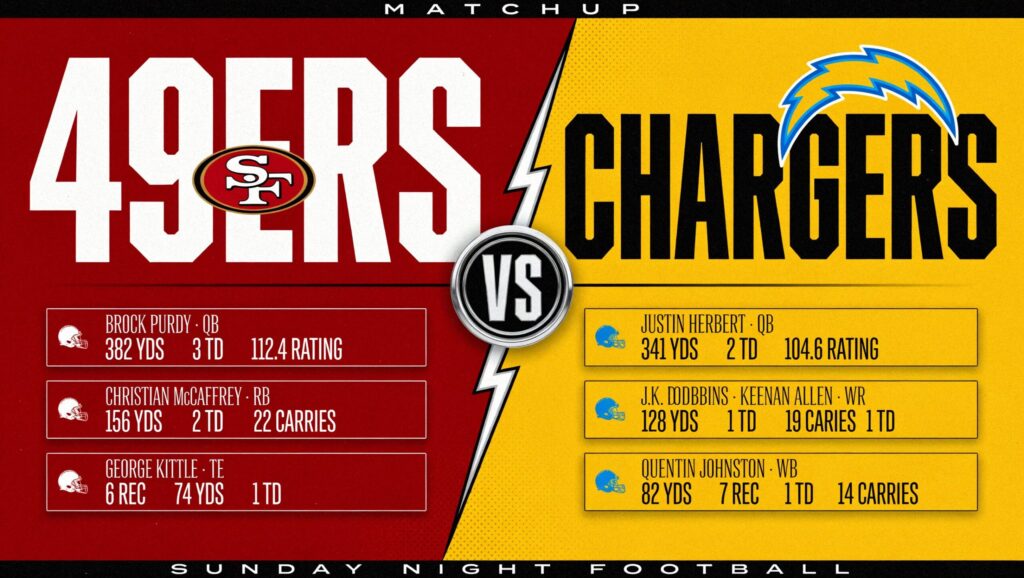
The Los Angeles Chargers: The Counter-Argument
The Chargers operate in a complicated space. They share a stadium with the Rams (who the 49ers already beat 27–7 to open the season), play in a market where football culture is diffuse and spread across multiple teams, and yet they consistently field rosters that are talented enough to compete with anyone.
SoFi Stadium is a legitimately spectacular place to play a game. The sight lines are clean, the atmosphere when the building is rocking is electric, and the turf has suited fast, skill-position-heavy teams. Home advantage here is real when the Chargers bring energy — and in December, with playoff stakes on the table, that energy tends to arrive.
The Chargers’ strength in recent years has revolved around offensive weaponry. Wide receiver depth, a capable tight end presence, and a quarterback who can push the ball down the field all create problems for defenses. Against San Francisco’s secondary — good as it is — this offense will get some shots.
What the Chargers have always had to prove is toughness in the trenches. The 49ers’ defensive line is precisely the kind of unit that exposes offensive line weaknesses. If the Chargers’ front five can hold up and give their quarterback time, this game becomes genuinely competitive. If they can’t, it becomes a long evening at SoFi.
Key Players to Watch: San Francisco 49ers
The Running Back Room
Shanahan’s system makes running backs look exceptional — and that’s not entirely a knock on the backs themselves, because they still have to be smart, patient, and physically capable. The 49ers’ ability to rush effectively opens everything else. When their ground game is working, opponents begin to cheat the run, play-action kills them, and suddenly receivers are running open routes with no safety help over the top.
Expect San Francisco to establish the run early against the Chargers. It’s not just philosophy — it’s a game-plan tool.
The Defensive Front
The 49ers’ pass rush has been one of the most consistent units in the NFC all season. Whether it’s manufactured pressure through stunts and games or pure one-on-one dominance, San Francisco gets to the quarterback. Against a Chargers offense that wants to push the ball vertically, disrupting the pocket early changes everything about what that offense can do.
If San Francisco gets home consistently — expect three or four sacks, some pressure on key third downs — the Chargers’ game plan collapses.
Kyle Shanahan’s Play-Calling
It sounds odd to put a head coach in a “players to watch” section, but Shanahan’s decision-making is genuinely a performance asset. He calls plays that set up other plays. He uses motion and formation shifts to get pre-snap reads. He adapts at halftime in ways that have been decisive all season. When Shanahan has a week of prep and a motivated team, his offense is very hard to stop.
Key Players to Watch: Los Angeles Chargers
The Quarterback
The Chargers’ ability to compete in this game lives and dies with what their quarterback can do against a smart, aggressive defense. San Francisco will mix coverages, show different looks pre-snap, and try to get the quarterback to hold the ball. If he can process quickly, check down when needed, and take his shots downfield when they’re there, the Chargers stay in the game. If he gets rattled early, the momentum swings hard.
Wide Receiver Corps
The Chargers have invested significantly in receiver talent over the years, and that group figures to be tested hard by San Francisco’s corners. This is a matchup worth watching rep-by-rep. If a receiver wins a one-on-one battle early and builds confidence, the Chargers’ offense can open up. If San Francisco’s corners lock them down and take away the deep ball, the Chargers will be grinding for yards underneath — and that’s not how they want to play.
The Defensive Line
If the Chargers have any chance of stopping the 49ers’ ground game, it starts with their defensive tackles. San Francisco will try to run at them, establish physicality, and control tempo. The Chargers need to hold the point of attack, stay in their gaps, and not get washed out by San Francisco’s athletic and experienced offensive linemen. That’s a tough ask, but it’s the job.

Historical Context: These Teams Don’t Meet Often
Because the 49ers play in the NFC and the Chargers in the AFC, they only meet in the regular season every few years as part of the NFL’s rotating interconference schedule. That relative rarity actually adds something to the matchup — coaches have less film to work from, players face unfamiliar schemes, and the chess match between coordinators becomes more interesting.
San Francisco and Los Angeles have always had a geographic rivalry of sorts — two cities, different vibes, competing for relevance in the same state. The NFL footprint in California is unique: three franchises (49ers, Chargers, Rams) all within a few hundred miles, all with passionate fan communities, all with legitimate championship aspirations. When these teams play each other, there’s bragging rights attached beyond just the standings.
The 49ers historically hold the stronger franchise pedigree — five Super Bowl championships, a dynasty in the 1980s, and a reputation as one of the premier organizations in NFL history. The Chargers have had their moments, including a Super Bowl appearance in the 1990s and multiple strong teams in the 2000s, but the championship has eluded them. That hunger is part of what drives this organization.
The Tactical Matchup: Where the Game Gets Decided
Can San Francisco Control the Clock?
The 49ers’ ideal game looks like this: run the ball effectively, chew clock, get into third-and-manageable situations, convert enough of them to sustain drives, and let their defense keep the Chargers’ offense on the sideline. If San Francisco can win the time-of-possession battle significantly, the Chargers simply don’t get enough chances to stay close.
This isn’t a passive strategy — it’s aggressive game theory. Keeping the opponent’s offense off the field is one of the most effective ways to win a close football game, and Shanahan runs his system with that logic embedded in every drive.
Can the Chargers Create Turnovers?
San Francisco has been careful with the football. Their quarterback doesn’t take unnecessary risks, the running backs protect it well, and Shanahan designs plays that give ball carriers clean running lanes. But turnovers are always possible — and in a game the Chargers need to win, one or two forced turnovers could completely swing the momentum.
If the Chargers’ defense creates a fumble or an interception, especially in the first half, they suddenly control the narrative of the game. That is the type of play that transforms everything.
Third-Down Conversion Rate
This is often where playoff-caliber teams separate themselves from good-but-not-great ones. San Francisco has been excellent on third down all season — they don’t put themselves in impossible third-and-long situations because their first and second-down execution is so clean. The Chargers will need to get off the field on third down against the 49ers’ offense, and they’ll need to convert their own third downs against a defense that makes life difficult for opposing offenses.
Watch the third-down numbers at halftime. They’ll tell you a lot about where the game is heading.
Atmosphere and Setting: SoFi on a December Night
SoFi Stadium opened in 2020 and quickly established itself as one of the best venues in professional sports. The design — open air, natural light, a see-through roof — creates a visual spectacle, and the playing surface has been consistently praised by players on both sides. At night, with the stadium lit up and a crowd engaged in a meaningful December game, it’s a genuinely great place to watch football.
For San Francisco, this is a road game in a stadium they’ve played in before (they opened the 2026 season against the Rams in this building). They know the environment, they’ve performed well in it, and their veteran roster won’t be rattled by the lights or the crowd.
For the Chargers, playing at home in December with something to prove is an opportunity. Their fan base has been vocal about wanting big moments — this is one of them.
What the Stats Through Week 12 Tell Us
San Francisco’s nine wins through twelve games tell a story of a team that is scoring enough and defending well enough to win most matchups. Their 46-point output against Dallas shows they can go up-tempo and throw the ball when needed. Their 10-point effort against Minnesota shows they can impose a physical, controlled game when they want to. That flexibility is what makes them dangerous.
The Minnesota win stands out as particularly impressive — the Vikings had been competitive against most of their opponents, and the 49ers made them look overmatched. That kind of performance, two weeks before a December road game against an AFC West team, suggests San Francisco is hitting their stride at the right time of year.
Prediction and Game Outlook
This matchup has the ingredients for a good football game. San Francisco is the better team on paper and comes in with momentum and a clear identity. The Chargers are home, motivated, and physically capable of competing.
The most likely outcome is a 49ers win somewhere in the range of 24–17 or 27–20 — competitive, but decided by San Francisco’s ability to run the ball and control the game’s pace. If the Chargers force turnovers or the 49ers’ running game is shut down unexpectedly, the final score could be much tighter.
For the 49ers, this game is about maintaining positioning heading into the final stretch of the season. For the Chargers, it’s about proving they belong in the conversation for January football.
Final Words
The San Francisco 49ers vs. Los Angeles Chargers matchup on December 17, 2026, is one of those games that rewards the football fan who pays attention to the details. It’s not just about which team scores more points — it’s about which coaching staff adapts better, which front seven imposes their will, and which team handles the December pressure with composure.
San Francisco has built something real this season. Nine wins, a punishing offensive system, a defense that makes opposing offenses look ordinary — this is a team that is playing its best football at the right time of year. The Chargers will give them a game, because that’s what talented, hungry teams do in December at home. But the 49ers’ margin for error, their system’s depth, and their recent form all point in one direction.
From kickoff until the last whistle, this game is worth watching.
FAQs
1. When is the 49ers vs. Chargers game in 2026?
The game is scheduled for Thursday, December 17, 2026, as part of Thursday Night Football. The start time is 5:15 p.m. Pacific Time.
2. Where is the game being played?
SoFi Stadium in Inglewood, California. It’s a home game for the Los Angeles Chargers.
3. What is San Francisco’s record going into this game?
The 49ers enter at 9–2, one of the best records in the NFC heading into the final weeks of the regular season.
4. Have the 49ers and Chargers played recently?
They play infrequently due to being in different conferences (NFC and AFC), so this interconference matchup is relatively rare in the regular season schedule.
5. Who is the San Francisco 49ers’ head coach?
Kyle Shanahan has been the head coach of the 49ers since 2017 and is widely regarded as one of the most creative offensive minds in the NFL.
6. What makes San Francisco’s offense so difficult to defend?
The outside zone running scheme creates horizontal stress on defenses, opens running lanes, and sets up play-action passing that consistently generates big plays. The system also makes multiple skill-position players look elite because of its design.
7. Why is SoFi Stadium considered one of the best venues in the NFL?
SoFi opened in 2020 and features an open-air design with a translucent roof, excellent sight lines, premium amenities, and a playing surface that gets high marks from players. It has hosted multiple major events including the Super Bowl.
8. What does San Francisco need to do to win this game?
Establish the run, control time of possession, avoid turnovers, and let their defensive front generate pressure on the Chargers’ quarterback. If they execute their system cleanly, they’re difficult to beat.
9. What is the Chargers’ biggest advantage in this matchup?
Home field at SoFi, wide receiver talent, and the motivation of a December game with playoff stakes. If they can turn their home crowd into a factor and force a turnover, they have a real chance.
10. How has San Francisco performed on the road in 2026?
They opened the season with a 27–7 road win at the Rams’ home at SoFi Stadium, and have shown they’re comfortable playing in hostile environments. Road games don’t appear to slow them down.
11. Is this game important for playoff seeding?
For San Francisco, yes — continuing to win in December protects their seeding in the NFC and positions them for home games in the postseason. Every win at this stage of the season has weight.
12. Where can fans watch Thursday Night Football?
Thursday Night Football games in 2026 air on Amazon Prime Video as the primary broadcaster, with additional distribution depending on regional markets. Check local listings for availability.