Quick Facts
| Detail | Info |
| Topic | BrandRank.AI Normalization Transformation Rules |
| What BrandRank.AI Actually Is | A real AI brand visibility measurement platform |
| Official Framework Name | Brand Health and Trust (BHT) framework |
| Diagnostic Tool | BRAND ANSWER (developed with Burke, Inc.) |
| “Normalization Transformation Rules” Status | Not an official published BrandRank.AI specification — a popular SEO shorthand for real data practices |
| Underlying Concepts | Real and established: data normalization, entity resolution, transformation pipelines |
| Relevant to | Marketers, SEO professionals, data scientists, brand managers |
| Core Goal | Make brands consistently recognizable to AI language models and answer engines |
| Key Statistic | 58% of users say AI is changing how they discover and evaluate brands (2026) |
| Primary Use Case | Answer Engine Optimization (AEO) and visibility in AI searches |
Introduction: The Phrase Everyone Is Searching and What It Actually Means
If you have spent any time in the world of AI marketing, SEO strategy, or brand analytics recently, you have probably come across the phrase “BrandRank.AI normalization transformation rules.” It has appeared in dozens of articles over the past year. It gets referenced in marketing forums, shared in LinkedIn posts, and cited in strategy documents.
There is just one important thing worth knowing before you go any further: it is not an officially published framework from BrandRank.AI.
That is not an insult to anyone who has written about it or searched for it. The underlying ideas are completely real and genuinely important. Normalization is a foundational practice in data science. Transformation rules are essential components of any serious data pipeline. And BrandRank.AI is a legitimate, operating platform that measures how visible brands are to artificial intelligence systems. All three things are real.
What is not real — or at least not verifiable — is a formally published document from BrandRank.AI that defines a specific proprietary framework under the name “normalization transformation rules.” Independent researchers who have dug into this, including analysts at AI Insights News and Perplexity AI Magazine, found no such document on BrandRank.AI’s official site, in their FAQ, or in any press materials released under that name.
What BrandRank.AI has published — and what is worth your attention — is the Brand Health and Trust framework, developed in partnership with research firm Burke, Inc., along with a diagnostic tool called BRAND ANSWER.
This article does two things. First, it gives you an honest account of what BrandRank.AI actually is and what it actually does. Second, it gives you a complete, practical explanation of what normalization and transformation rules genuinely mean in the context of brand data, AI visibility, and the emerging field of Answer Engine Optimization. Because even if the phrase is SEO shorthand rather than an official specification, the concepts behind it are not shorthand at all. They are real, they matter, and understanding them will make you significantly better at managing your brand’s presence in the AI era.
See also “studiosoapp.com: The Music Education Platform Bridging Teachers and Students Through Technology“
What BrandRank.AI Actually Is
Start here, because getting this right is the foundation for everything else.
BrandRank.AI is a technology platform focused on measuring how well brands appear in AI-generated responses. Its core proposition is straightforward: as AI assistants like ChatGPT, Gemini, Perplexity, and others become primary discovery tools for millions of consumers, the question of whether your brand gets mentioned, cited, or recommended by those systems has become a genuinely consequential business issue.
Traditional search engine optimization was about ranking on page one of Google results. The new challenge is whether AI assistants name your brand when someone asks a relevant question. This space is called Answer Engine Optimization, or AEO, and it is growing rapidly.
BrandRank.AI was built to help brands understand and improve their position in this emerging landscape. Its primary published framework is the Brand Health and Trust framework — developed through a partnership with Burke, Inc., a research firm with deep expertise in brand measurement and consumer insight. This framework produced the BRAND ANSWER diagnostic tool, which gives brands a structured assessment of how they appear across AI answer systems.
Among the platform’s publicly documented capabilities are multi-market support, language variation analysis, identification of local sources of authority, and guidance on prioritized actions for marketing operations. The platform helps brands understand what AI systems say about them, why, and what can be changed to improve that picture.
That is what BrandRank.AI does. And understanding it properly makes the normalization question much clearer.

What Data Normalization Actually Means: The Foundation
Now that we know what BrandRank.AI is, we can address the concept that generates all the confusion around this phrase.
Data normalization, in its technical sense, is the process of converting raw, inconsistent data into a standardized format that downstream systems can process reliably. It is not a new idea. It has been a cornerstone of database management, machine learning, and data analytics for decades.
Here is a simple example. Imagine you are collecting brand mentions across the internet. Some sources write your company name as “BrandRank AI.” Others write “BrandRank.ai.” Others write “brandrank.ai.” A few write “Brand Rank A.I.” or “BrandRank Ai” or even just “Brandrank.”
To a human reader, these all clearly refer to the same company. To an AI language model processing text as mathematical vectors, these variations may register as different entities. The model is not reading words the way you do — it is processing patterns of tokens and their statistical relationships. Inconsistent presentation creates genuine recognition problems.
Normalization addresses this by establishing a canonical form — the definitive version of a brand name, URL, product name, or other identifier — and applying rules that resolve all variations back to that form before data is processed.
In the context of AI brand visibility, normalized data means that when an AI system encounters your brand across thousands of different sources, it reliably recognizes all those mentions as referring to the same entity. That recognition is what allows the AI to build an accurate, comprehensive understanding of who you are, what you do, and why you are relevant to specific questions.
What Transformation Rules Actually Mean
Transformation is the broader category that normalization sits within.
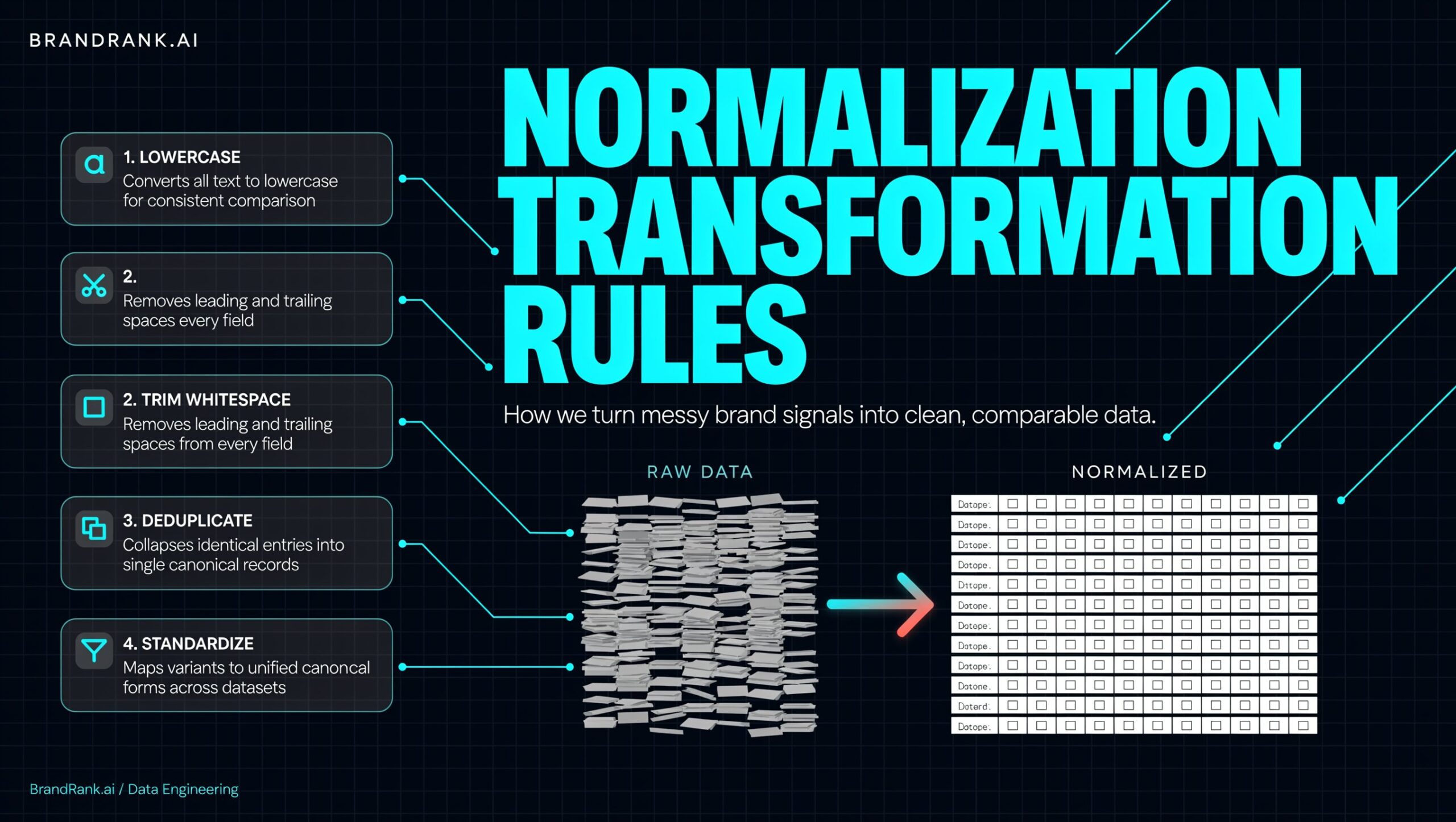
Where normalization focuses specifically on making equivalent representations consistent — resolving “BrandRank AI” and “BrandRank.ai” into the same canonical entity — transformation covers the wider process of converting data from its raw source format into a structured form that analytical systems can use.
Think of it this way. Raw data about your brand comes from everywhere: social media mentions, press coverage, review platforms, forum discussions, structured databases, marketing materials, competitor analyses. Each of these sources formats data differently. The language is different. The structure is different. One source’s fields are absent from another.
Transformation rules define how data moves from that messy, varied input state into a clean, structured, comparable output state. They specify what gets kept, what gets discarded, what gets converted, and how conflicts between different sources get resolved.
In brand analytics specifically, transformation typically means converting raw AI responses — the text that an AI system generates when asked about a brand — into structured data fields: mentions, citations, topics, sentiment scores, competitor comparisons, and authority signals. That structured data is what allows meaningful analysis and meaningful improvement.
The two processes work together. Normalization ensures that all the input data points to the right entities. Transformation ensures that the resulting data is in a form that analytical platforms can actually use.
The Core Normalization Rules That Apply to Brand Data
Even though BrandRank.AI has not published an official rulebook under this name, the normalization practices that apply to brand data in AI systems are real and well-established. Here is a clear account of the most important ones.
Case normalization is the starting point. Brand names, product names, URLs, and other identifiers should be presented consistently in terms of capitalization. If your official brand name is “BrandRank.AI” with a capital B, capital R, capital A, capital I, and a period before AI, then every public representation of that name should follow that convention. AI systems are sensitive to these variations.
Entity suffix removal addresses the noise created by legal business identifiers. Terms like LLC, Inc., Ltd., Corp., and GmbH are essential for legal and regulatory purposes, but they create semantic noise when AI systems are building their understanding of your brand. Transformation rules typically strip these suffixes when processing brand data for AI visibility purposes, leaving the clean brand name.
URL canonicalization ensures that your website is consistently represented as a single definitive address. The same domain might be accessible through www. and without www., through http:// and https://, with and without trailing slashes, and through various subdomain combinations. Canonical URL rules establish which of these is the primary form and ensure that links and citations consistently use it.
Whitespace and formatting normalization handles the small inconsistencies that multiply across large datasets. Extra spaces, inconsistent hyphenation, different dash types, and unusual punctuation all create variations that need to be resolved.
Language and transliteration normalization becomes critical for brands operating in multiple markets. The same brand may be spelled differently in different languages or scripts. Normalization rules need to map all of these back to the canonical brand entity.
Sentiment normalization standardizes the way emotional tone is measured across different sources. Different platforms and different types of content express sentiment in different registers. Normalization ensures that sentiment scores from a Reddit forum can be compared meaningfully with sentiment scores from a press release.

Why This Matters: The AI Discovery Revolution
The practical significance of all these normalization and transformation practices flows from something that is happening right now in the way people find and evaluate brands.
As of 2026, research suggests that 58% of people say AI systems are changing how they discover and evaluate brands. Nearly one in four say they rely less on traditional search than they did a year ago. The trend is accelerating. Consumers are increasingly getting their brand recommendations not from search result pages but from conversational AI assistants that synthesize information from across the web and deliver direct answers.
In that world, the question is not whether your website ranks on page one of Google. The question is whether ChatGPT, Gemini, Perplexity, or any other major AI assistant mentions your brand when someone asks a relevant question. And the answer to that question depends significantly on whether the AI system has a clear, consistent, accurate understanding of who you are.
An AI model that has encountered your brand represented in a dozen different inconsistent ways across thousands of data sources will have a fuzzy, uncertain picture of your entity. A model that has encountered your brand consistently represented — same name, same canonical URL, same set of clear associations — will have a sharp, confident picture. That confidence directly influences whether and how prominently the model recommends you.
This is why normalization is not just a technical housekeeping exercise. It is a strategic business priority for any brand that wants to be visible in the AI era.
The Brand Health and Trust Framework: What BrandRank.AI Actually Published
Since so much content about “BrandRank.AI normalization transformation rules” circulates without pointing to what BrandRank.AI actually documented, it is worth being clear about the real published framework.
The Brand Health and Trust framework, developed by BrandRank.AI in partnership with Burke, Inc., organizes brand performance in AI systems around several core measurement areas.
AI Search Visibility measures how frequently and prominently a brand appears in AI-generated responses to relevant queries. This is the foundational metric — if the AI does not mention you, nothing else matters.
Content readiness measures whether the information available about your brand online is in a form that AI systems can effectively process and use. This is where normalization practices have the most direct impact.
Brand authority signals measure the trust indicators that AI systems use to evaluate whether a source or brand deserves to be recommended. These include the quality and consistency of citations, the authority of the sources that mention the brand, and the coherence of the brand’s information across platforms.
The BRAND ANSWER diagnostic tool generates an assessment of where a brand stands across these dimensions and what specific actions would most improve its position. It is a practical instrument for brand managers who want to move from general awareness of AI visibility as a concept to specific action plans.
Practical Application: How to Actually Normalize Your Brand Data
If you want to apply these principles to your own brand or clients, here is a practical framework for getting started.
Begin with a brand data audit. Collect every significant online representation of your brand — your own website, social media profiles, listings in business directories, press coverage, review platforms, Wikipedia if applicable, and any other prominent sources. Document every variation in your brand name, URL, address, product names, and other key identifiers that appears across these sources.
Then establish canonical forms. Decide definitively what your brand name looks like in its official form. How is it capitalized? Does it include punctuation? What is the primary domain? What are the official names of your key products and services? Document these decisions clearly.
Systematically update inconsistent representations wherever you have control. Your own website, your social media bios, your Google Business Profile, your LinkedIn company page, your press release boilerplate — these are all within your control and should reflect your canonical forms precisely.
Work outward to sources you influence. Media partners, industry directories, affiliate networks, customer-facing partners — these can often be updated through direct outreach.
Build monitoring into your ongoing workflow. Brand data changes over time as new content is created, as you launch new products, as you rebrand elements of your identity. Normalization is not a one-time project. It is a continuous practice.
See also “studiosoapp.com: The Music Education Platform Bridging Teachers and Students Through Technology“
Final Words
The phrase “BrandRank.AI normalization transformation rules” has spread across the internet as though it references a formally published technical specification. The honest truth is that it does not. It is SEO shorthand that has taken on a life of its own, referencing real concepts through an unofficial label.
But the actual substance underneath the label — the normalization of brand data, the transformation of raw information into structured analytical formats, the importance of entity consistency for AI visibility — is genuinely important. This is not marketing fluff. It is data science applied to a problem that every brand with a digital presence needs to take seriously.
The brands that understand this early and invest in the consistency and clarity of their online data will be the ones that AI systems recommend confidently. The brands that ignore it will find themselves invisible to a growing share of the consumers who rely on AI assistants as their primary discovery tool.
Whether you call it normalization transformation rules or brand data standardization or entity consistency management, the work is the same. And the value of doing it well is only going to increase.
FAQs
1. Are BrandRank.AI normalization transformation rules an official published framework?
No. Despite widespread use of the phrase, there is no publicly available document from BrandRank.AI that formally defines a framework under this exact name. What BrandRank.AI has officially published is the Brand Health and Trust framework, developed with Burke, Inc., and the BRAND ANSWER diagnostic tool. The “normalization transformation rules” phrase is better understood as popular shorthand for real data practices that apply to AI brand visibility.
2. What is BrandRank.AI and what does it actually do?
BrandRank.AI is a real technology platform that measures how visible brands are in AI-generated responses. It tracks whether and how prominently AI systems mention, cite, or recommend brands when answering relevant questions. Its official framework — Brand Health and Trust — evaluates AI search visibility, content readiness, and brand authority signals.
3. What is data normalization in the context of brand analytics?
Data normalization is the process of converting inconsistent representations of brand information into a standardized, canonical form. For example, resolving all variations of a brand name — different capitalizations, punctuation differences, abbreviated forms — into one definitive representation so that AI systems recognize all mentions as referring to the same entity.
4. What is the difference between normalization and transformation?
Normalization focuses specifically on making equivalent representations consistent — resolving different versions of the same brand name, URL, or identifier. Transformation is the broader process of converting raw source data into structured formats that analytical systems can process. Normalization is one component within a broader transformation pipeline.
5. Why does brand data normalization matter for AI visibility?
AI language models build their understanding of brands from patterns across large amounts of training data. When a brand is represented inconsistently across its digital footprint, the AI’s understanding of that brand becomes fragmented and uncertain. Consistent, normalized brand data helps AI systems develop a clear, confident picture of a brand — which directly influences whether that brand gets recommended in AI responses.
6. What is Answer Engine Optimization (AEO)?
Answer Engine Optimization is the emerging practice of optimizing brand presence specifically for AI answer systems — platforms like ChatGPT, Gemini, and Perplexity that generate direct responses to user questions rather than providing lists of links. Where traditional SEO focused on search engine rankings, AEO focuses on whether AI assistants mention and recommend your brand in their responses.
7. What are the most important normalization rules for brand data?
The most practically important include: case normalization (consistent capitalization of brand names), URL canonicalization (one definitive website address), entity suffix removal (stripping LLC, Inc., and similar legal identifiers from brand data), whitespace and formatting normalization, language and transliteration normalization for international brands, and sentiment normalization to allow consistent cross-source comparison.
8. What is entity resolution and why does it matter?
Entity resolution is the process by which AI systems determine that multiple different representations of a name or identifier refer to the same real-world entity. When an AI encounters “BrandRank AI,” “BrandRank.ai,” and “brandrank.ai,” entity resolution determines whether these are the same brand. Well-normalized brand data makes entity resolution more accurate and reliable.
9. What is the BRAND ANSWER tool?
BRAND ANSWER is a diagnostic tool developed by BrandRank.AI in partnership with Burke, Inc. It provides brands with an assessment of their current AI visibility, content readiness, and brand authority, along with guidance on the highest-priority actions to improve their position in AI-generated responses.
10. How do transformation rules affect brand rankings in AI systems?
Transformation rules convert raw data — web text, AI responses, mentions across platforms — into structured data fields like citations, sentiment scores, topic associations, and competitor comparisons. The quality of these transformations directly affects the accuracy and usefulness of brand analytics. Poor transformation produces misleading insights; well-designed transformation produces actionable intelligence.
11. Is normalization a one-time project or an ongoing process?
It is an ongoing process. Brand information changes over time as companies launch new products, rebrand elements of their identity, expand into new markets, or acquire new entities. Sources that accurately represented a brand last year may carry outdated information today. Effective brand normalization requires continuous monitoring and regular updates.
12. How should a brand start improving its AI visibility through normalization?
Begin with a comprehensive audit of how your brand is represented across your digital footprint — your own properties, major directory listings, media coverage, and review platforms. Document all variations. Establish canonical forms for your brand name, URL, product names, and key identifiers. Update inconsistent representations systematically starting with the sources you directly control. Build monitoring into your ongoing operations so that new inconsistencies are caught and corrected promptly.
Explore ideas that elevate your thinking with The Elevate Magazine.