Richard Fairbank: The Man Who Turned Data Into a Dynasty
Quick Bio
| Detail | Information |
| Full Name | Richard Dana Fairbank |
| Born | September 18, 1950, United States |
| Age | 75 (as of 2026) |
| Nationality | American |
| Education | Stanford University (B.A., 1972; M.B.A.) |
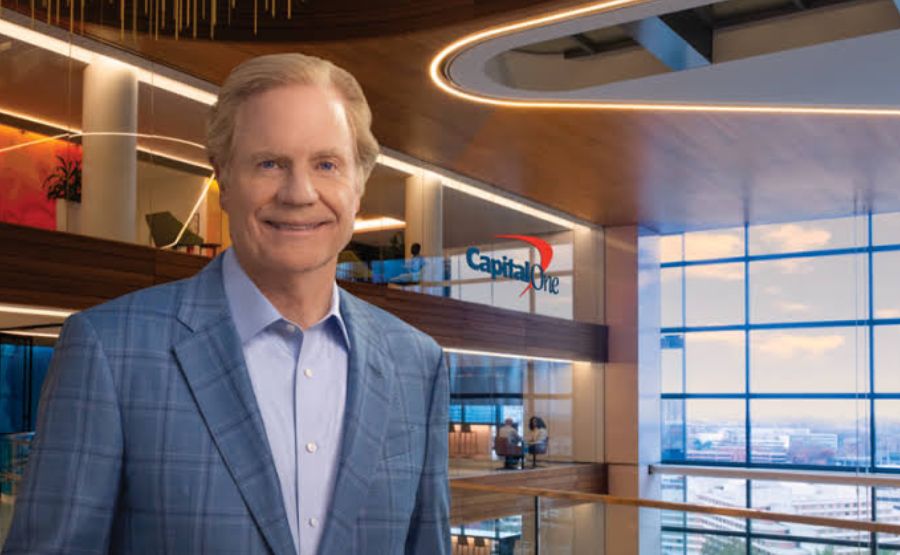
| Occupation | Founder, Chairman, President, and CEO of Capital One Financial Corporation |
| Founded | Capital One (1987, with Nigel Morris; spun off from Signet Banking 1994) |
| Net Worth | ~873million–1.4 billion (sources vary; estimates current as of 2025–2026) |
| Spouse | Chris Fairbank |
| Key Awards | Business Leader of the Year (Washingtonian); Top 10 and 50 Best CEOs (Worth); Governors’ Award (Federal Advisory Council, Federal Reserve); Entrepreneur of the Year (Credit Card Management) |
| Board Service | Federal Reserve’s Fifth District Federal Advisory Council; Greater Washington Partnership; Kennedy Center Corporate Fund; former MasterCard International |
| Base Salary | $0 since 1998 (compensated entirely through equity) |
Introduction: The Man Who Convinced a Bank That Data Was Everything
There is a particular type of business founder whose insight seems obvious in retrospect and genuinely revolutionary in the moment it was first articulated. Richard Fairbank is that type.
His core insight, developed in the mid-1980s while working as a strategy consultant, was straightforward once stated: if you could collect and analyze enough data about individual consumers, you could price credit risk far more accurately than banks had ever managed before. Instead of offering the same credit card terms to everyone, you could offer exactly the right product to exactly the right person at exactly the right time. Custom risk pricing. Mass customization of financial products, decades before that phrase became an industry buzzword.
The banks he pitched this idea to were largely uninterested. Signet Banking Corporation in Virginia was interested enough to give him and his partner Nigel Morris a laboratory to test it. What they built in that laboratory eventually became Capital One — one of the largest banks in the United States, with over 100 million customers, total assets exceeding $669 billion as of 2025, and a position as one of the most recognized financial brands in American consumer life.
Richard Fairbank is, at seventy-five, one of the very few founder-CEOs of a major American financial institution still running the company they built from a startup within a larger organization. He has been at the helm for more than three decades. His name is not as famous as his company’s, which is probably exactly how he prefers it.
See also “Jack Steadman: The North London Kid Who Never Stopped Learning“
Early Life and the Values That Shaped a Founder
On September 18, 1950, Richard Dana Fairbank was born in the United States. The specific details of his childhood — where exactly he grew up, what his parents did professionally, how he came to the intellectual orientation that would define his career — are not documented in any primary biographical source he has shared publicly.
What is documented is the person who emerged from that childhood: someone drawn to systematic thinking, to the idea that problems have solutions if you approach them with sufficient rigor and data, and to the particular combination of long-term strategic vision and operational discipline that building a durable business requires.
He was, by the evidence of every professional chapter of his life, someone who thought in frameworks and who was genuinely excited by the possibilities that emerging information technology was creating in the 1980s — the intersection of computing, databases, and consumer finance that nobody in traditional banking had fully exploited yet.
Stanford: The Education That Made Everything Possible
Richard Fairbank attended Stanford University — one of the world’s most selective and intellectually demanding research universities, set in the heart of what would become Silicon Valley. He earned a bachelor’s degree in 1972 and subsequently completed an MBA at the Stanford Graduate School of Business.
The Stanford education was not incidental to what followed. It gave him the analytical toolkit that the data-driven lending model required, exposure to the quantitative methods that were beginning to reshape business strategy, and the intellectual confidence to look at an industry’s foundational assumptions and ask whether they actually held up.
Stanford’s Graduate School of Business in the 1970s was training a generation of people who would go on to build and transform American business across the following decades. Fairbank’s exposure there to emerging ideas about strategy, information, and competitive advantage shaped the consulting career he pursued afterward and, ultimately, the startup within a startup that he would build within Signet Banking.
He also served on the Stanford Business School Advisory Council in later years — a meaningful return to the institution that had shaped him, through which he helped influence the next generation of students who would face the same blank page he had once faced.
Strategic Planning Associates: The Consulting Years
After Stanford, Fairbank became a strategy consultant at a firm called Strategic Planning Associates in Washington, D.C. He worked there from 1985 through 1990 — five years in the specific discipline of helping major companies think through their long-term competitive positioning and growth opportunities.
Consulting at that level, for those years, is an extraordinary education in how industries actually work. You are not studying them from a textbook — you are inside them, with access to real financial data, real competitive dynamics, and real decision-makers who need real answers. You see what the best-run companies in an industry do differently. You see where the ossified assumptions are. You see where the opportunities are that incumbent players have stopped seeing because they are too inside the existing model to recognize them.
Fairbank saw, somewhere in those consulting years, what banks were not doing with consumer data. They were pricing credit risk by category rather than by individual. They were offering everyone in a demographic the same product rather than analyzing each customer’s specific risk and behavioral profile and offering them something priced for exactly who they were. The technology to do it better existed. Nobody was doing it.
He tried to sell the idea to multiple banks. Most of them declined. Signet Banking Corporation, based in Richmond, Virginia, said yes.
Signet Banking and the Laboratory That Became a Legend
In 1990, Fairbank joined Signet Banking with his consulting partner Nigel Morris. Signet gave them the resources and the runway to test the information-based credit card strategy they had been developing. Fairbank became increasingly senior within the credit card division, eventually leading it, while Morris served as his operational counterpart.
What they built within Signet’s credit card operation was essentially a different kind of business — one that used statistical analysis and direct marketing to identify consumers with specific risk profiles and offer them products tailored to those profiles. They tested relentlessly. They examined what succeeded and what failed. They optimized.
The results were sufficiently compelling that Signet made a decision in 1994 that would permanently change American consumer finance: they spun off the credit card division as a separate public company. The spinoff was initially named OakStone Financial. By the time it went through its initial public offering in November 1994, it had been renamed Capital One Financial Corporation. Richard Fairbank became its CEO. Nigel Morris became its Chief Operating Officer.
The rest, in the most literal possible sense, is financial history.
Building Capital One: Three Decades of Relentless Expansion
What Fairbank and his team built over the three decades that followed the 1994 IPO is genuinely remarkable in the history of American banking.
Initially, Capital One was a credit card business. A very good credit card company — one that used its information-based model to offer products like balance transfer cards and secured cards that reached consumers the traditional banking model had either ignored or mispriced. The “What’s In Your Wallet?One of the most well-known slogans in American consumer advertising, it was introduced in 2000 and is easily remembered by entire generations.
Then Fairbank pushed beyond credit cards. In the 2000s and 2010s, Capital One acquired banks, auto finance companies, and other financial institutions that expanded it into a full-service consumer banking operation. The acquisition of ING Direct in 2012 — a $9 billion deal — brought in millions of online banking customers and established Capital One as a significant player in retail deposits. The acquisition of HSBC’s U.S. card business, the purchase of Chevy Chase Bank, and numerous other transactions transformed what had been a credit card startup into an institution with nearly $670 billion in total assets.
The technology investment that Fairbank prioritized throughout this expansion was also genuinely forward-looking. He pushed Capital One to migrate its technology infrastructure to cloud computing, to invest in data science and machine learning capabilities, and to build what he described as a technology firm that also happens to be a bank, as opposed to a bank that has a technology division. The company was consistently recognized as one of the most innovative financial services providers in the world as a result of that sustained investment.
In 2025, Capital One completed the acquisition of Discover Financial Services — a $35 billion deal that, when finalized, made Capital One the largest credit card issuer in the United States by loan volume, adding the Discover card network and its tens of millions of cardholders to an already formidable portfolio.
A CEO Who Doesn’t Take a Salary
One of the more distinctive aspects of Richard Fairbank’s tenure as Capital One’s CEO is a compensation arrangement he put in place in 1998: he stopped taking a base salary. Since then, his compensation has been entirely equity-based — stock and options rather than cash.
This is not a small gesture. Base salaries for major bank CEOs typically run into the millions of dollars annually. Fairbank walked away from that consistent cash income in favor of an arrangement that tied every dollar of his compensation to the company’s stock price performance. If Capital One performed well for shareholders, he benefited. If it didn’t, neither did he.
In January 2018, when Capital One’s stock hit a record high, his net worth crossed the billion-dollar threshold for the first time. As of late 2025 and into 2026, various sources place his net worth between approximately $873 million and $1.4 billion, depending on Capital One’s stock price at the time of the estimate. The variation reflects market fluctuation rather than any ambiguity about his assets — his wealth is almost entirely held in Capital One equity.
His total compensation in specific years — approximately $22.6 million in 2012, for example — reflected the combination of stock awards, restricted stock, and options that the board approved for that year, not a cash salary.
Personal Life: Chris Fairbank and a Private Family
Richard Fairbank is married to Chris Fairbank. The couple has maintained a genuinely private family life throughout his thirty-year tenure as one of Washington D.C.’s most prominent business figures. He has not discussed his family in public forums, and their children — if any — are not part of any public record.
He has been consistently involved in the Washington D.C. community through board service and civic engagement — serving on the Greater Washington Partnership, the Federal Reserve’s Fifth District Federal Advisory Council, and the Kennedy Center Corporate Fund. These are the kinds of commitments that reflect a person who understands the relationship between business success and civic responsibility, and who acts on that understanding in concrete rather than merely rhetorical ways.
Challenges: Regulation, the Great Recession, and the Data Breach
Building a company of Capital One’s scale across three decades means navigating every significant financial disruption and regulatory shift that American banking has experienced in that period.
The 2008 financial crisis hit the credit card industry particularly hard. Consumer defaults rose sharply. Credit losses mounted across the industry. Capital One was not immune — like every lender, it absorbed significant losses during the recession period. Fairbank navigated the crisis without the kind of existential threat that took down some of the company’s competitors, but it was a genuinely difficult period that tested everything the company had built.
In 2019, Capital One experienced a major data breach — one of the largest in American financial industry history, exposing the personal information of approximately 100 million customers and applicants in the U.S. and Canada. A former Amazon Web Services employee was charged with the intrusion. The breach generated regulatory scrutiny, legal settlements, and significant reputational damage. Capital One paid a $80 million fine to banking regulators and reached a $190 million settlement with affected consumers. It was the most significant negative event in the company’s history and the most direct challenge to the data-and-technology identity that Fairbank had built the company around.
He addressed it publicly, committed to strengthened security infrastructure, and continued building.
Financial Situation: Billionaire (On Some Days), Very Wealthy (On All of Them)
Richard Fairbank’s personal wealth fluctuates with Capital One’s stock price, since nearly all of it is held in company equity. Various estimates place his current net worth between approximately $873 million (MarketScreener, as of mid-2026) and $1.4 billion (Mabumbe, as of January 2025). The variation is real and reflects actual market movement rather than conflicting data.
He has sold approximately $500 million in Capital One shares since 2004 — proceeds that would represent diversification of his concentrated equity position into other assets. Even accounting for those sales, his remaining Capital One stake represents enormous ongoing exposure to the company’s performance.
He lives in the greater Washington D.C. area, consistent with Capital One’s Virginia headquarters, and by all available accounts maintains a lifestyle focused on work and family rather than the conspicuous consumption that sometimes accompanies business success of this scale.
Today: Still Founder, Still CEO, Still Building
As of 2026, Richard Fairbank is seventy-five years old and still running Capital One — one of just a handful of founder-CEOs remaining in charge of major American public companies that they built from the ground up.
The Discover acquisition, when fully integrated, will make Capital One the largest credit card issuer in the United States and one of the most significant consumer banking institutions in the world. The company employs over 76,000 people. Over 100 million people are served by it. It has total assets exceeding $669 billion.
Fairbank is still at the helm, still driving the technology-forward, data-driven strategy that has always distinguished Capital One from more traditional banking institutions, and still holding equity that means his personal financial interests are permanently aligned with the company’s long-term performance.
Final Words
Richard Fairbank’s story is one of the most successful in American entrepreneurial history — a man who identified an insight that the established industry had missed, found one institution willing to let him test it, built something extraordinary from that opportunity, and has sustained it across three decades without losing either the original vision or the drive to keep building.
The $0 salary is the detail that tells you the most about his character. In 1998, when he was already the CEO of a successful and growing company, he made a decision to tie his personal compensation entirely to the outcome he was promising shareholders. Not a portion of it. All of it. That is either very confident or very committed or both — and thirty years of results suggest it was both.
He is seventy-five years old. He is still running the company he founded. The business has grown to its largest size ever. The data-driven model he proposed to a series of skeptical banks in the 1980s now processes financial decisions for more than 100 million people.
It turns out the data was everything, after all.
See also “Jack Steadman: The North London Kid Who Never Stopped Learning“
FAQs
1. Who is Richard Fairbank?
Richard Dana Fairbank, born September 18, 1950, is an American businessman and one of just a handful of remaining founder-CEOs of major U.S. public companies. He co-founded Capital One Financial Corporation in 1987 with Nigel Morris, initially within Signet Banking Corporation, and has served as its Chairman and CEO since its 1994 initial public offering. Under his leadership, Capital One has grown into one of the largest banks in the United States.
2. Where did Richard Fairbank go to school?
He attended Stanford University, earning a Bachelor of Arts degree in 1972 and subsequently completing a Master of Business Administration from the Stanford Graduate School of Business. He later served on the Stanford Business School Advisory Council.
3. How did Richard Fairbank start Capital One?
In 1990, he and co-founder Nigel Morris joined Signet Banking Corporation in Virginia as consultants and gradually built an information-based credit card operation within the bank. Signet spun this division off as a separate public company in 1994, initially named OakStone Financial before being renamed Capital One Financial Corporation. Fairbank became its CEO at the time of the November 1994 IPO.
4. What was Fairbank’s key business insight?
His foundational insight, developed during his consulting years at Strategic Planning Associates, was that statistical analysis of individual consumer data could allow far more precise pricing of credit risk than the category-based approach traditional banks used. This permitted the creation of customized credit products for different risk profiles — offering the right product to the right consumer at the right price rather than a single standardized product to everyone.
5. Why does Richard Fairbank take a $0 base salary?
Since 1998, he has received no base salary from Capital One. His compensation is entirely equity-based — consisting of stock, restricted stock, and options — which ties his personal financial outcome directly to the company’s stock price performance. This aligns his interests completely with shareholders and reflects his conviction that his role is to build long-term value rather than collect a guaranteed cash income.
6. What is Richard Fairbank’s estimated net worth?
Estimates vary based on Capital One’s stock price, since nearly all of his wealth is held in company equity. As of 2025–2026, estimates range from approximately $873 million (MarketScreener) to $1.4 billion (various financial media). He crossed the billion-dollar threshold in January 2018 when Capital One’s stock hit a record high. He has sold approximately $500 million in shares since 2004.
7. What was the Capital One data breach?
In 2019, Capital One disclosed that a data breach had exposed the personal information of approximately 100 million customers and applicants in the U.S. and Canada. A former Amazon Web Services employee was charged with the intrusion. Capital One paid an $80 million regulatory fine and reached a $190 million settlement with affected consumers. It was the most significant security incident in the company’s history.
8. How big is Capital One in 2026?
As of 2025–2026, Capital One has total assets exceeding $669 billion, serves more than 100 million customers, employs approximately 76,300 people, and operates in the United States, Canada, and the United Kingdom. The 2025 acquisition of Discover Financial Services made it the largest credit card issuer in the United States by loan volume.
9. Who is Nigel Morris and what was his role?
Richard Fairbank and Nigel Morris were co-founders of Capital One. While Fairbank focused on strategy and the CEO role, Morris served as Chief Operating Officer during the company’s early years, managing the operational execution of the information-based credit strategy they had developed together. Morris later departed Capital One to pursue other ventures.
10. What boards does Richard Fairbank serve on?
He serves or has served on the Greater Washington Partnership, the Federal Reserve System’s Fifth District Federal Advisory Council, the Kennedy Center Corporate Fund, and previously the MasterCard International Global Board of Directors (2004–2006) and the U.S. Region Board of MasterCard. Additionally, he is a member of the Advisory Council of Stanford University.
11. What is the “What’s In Your Wallet?” campaign?
It is Capital One’s long-running advertising campaign launched in 2000. The tagline became one of the most recognized phrases in American consumer advertising — associated with celebrity-hosted commercials and consistent television presence that built Capital One’s consumer brand recognition far beyond what its financial product metrics alone might have generated.
12. What is Richard Fairbank doing in 2026?
He remains Chairman, President, and CEO of Capital One at age seventy-five, continuing to lead the company through the integration of the Discover Financial Services acquisition and the ongoing development of Capital One’s technology infrastructure, data science capabilities, and cloud computing platform.
Explore ideas that elevate your thinking with The Elevate Magazine.