Quick Facts
| Detail | Info |
| Character name | Steve (officially “Steve?”) |
| Game | Minecraft |
| Developer | Markus “Notch” Persson / Mojang Studios |
| First appearance | May 13, 2009 (pre-classic version) |
| Official name confirmed | October 24, 2010 (Notch’s Tumblr post) |
| Origin | Repurposed from Notch’s unfinished game “Zombie Town” |
| Original name | “Human” — later nicknamed “Steve” by the player community |
| Companion character | Alex — added in 2014 for diversity and inclusivity |
| Physical description | Blue shirt, grey trousers, brown hair, dark eyes, blocky proportions |
| Total default skins today | 9 — Steve, Alex, Noor, Sunny, Ari, Zuri, Makena, Kai, and Efe |
| Major crossover | Super Smash Bros. Ultimate — announced October 1, 2020 |
| Cultural status | One of the most recognised video game characters in history |
| Lore classification | Officially described as an “avatar” — a vessel for the player |
Introduction: The Block-Shaped Icon Who Conquered Gaming
If you showed a silhouette of Steve to almost anyone on the planet under the age of thirty, there’s a good chance they’d know exactly who it is.
A square head. A blue shirt. Brown hair. Pixel-perfect skin from a game that turned the world of video games upside down and redefined what a character even needs to be.
Steve from Minecraft is not a deep character in the traditional sense. He has no spoken lines. No backstory that the developers have ever fully committed to. No personality quirks, no family, no character arc across a decades-long game series. He is, by almost every conventional storytelling measure, an empty vessel.
And yet he is everywhere.
He’s on hundreds of millions of screens every day. He’s on lunch boxes and T-shirts and plush toys and birthday cakes. He’s a fighter in Super Smash Bros. He’s the subject of fan theories, academic papers about game design, and YouTube videos with hundreds of millions of views. His pixelated face has become as instantly recognisable as Mario’s hat or Pikachu’s ears.
How does a character with essentially no character become one of the most beloved figures in gaming history? This essay aims to provide an answer to that issue.
Where Steve Came From: An Accidental Beginning
The story of Steve’s creation is one of the more unusual origin stories in video game history. Because unlike most iconic characters, Steve wasn’t designed with intention.
Markus “Notch” Persson was working on a prototype zombie game called Zombie Town some time before Minecraft existed. He created a blocky humanoid character model for that project — simple geometry, minimal detail, functional rather than artistic. The game was never finished.
When Notch began building what would become Minecraft, he needed a player character quickly. Rather than designing something new from scratch, he simply reused what he already had. The Zombie Town model was dropped into Minecraft’s early code and became the thing you controlled when you spawned into the world.
Steve first appeared in Minecraft on May 13, 2009, during the game’s pre-classic development phase. At this point he wasn’t even called Steve. He was simply “Human” — a descriptor so generic it barely counts as a name. But that wasn’t Notch’s concern. He was building a game, not a character.
In those early days, there were a handful of mob variants based on the same model. Players on forums and in early online chatrooms started giving them informal names. One variant with darker skin got called “Black Steve.” Another oddly-shaped one got called “Beast Boy.” The original default character got called “Steve” — likely influenced by calling the other one Black Steve, which naturally led to the original being referenced as simply Steve.
What matters is when that name reached Notch. He was present in those early online communities. He saw what the players were doing with the character, saw the nickname spreading, and eventually made it official on October 24, 2010, when he published a Tumblr post referring to the default player character as “Steve?” — the question mark itself revealing just how uncertain he was about committing to the name.
That hesitance didn’t matter. The community had already decided. Steve it was.
What Steve Actually Looks Like: Design as Identity
There’s something worth stopping to appreciate about Steve’s design, because it is simultaneously one of the simplest and most successful character designs in video game history.
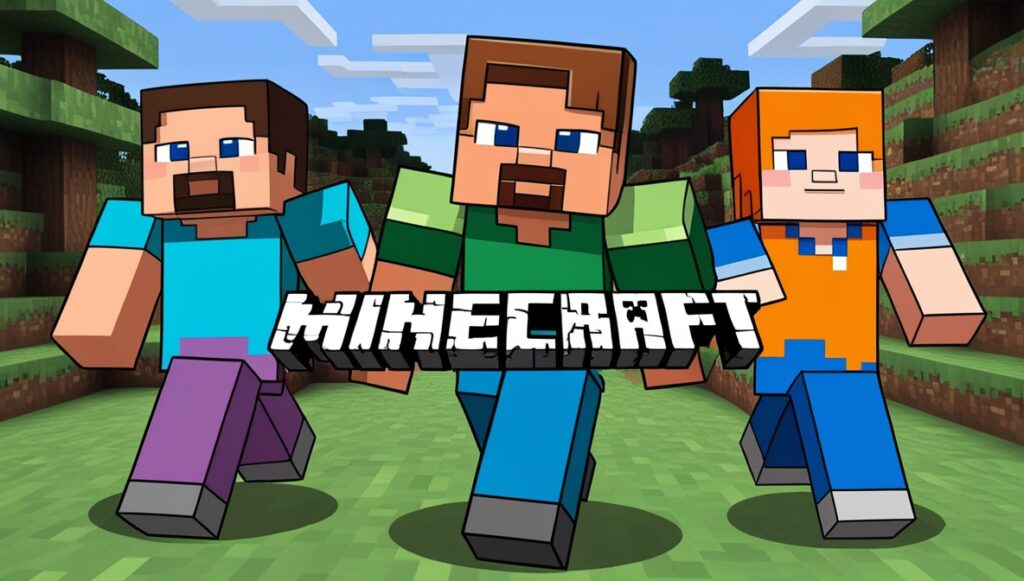
He is built from the same visual logic as the world he inhabits. Minecraft renders everything as cubes and rectangular blocks, and Steve is no different. His head is a perfect square. His body is a rectangular block. His arms and legs are rectangular tubes. He has no curves, no fine details, no expressive face beyond two small dark eyes.
His default outfit is understated to the point of plainness. Blue shirt, grey or dark blue trousers, brown hair, brown shoes. That’s it. No armour, no weapons, no special markings. He looks, essentially, like someone pulled a generic person out of a clip art library and gave them pixelated features.
And that’s exactly why it works.
Steve’s visual blankness is a design feature, not a flaw. He is meant to be a container for the player’s imagination rather than a character with his own fixed identity. His face expresses nothing because he is meant to express you. His clothes are neutral because you’re going to change them anyway through the game’s skin customisation system. His body is simple because the complexity of Minecraft is supposed to come from what you build with the world, not what story the character carries.
Notch made one important design decision that is easy to miss. Steve has no beard. An earlier version of Steve did have a beard in the texture file, but it was removed before becoming standard. The beardless face reads younger, friendlier, and more universally neutral — a better canvas for millions of different players to project themselves onto.
Steve Gets a Companion: The Arrival of Alex
For several years, Steve was the only default player character option. Every new Minecraft player spawned in as Steve — blue shirt, brown hair, no discussion.
That changed in 2014 when Mojang introduced Alex, a second default character with a noticeably different look. Where Steve’s features were broad and solid, Alex was designed to be more androgynous, with lighter-coloured hair pulled back, a slightly slimmer frame, and different proportions. The intent was clear: Mojang wanted players who didn’t identify with Steve’s default presentation to have an alternative that felt more like them.
The introduction of Alex wasn’t without friction. Some long-time players pushed back, feeling that Steve was the authentic Minecraft character and that introducing a second default option somehow diluted the identity of the game. Those voices were a minority, and they were wrong — Alex’s arrival simply reflected the reality that Minecraft’s 100-million-plus player base was always far more diverse than a single brown-haired man in a blue shirt could represent.
Today, Minecraft has nine default character options — Steve, Alex, and seven others including Noor, Sunny, Ari, Zuri, Makena, Kai, and Efe. Each has their own visual identity. Steve remains the most immediately recognised, but the roster reflects Mojang’s genuine commitment to making sure every player can see themselves in the game’s starting point.
The Lore Question: Who Is Steve, Really?
Here’s where things get genuinely interesting, because the honest answer to “who is Steve?is that no one is completely aware of it, and Mojang has purposefully kept it that way.
The official Minecraft game manual describes the player characters as “avatars” — a term that explicitly positions Steve and Alex not as independent characters with their own identities, but as representations of the player within the game world. In this framing, Steve isn’t a person. He’s more like a customisable window through which the player experiences the game.
But that hasn’t stopped the community from building their own theories.
The most persistent fan interpretation holds that Steve is some kind of last survivor — the final human in a world that has been mostly consumed by hostile mobs, ancient structures, and unexplained catastrophes. The ruined portals, the abandoned villages, the strongholds buried underground with no living inhabitants — all of it gets woven into theories about a civilisation that once existed and collapsed before the player ever arrives.
The mysterious End poem, which players see after defeating the Ender Dragon, suggests that the game world itself might be a dream or a simulation — which layers another level of philosophical ambiguity onto who Steve is and whether his experiences are “real” in any meaningful sense.
Mojang has generally avoided confirming or denying any of this. The intentional vagueness isn’t laziness. It’s strategy. An open-ended character invites every player to fill in the blanks for themselves, which creates a personal connection that no amount of official backstory could manufacture.
Steve’s Biggest Moment: Super Smash Bros.
On October 1, 2020, Nintendo announced that Steve — along with Alex, a Zombie, and an Enderman as alternate costumes — would be joining the roster of Super Smash Bros. Ultimate as downloadable fighters.
The announcement was a significant cultural moment. Super Smash Bros. is a crossover fighting game that brings together the most iconic characters in video game history. Joining its roster alongside Mario, Link, Pikachu, Samus, Cloud Strife, and Solid Snake is a form of official canonisation as a gaming legend.
Steve brought his full Minecraft toolkit to the fight. His moveset was unlike anything else in Smash — built around resource gathering, crafting, and building. He could mine the stage itself for materials, craft weapons and armour mid-fight, and build platforms as both offensive and defensive tools. It was a moveset that required understanding Minecraft’s logic to play effectively, which delighted fans and baffled newcomers in equal measure.
Several notable firsts came with Steve’s Smash inclusion. He became the first playable character in Smash history to originate from an independently developed game. He was the first character created entirely outside Japan without any Nintendo involvement in his original design. And he was one of only a handful of characters who brought a genuinely new gameplay paradigm to a game that had refined its core systems across decades.
His inclusion also highlighted how far Minecraft had travelled. A game that started as one person’s weekend project had produced a character legitimately considered among the all-time greats of the medium.
Steve in Culture: Memes, Merch, and Everything Else
Beyond the game itself, Steve has become something close to a cultural institution — a symbol that operates independently of any single piece of media.
The Minecraft aesthetic, Steve’s pixelated face in particular, has been absorbed into internet culture in ways that would be nearly impossible to catalogue fully. He appears in memes across every platform. His face gets printed on products in every conceivable category. Cosplayers build cardboard block heads and wear them to conventions. Fan artists have rendered him in every style from photo-realistic to classical oil painting.
YouTube has played an enormous role in amplifying Steve’s cultural presence. The game’s enormous creator ecosystem — channels built around survival challenges, speed runs, elaborate constructions, and storytelling within the game — has collectively generated billions of views, with Steve’s default appearance appearing in countless thumbnails, animations, and videos.
Minecraft: The Movie, released in 2025, brought Steve and Alex to live action cinema. The film introduced the characters to audiences who may have encountered Minecraft as a cultural backdrop without ever actually playing it — expanding the reach of both characters to a genuinely global theatrical audience.
Why Steve Matters: The Deeper Story
It would be easy to dismiss Steve as simply the face of a very successful product. But the more interesting question is why that face resonates across cultures, age groups, and gaming backgrounds in a way that most video game characters never achieve.
Part of the answer is timing. Minecraft arrived at a moment when gaming was expanding beyond its traditional audience, and Steve’s total visual neutrality meant there was no barrier to entry in identifying with him. He looked like nobody in particular, which meant he could look like everybody.
Part of the answer is participation. Steve doesn’t have adventures that players watch. He has adventures that players create. Every discovery, every construction, every survival story belongs to the player. Steve is the body through which those stories happen, which means players’ attachment to him is really an attachment to their own experiences.
And part of the answer is sheer scale. More than 140 million copies of Minecraft have been sold across platforms. Hundreds of millions of people have spawned into a world as Steve or Alex. That shared experience creates a cultural reference point that transcends any single country, language, or gaming community.
Final Words
Steve from Minecraft is proof that iconic status in gaming doesn’t require complexity, backstory, or even a fully defined name. It requires presence — a visual and interactive identity that players can inhabit, project onto, and carry with them long after they close the game.
He started as a recycled character model from an unfinished zombie game. He got his name from player communities rather than from his creator. He has no official biography, no canonical age, no confirmed history. His developer described him as an avatar — a word that deliberately stops short of calling him a person.
And yet here he is, on hundreds of millions of screens, in Super Smash Bros., on cinema screens, on T-shirts in countries where Minecraft barely has a presence. He is one of the most recognised fictional figures of the past two decades.
There’s a lesson in that. Sometimes the most powerful character you can give a player is the one who gets out of the way and lets the player become the story themselves.
That is Steve’s greatest achievement. And it happened almost entirely by accident.
FAQs
1. Who created Steve from Minecraft?
Markus “Notch” Persson created the character model that became Steve, originally designing it for an unfinished game called Zombie Town. He repurposed it for Minecraft’s early development in 2009 as a quick solution for a player character rather than as a deliberate design decision.
2. Why is the character called Steve?
The name came from the player community rather than from Notch. Early online players gave informal names to the various mob models based on the same design. The default character came to be called Steve — likely in contrast to another variant players called Black Steve. Notch saw the name spreading in community spaces and officially used it in a Tumblr post on October 24, 2010, though he included a question mark, suggesting his own uncertainty.
3. What did Steve look like originally?
Steve’s basic appearance has remained consistent since 2009 — blue shirt, grey trousers, brown hair, dark eyes, blocky proportions. An earlier version included a beard, which was removed before becoming the standard design. Minor texture and colour adjustments happened over the years, including a model update in August 2022, but the core look stayed the same.
4. When was Alex introduced and why?
Alex was added to Minecraft in 2014. Mojang wanted to provide a default character option that offered more visual diversity than Steve’s single presentation. Alex features lighter hair, a more androgynous build, and different proportions. The goal was to make more players feel represented from the moment they first entered the game.
5. How many default character skins does Minecraft have now?
Nine. They are Steve, Alex, Noor, Sunny, Ari, Zuri, Makena, Kai, and Efe. Each has a distinct appearance and represents Mojang’s commitment to offering diverse starting options for new players.
6. What is Steve’s official lore or backstory?
Very little has been officially confirmed. The Minecraft game manual describes Steve and Alex as “avatars” — vessels for the player rather than independent characters. Mojang has deliberately kept the lore vague to allow players to project their own interpretations onto the character.
7. Is Steve the last human in Minecraft?
This is one of the most popular fan theories but it has never been confirmed by Mojang. The theory is built on the observation that no other living humans appear in the Minecraft world, combined with the presence of ancient ruins and abandoned structures that suggest a prior civilisation. It remains community speculation rather than official lore.
8. When did Steve join Super Smash Bros.?
Nintendo announced Steve’s inclusion in Super Smash Bros. Ultimate on October 1, 2020. He was released as downloadable content alongside Alex, a Zombie, and an Enderman as alternate costumes. His moveset was built around Minecraft’s crafting and building mechanics, making him one of the most mechanically unique fighters in the game’s history.
9. What records or firsts did Steve achieve in Super Smash Bros.?
Several. He was the first playable Smash character to originate from an independently developed game. He was the first character created outside Japan without any Nintendo involvement in his original design. His moveset — built around resource gathering, crafting, and building within the stage — introduced gameplay mechanics unlike anything previously seen in the series.
10. Can players change Steve’s appearance?
Yes. Minecraft has an extensive skin customisation system that allows players to replace Steve’s default look with virtually any design they can create or download. Players can also purchase official character packs. The nine default skins provide starting options, but the community has created millions of custom skins that players can apply freely.
11. Did Steve appear in the Minecraft movie?
Yes. Minecraft: The Movie, released in 2025, featured Steve and Alex in a live-action adaptation of the game’s world. The film extended both characters’ reach to audiences beyond the game’s player base, including viewers who knew Minecraft primarily as a cultural phenomenon rather than something they had played directly.
12. Why has Steve become such a culturally significant character despite having no personality?
Several factors converge. His visual design is so simple and neutral that players of any background can project themselves onto him, removing barriers to identification. He is the vehicle for player-created experiences rather than a character with a pre-written story, which means players’ emotional connections to Steve are really connections to their own memories and achievements. And Minecraft’s enormous scale — hundreds of millions of copies sold globally — means that experience is shared across generations and cultures, turning Steve into a universal reference point.
Explore ideas that elevate your thinking with The Elevate Magazine.