Quick Facts
| Detail | Info |
| Topic | The difference between envy and jealousy |
| Category | Psychology / Emotional intelligence / Human behaviour |
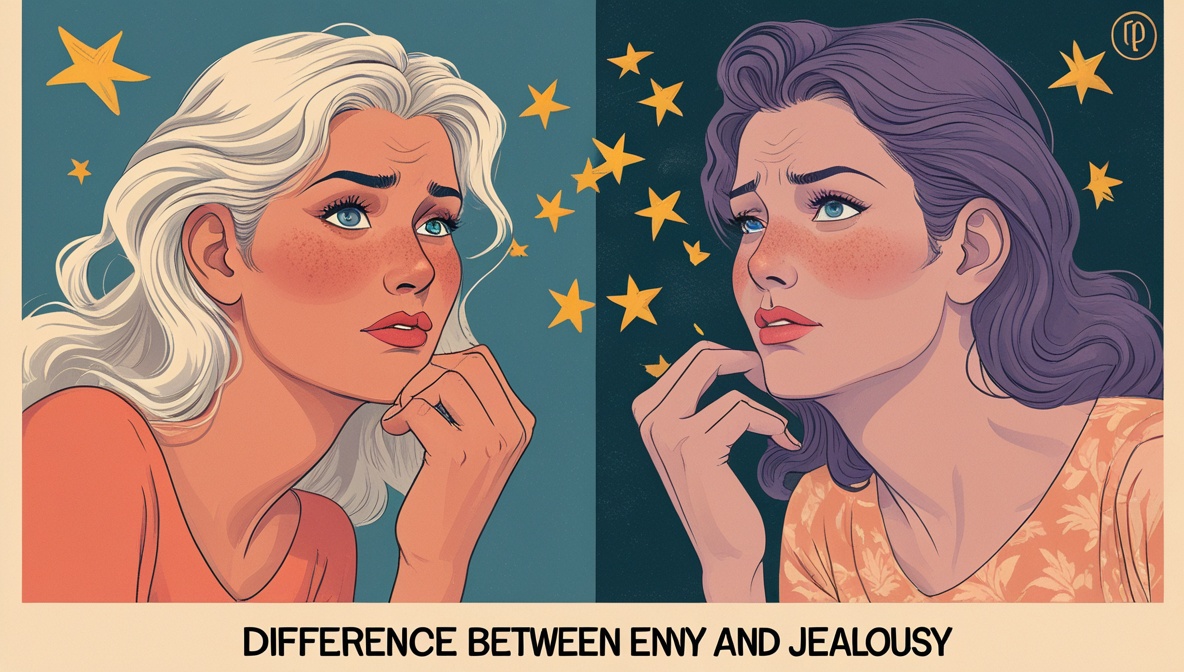
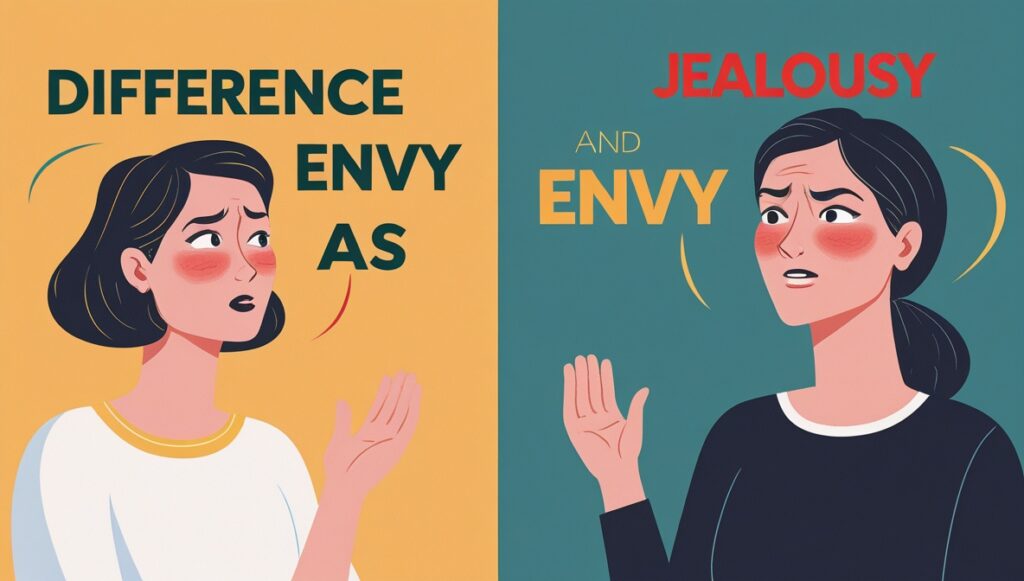
| Core distinction | Envy = wanting what someone else has. Jealousy = fearing you’ll lose what you already have |
| Number of people involved | Envy: typically two. Jealousy: typically three |
| Moral history | Envy is one of the original seven deadly sins; jealousy has a more complex moral status |
| Can they be useful? | Yes — both emotions carry information and can motivate positive change |
| Who studies them | Psychologists, philosophers, linguists, relationship therapists |
| Common mistake | Using both words as if they mean the exact same thing |
Introduction: Two Words, Two Very Different Feelings
Picture two scenarios.
In the first, your coworker gets a promotion you really wanted. You didn’t lose anything — you never had the job. But watching them walk past your desk with a new title stings in a way that’s hard to shake. You want what they have. That feeling has a name: envy.
Now picture the second scenario. You’re at a party with your partner and you notice them laughing a little too easily with someone across the room. Your stomach tightens. Your mind starts running. You’re not thinking about what that other person has — you’re scared about what you might lose. That feeling has a different name: jealousy.
Most people use these two words interchangeably. In casual conversation, hardly anyone stops to correct themselves. But psychologists, philosophers, and linguists have spent considerable effort arguing that these are genuinely distinct emotional experiences — with different triggers, different targets, different people involved, and very different things to tell you about your inner life.
Getting them straight isn’t just an exercise in vocabulary. It’s actually one of the more useful things you can do for your emotional intelligence.
See also “Boov: The Story, Meaning, and Rise Behind the Name“
The Core Distinction: A Simple Way to Remember It
Here’s the clearest way to put it:
Desiring something you lack is the essence of envy.
Jealousy is about protecting something you already do have.
That’s the heart of it. Simple in theory — surprisingly easy to mix up in practice.
Envy happens when you look at someone else and wish you had their talent, their relationship, their house, their career, their confidence, or their life. There’s a gap between what they have and what you have, and that gap bothers you. The other person isn’t threatening you. They’re just holding something you want.
Jealousy works differently. It involves a perceived threat to something you already possess and value — usually a relationship or a person’s affection. Someone else enters the picture and you start worrying that what’s yours might not stay yours. The focus isn’t on what the other person has. The focus is on what you might lose.
One quick way to test which one you’re feeling: ask yourself, “Am I afraid of losing something, or am I wishing I had something I don’t?” Fear of loss → jealousy. Longing for something absent → envy.
The People Involved: Two vs. Three
There’s a structural difference between these emotions that’s worth understanding, because it shapes everything else about how they feel.
Envy is a two-person situation. You see someone. They have something. You want it. That’s the whole picture. Even if you’ve never spoken to this person, never interact with them again, you can still feel genuine envy. You could envy a stranger’s house you drive past every morning.
Jealousy is a three-person situation. There’s you, there’s someone you care about (the person or relationship you value), and there’s a third party — the perceived rival or threat. Jealousy by its nature requires someone to be worried about losing to another person. Take away the third party and the feeling dissolves.
This is why jealousy often feels more intensely relational and more urgent. The stakes involve someone you’re already attached to. Envy can simmer quietly for years. Jealousy tends to flare fast.
Where These Words Actually Come From
Words often carry their meanings inside them, and these two are no exception.
Envy traces back through Old French to the Latin word invidia, which itself comes from invidere — meaning to look at with hostility, or to “look hard at” something. This was intimately associated by the ancient Romans with the idea of the “evil eye,” which is the deadly, envious look you give to someone who is better off than you. The idea that wanting what someone else has could literally harm them has ancient roots.
Jealousy has a different lineage. It connects through Old French and Medieval Latin back to the Greek zelos, meaning zeal, intense passion, or fervent devotion. You can hear it in the word “zealous.” The original meaning was almost positive — it described a burning dedication. Over time, particularly in religious writing, it took on that darker association with possessiveness and the fear of being displaced.
Interestingly, in some languages there are actually separate words for the two types of envy (benign and malicious — more on those shortly), but in English we get just the one word to carry both meanings. That’s part of why the confusion between envy and jealousy has persisted.
Benign Envy vs. Malicious Envy: Yes, There Are Two Kinds
Psychologists have found it useful to split envy into two distinct types, and once you know the difference, you’ll start recognizing them in yourself.
Benign envy is the kind that quietly motivates you. You see someone with something you want — a skill, a body, a lifestyle, a career — and instead of wanting to tear them down, it sparks something closer to admiration mixed with determination. I want that. Maybe I can work toward it. Benign envy points you forward. It’s the kind that makes you study harder after seeing a classmate ace an exam, or start going to the gym after a friend runs their first marathon.
Malicious envy — sometimes called invidious envy — is darker. It’s not just that you want what they have; it’s that you resent them for having it. The uncomfortable wish that they would lose it, fail, or at least stop being quite so successful. This is the version that corrodes friendships, fuels gossip, and can push people toward genuinely harmful behavior. This is the kind that philosophers placed among the deadly sins.
Interestingly, in the Netherlands there are two entirely separate Dutch words for these two types. Research carried out across different cultures has confirmed that these are genuinely distinct emotional experiences, not just different intensities of the same feeling.
Jealousy doesn’t have quite the same clean subdivision, though it can certainly range from mild and manageable (a small pang when your partner gets a long text from an ex) to consuming and destructive (constant surveillance, controlling behavior, the dark end of the spectrum).

Why We Mix Them Up So Easily
There are a few reasons this confusion is so persistent, and they’re all understandable.
First, the emotions share a family resemblance. Both involve comparison with another person. Both can produce resentment. Both are uncomfortable. Both tend to flare in the same kinds of situations — relationships, workplaces, social gatherings.
Second, they often occur at the same time. Think about what happens when your partner starts spending more time with someone who is more attractive, more successful, or more charming than you. You feel jealous — because you fear losing your partner’s attention. But you also feel envious — because that other person has qualities you wish you had. The two emotions stack on top of each other and blur together into one painful mess.
Third, and most practically: people commonly use the word “jealous” when they actually mean envious. “I’m so jealous of your vacation photos!” That’s envy. You want what they have; you’re not afraid of losing anything. But English speakers have largely normalized this usage, and most dictionaries now acknowledge both meanings. It’s only when precision actually matters — in therapy, in a difficult conversation with a partner, in genuine self-examination — that the distinction becomes important to get right.
What Each Emotion Is Really Telling You
This is the part most articles skip over, and it might be the most useful bit.
Both envy and jealousy, as uncomfortable as they are, carry real information. They’re not just noise to be suppressed. They’re pointing at something.
When you feel envy, ask yourself: What is it, specifically, that I want? Usually, the response is more truthful than you anticipate. Envy has a way of bypassing the rationalizations and going straight to your actual desires. If you envy a colleague’s confidence, maybe you’ve been underestimating how much your own self-doubt holds you back. If you envy a friend’s relationship, maybe you’re lonely in a way you haven’t fully admitted. Envy, at its best, is a map to what you genuinely value.
When you feel jealousy, ask yourself: What exactly am I afraid of losing? And is that fear grounded in reality, or is it rooted in something older — insecurity, past experiences, a pattern that predates this relationship? Jealousy often isn’t really about the present threat. It’s about a deeper fear of being abandoned, replaced, or not being enough. Identifying that can change everything about how you respond.
The psychologist and researcher Brené Brown has put it well: both emotions, when examined rather than acted upon, are gateways to understanding your own values, your needs, and your fears. The problem is never the feeling itself — it’s what you do with it.
The Impact on Relationships (And on You)
Left unexamined, both emotions do real damage.
Chronic envy — especially the malicious kind — corrodes your capacity for genuine connection. It’s very hard to be a good friend to someone you secretly resent for their success. It makes celebrations feel like insults. It turns other people’s good news into a referendum on your own worth. Over time it can quietly hollow out your relationships and your sense of self.
Unchecked jealousy does something similar but through a different mechanism. It creates controlling behavior, constant suspicion, demands for reassurance, and the kind of emotional intensity that exhausts both partners in a relationship. What starts as fear of loss can become the very thing that drives the loss.
Both emotions also carry a physical cost. Research has linked chronic envy and jealousy to elevated stress responses, poor sleep, and reduced wellbeing. The body treats these emotions as threats — because psychologically, that’s what they are.
Managing These Emotions: What Actually Helps
No one expects you to never feel envious or jealous again. These are human emotions with deep evolutionary roots. What changes is your relationship with them.
Name the emotion correctly. Before anything else, get specific. Is this envy or jealousy? The act of naming it precisely — saying to yourself “I’m feeling envious of their promotion” rather than the vague sense of discomfort — creates enough distance to think rather than just react.
Get curious, not defensive. Ask what the emotion is pointing at. What do you actually want? What are you actually afraid of? This kind of honest self-questioning is uncomfortable, but it’s far more productive than either suppressing the feeling or acting it out.
Resist the comparison trap. Both emotions feed on comparison, and comparison almost always happens on incomplete information. You’re comparing your inside — all your doubts, your struggles, your private fears — to someone else’s outside, the polished version they show the world. Nobody posts photos of their worst days.
Communicate openly in relationships. If you’re feeling jealousy in a partnership, saying so — clearly, without accusation, and with curiosity about your own part in it — is almost always more effective than either acting jealous or pretending you’re not. Most of what jealousy needs is reassurance and honest conversation.
Use benign envy as a compass. If you feel a genuine pull toward something someone else has, take it seriously as information about your own goals. Let it motivate rather than corrode.
Know when to seek help. When jealousy becomes controlling, or when envy is constant and consuming and affecting your daily life, a therapist can make a significant difference. These aren’t weaknesses that more willpower will fix; they’re emotional patterns that respond well to the right kind of support.
Final Words
Here’s what’s worth remembering when you walk away from this article.
Envy and jealousy are not the same thing. One is about wanting. The other is about protecting. One involves two people; the other involves three. One is listed among history’s most condemned vices; the other has a slightly more nuanced moral reputation.
But more than their differences, what matters is this: both emotions are trying to tell you something. The person who can sit with the discomfort of either feeling long enough to ask what is this actually about? has a real advantage — not just for managing the emotion itself, but for understanding themselves more honestly.
We live in a world that’s designed to trigger envy constantly. Social media is an envy machine. Advertising runs almost entirely on manufactured desire. And in close relationships, jealousy will show up at some point for most people — because caring about someone means having something to lose.
The goal isn’t to feel neither. It’s to feel them clearly, name them honestly, and respond with more wisdom than you’d have if you just let them run.
FAQs
1. Can a person feel both envy and jealousy at the same time?
Yes, and it’s actually common. Imagine your partner spending time with someone who’s more accomplished and charming than you feel you are. You’re jealous about what you might lose, and envious of what that other person has — simultaneously. The two emotions can stack on top of each other in ways that make them feel like one overwhelming experience.
2. Is jealousy only about romantic relationships?
No, though that’s the most common association. Jealousy can arise in friendships when a close friend develops a new tight friendship and you feel at risk of being replaced. It can happen between siblings, between coworkers competing for the same approval, and even between a parent and a new romantic partner entering a child’s life. Any time you fear losing a valued relationship to a third party, jealousy can appear.
3. Is feeling envious a sign that something is wrong with you?
Not at all. Envy is a completely normal human experience. The more useful question is what kind of envy you’re experiencing. Benign envy — the kind that sparks motivation and admiration — is not only normal but can actually drive growth. It’s malicious envy, the kind that makes you want others to fail, that becomes a problem worth examining.
4. Why do some languages have separate words for benign and malicious envy, but English doesn’t?
This varies by linguistic history. Dutch, for example, has distinct words for the two types of envy. English evolved with a single term that carries both meanings, which contributes to the difficulty in discussing the emotion precisely. Some psychologists and philosophers have argued this is worth fixing — that having the right vocabulary for our inner experiences matters for how well we can understand and communicate them.
5. Can jealousy ever be healthy in a relationship?
In small doses, a mild pang of jealousy can sometimes act as a reminder that you value a relationship. It can prompt honest conversations about needs and insecurities that might otherwise go unspoken. The problem is when jealousy becomes chronic, disproportionate, or starts driving controlling behavior — at that point it stops being useful information and becomes something that damages both the relationship and the person experiencing it.
6. What’s the link between envy and low self-esteem?
Envy tends to be strongest when we compare ourselves to people we perceive as similar to us in relevant ways. If you don’t consider yourself a writer, you probably don’t envy a prize-winning novelist — their success feels too distant. But when someone in your same profession, age group, or social circle succeeds in a way you wanted to succeed? That comparison cuts much closer. Low self-esteem makes envy more frequent and more intense because it makes unfavorable comparisons feel more definitive.
7. How does social media amplify envy specifically?
Social media creates a curated stream of other people’s highlights — vacations, promotions, relationships, milestones — with almost no context about the difficulties behind them. You’re comparing your ordinary Tuesday to everyone else’s best moments, which is a recipe for chronic low-grade envy. Research has consistently linked heavy social media use to higher rates of envy and lower self-reported wellbeing, particularly in younger users.
8. Is jealousy always rooted in insecurity?
Often, but not always. Sometimes jealousy is a rational response to a genuine and visible threat — a partner who is openly flirtatious with others, for example. The distinction matters because reflexively labeling all jealousy as “insecurity” can dismiss real concerns. The key question is whether the jealousy is proportionate to actual evidence or whether it’s running far ahead of what the situation reasonably calls for.
9. What does it mean that envy is one of the seven deadly sins?
The classification of envy as a deadly sin in Christian moral theology goes back at least to the 4th century. It was considered not just a personal failing but a social one — envy was seen as inherently hostile to others’ good, and as something that twists the heart by making other people’s happiness a source of pain. Jealousy, by contrast, has a more complicated moral history, partly because “zealous” language — including “jealous God” references in the Bible — associated it with passionate devotion rather than pure vice.
10. Can therapy help with chronic envy or jealousy?
Yes, significantly. Both emotions, when they’re frequent or intense enough to affect relationships and quality of life, respond well to therapy — particularly approaches like cognitive-behavioral therapy (CBT), which helps identify the thought patterns that fuel the emotions, and attachment-based therapy, which can address the deeper fears of abandonment or inadequacy that often sit beneath jealousy.
11. What’s the difference between jealousy and possessiveness?
They’re related but not identical. Jealousy is the emotional experience — the fear, the anxiety, the threat response. Possessiveness is a behavioral pattern — treating another person as something to be owned or controlled. Chronic jealousy can push someone toward possessive behavior, but possessiveness can also operate from a place of ego or control that isn’t primarily about fear. Someone can be possessive without being particularly afraid of loss.
12. Is it useful to tell someone you’re envious of them?
Sometimes — and more often than people think. Expressing benign envy in a warm, direct way (“I genuinely envy your ability to stay calm under pressure — it’s something I’m working on”) can actually land as a compliment and open a useful conversation. Malicious envy, obviously, isn’t something you’d typically disclose. But naming the lighter kind can dissolve some of its power over you and occasionally deepen a friendship through honesty.
Explore ideas that elevate your thinking with The Elevate Magazine.