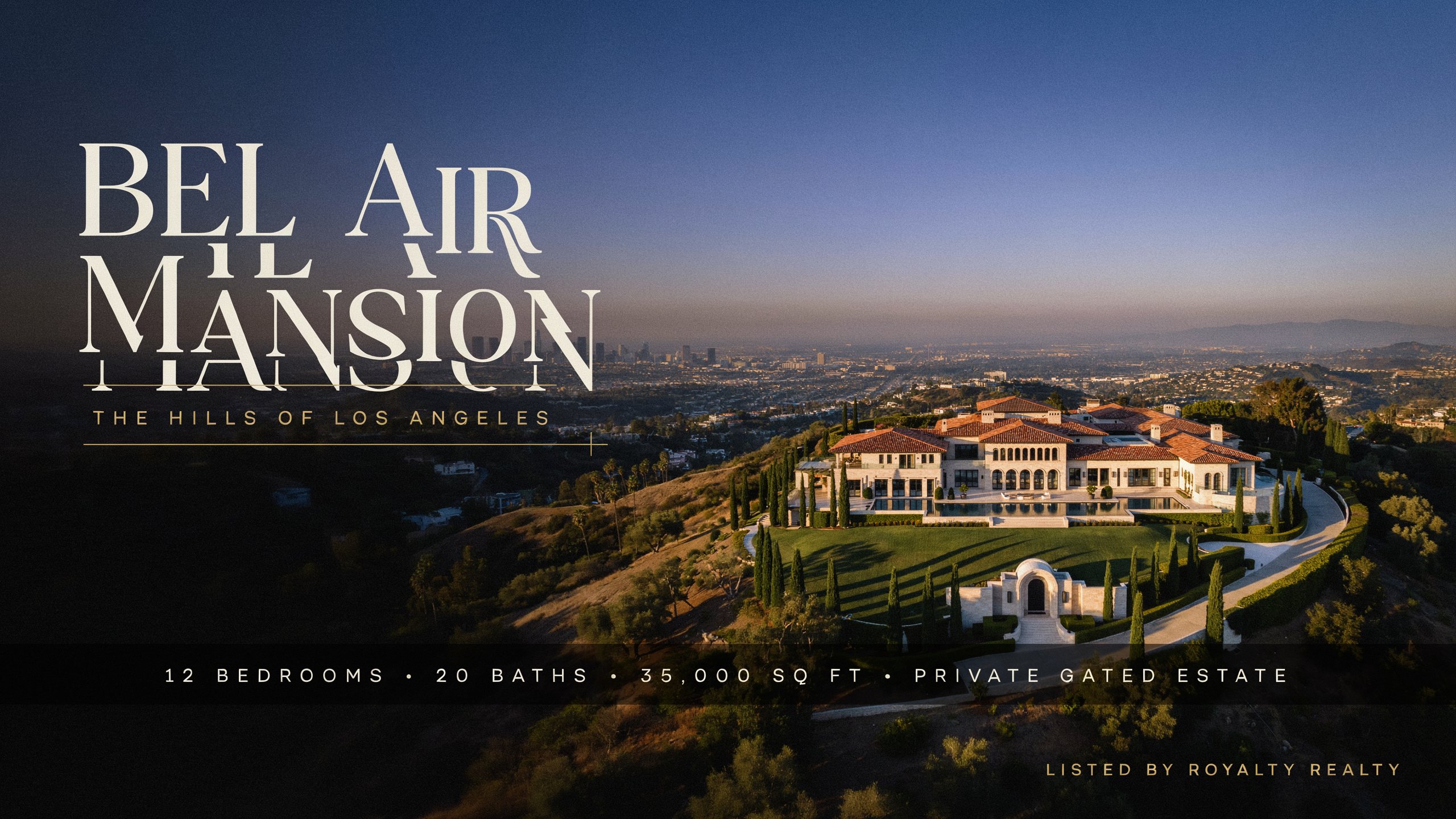
Quick Facts
| Detail | Info |
| Neighborhood | Bel Air, Los Angeles, California |
| Founded | 1921 by Alphonzo E. Bell, Sr. |
| Zip Code | 90077 |
| Size | Approximately 6 square miles |
| Residents | ~7,248 |
| Known For | World’s most expensive residential real estate |
| Notable Sections | East Gate, West Gate, Upper Bel Air, Bel Air Crest |
| Platinum Triangle | Bel Air + Beverly Hills + Holmby Hills |
| Most Expensive Sale | Chartwell Estate — $150 million (2019) |
| Current Top Listing | $400 million (11201 Chalon Road, 2026) |
| Famous Neighbors | Reagan, Hitchcock, Presley, Lachlan Murdoch, Eric Schmidt |
Introduction: The Address That Defines Luxury
There is wealth. There is extreme wealth. And then there is Bel Air.
Tucked into the foothills of the Santa Monica Mountains, about twelve miles west of downtown Los Angeles, Bel Air is a neighborhood that the word “exclusive” was practically invented to describe. It covers roughly six square miles of winding canyon roads, terraced hillsides, and private estates so large that some contain their own running tracks, wine vaults, bowling alleys, and staff villages.
The neighborhood has been home to U.S. presidents, Hollywood legends, tech billionaires, and media dynasties. It has been the setting for record-breaking real estate sales that made international headlines. One house here was once asking half a billion dollars. Another actually sold at bankruptcy auction for $141 million — and that was considered a bargain.
To understand what makes a Bel Air mansion so exceptional, you need to understand the neighborhood itself: where it came from, how it was designed to feel the way it does, and what separates these estates from merely expensive homes in other parts of the world.
See also “Free Temp Phone Numbers: The Complete, Honest Guide to Disposable Numbers in 2026“
The Man Who Built a Dream Neighborhood
The story of Bel Air begins with one man and a lot of land.
Alphonzo E. Bell, Sr. was a prosperous oil tycoon who became wealthy after oil was found on his Santa Fe Springs, California, estate. He was not just rich in the ordinary sense — he was the kind of rich that makes you want to build something that lasts. In 1921, he and his wife Minnewa purchased 1,760 acres of hillside terrain and set about creating what he envisioned as the ultimate suburban community.
Bell was remarkably intentional in his vision. He installed underground electric and telephone lines — unheard of at the time — along with water and sewer infrastructure and thousands of trees. He wanted the neighborhood to feel lush, private, and timeless from day one.
In 1923, 128 parcels along Bel Air Road were included in the initial residential allocation, which was reachable via the now-famous East Gate at Sunset and Beverly Glen Boulevards. He required that buyers spend at least $20,000 on their home construction — a significant sum in the 1920s designed to ensure the caliber of what got built. He was picky about who could buy, initially refusing to sell to people in the film business, though he relaxed that restriction during the Great Depression.
Minnewa Bell contributed her own lasting touches. She gave the streets their distinctive Italian-inspired names — Saint Pierre, Saint Cloud, Bellagio, Copa De Oro, Nîmes Road. She also founded the Bel-Air Garden Club, which helped shape the neighborhood’s lush, garden-centric aesthetic that remains today.
The foundation of one of the most elite neighborhoods in history was solidified by the time the Bel-Air Land Company ceased active development in 1952.
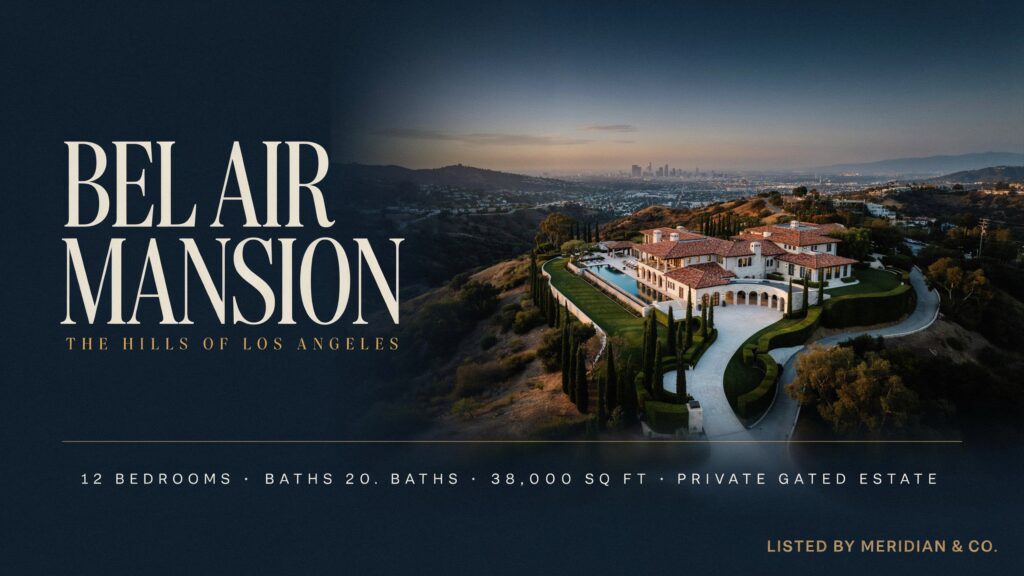
The Lay of the Land
Bel Air is not a flat neighborhood. That is important to understand, because the terrain itself is a major reason why it is so private.
The hillside topography of the Santa Monica Mountains creates natural barriers between properties. Canyons and ridges mean that even without fences, many estates are invisible to their neighbors. The further you climb from Sunset Boulevard toward Mulholland Drive, the more dramatic the elevation — and typically, the more dramatic the views.
The neighborhood divides naturally into distinct areas.
East Gate is the original Bel Air, entered off Beverly Glen and Sunset. This is Old Money territory — large, historic estates developed mostly before World War II. Along with neighboring Holmby Hills, it is widely considered the finest concentration of luxury properties on earth.
West Gate, entered via Bellagio Road, is more associated with newer construction and bolder architectural experiments. This section was particularly hard hit by the catastrophic 1961 fire and was largely rebuilt in subsequent decades with more contemporary homes.
Upper Bel Air reaches north toward Mulholland Drive and offers sunset views across the Pacific and sweeping panoramas of the city below. Estate-scaled properties here trade at extraordinary premiums.
Bel Air Crest is a fully gated sub-community with its own homeowners’ association and a staffed entrance — a neighborhood within the neighborhood for those who want an extra layer of controlled access.
Bel Air, Beverly Hills, and Holmby Hills make up what real estate experts refer to as the “Platinum Triangle,” a region that contains more concentrated residential wealth than almost anywhere else on the planet.
What a Bel Air Mansion Actually Looks Like
“Bel Air house” conjures up images of something opulent. The reality often exceeds the imagination.
The architectural range in Bel Air is genuinely remarkable. You find French neoclassical chateaux sitting a mile from glass-and-steel contemporary structures cantilevered off a hillside. Spanish Colonial estates with red-tile roofs share canyons with mid-century modern homes that look like they belong in an architecture textbook.
Scale and intentionality are what the houses have in common. Even a modest Bel Air property tends to sit on a serious piece of land. The larger estates run 15,000 to 25,000 square feet of interior space. And then there is an entirely different category — the megamansion tier — where we start counting rooms by the dozen.
A well-appointed Bel Air estate in the $20–50 million range typically offers a home theater (proper screening room with tiered seating and professional audio), multiple kitchens including a dedicated staff or catering kitchen, a wine cellar capable of storing several hundred bottles, a primary suite that would dwarf most apartments, a guest house, motor court, and pool. Staff quarters are considered standard at this level, not a bonus.
Move into the $100 million territory and the features escalate substantially. Home gyms become full fitness centers. Single pools become multiple pools, some with infinity edges and underwater lighting systems. Basements contain bowling alleys, nightclubs, and wine vaults holding thousands of bottles. Rooftop terraces become sky decks. And the staff situation moves from a few people to a full household staff: a house manager, private chef, chauffeurs, security personnel, landscaping crew, pool and maintenance teams.
The list grows quite bizarre at the ultrahigh end, which Bel Air has more of than any other place in California. The 70,000-square-foot estate currently listed at $400 million on Chalon Road features an on-site security office, art storage rooms, X-ray facilities, 39 bedrooms, 50 bathrooms, a 25-car garage, cascading pools, indoor spa facilities with hot and cold plunge pools, eight butler’s pantries, and multiple staff kitchens. Architect Peter Marino created the design, and construction took almost ten years.
The Famous Mansions That Made Bel Air Legendary
A few specific properties have become landmarks in their own right — talked about in real estate circles and beyond as symbols of what Bel Air represents.
The Spelling Manor
Aaron Spelling, the prolific television producer behind Dynasty, Beverly Hills 90210, and dozens of other hits, built what was for years the largest private residence in Los Angeles. After purchasing the former Bing Crosby estate in 1983 and demolishing the original 1932 structure, Spelling constructed a 56,500-square-foot French-style manor with 14 bedrooms and 27 bathrooms — eventually nicknamed “Candyland” for its excess.
The house contained a 7,000-square-foot master suite, a 20-seat cinema, a two-lane bowling alley, a basement nightclub, a wine cellar, a gymnasium, and a tennis court. Critics were not kind — one architectural writer called it among the worst buildings in the region. But Spelling loved it, and he died there in 2006.
In 2011, his wife, Candy Spelling, listed the house for $150 million before selling it to Formula One heiress Petra Ecclestone for about $85 million. Ecclestone spent around $20 million redesigning the interior before selling it again in 2019 for approximately $120 million — which briefly set a California residential record. In 2025, former Google CEO Eric Schmidt purchased the estate for $110 million.
Chartwell Estate
The Chartwell Estate on Bellagio Road has one of the more unusual origin stories in Bel Air history. A French neoclassical chateau built in 1933, it was commissioned by an engineer named Lynn Atkinson as a surprise gift for his socialite wife. She found it “pretentious.” They never moved in.
Later on, the property gained a layer of pop culture prominence as the mansion featured in The Beverly Hillbillies’ opening credits. of its architectural grandeur. Spanning 25,000 square feet with 18 bedrooms, 24 bathrooms, a 12,000-bottle wine vault, a 75-foot pool, a 40-car underground parking facility, and a guest house designed by the prominent architect Wallace Neff, the estate also included the former Ronald and Nancy Reagan residence on the grounds.
Media heir Lachlan Murdoch purchased Chartwell in December 2019 for $150 million — setting what was then the highest residential sale price in California history.
The One
No conversation about Bel Air mansions is complete without The One, and no story about The One is complete without acknowledging how dramatically it collapsed.
Developer Nile Niami spent years building what he called the largest modern home ever constructed — 105,000 square feet across nearly four acres, with 21 bedrooms, 42 full bathrooms, five pools, an outdoor running track, a movie theater, a nightclub, a salon, and a 10,000-square-foot sky deck. He confidently talked about it reaching $500 million.
It never came close. Niami defaulted on roughly $165 to $190 million in debt. The property entered bankruptcy proceedings. In March 2022, it sold at auction for $126 million — $141 million including fees — which set a world auction record for a home but represented a catastrophic loss for creditors. The saga became one of real estate’s most widely covered cautionary tales about megamansion speculation.
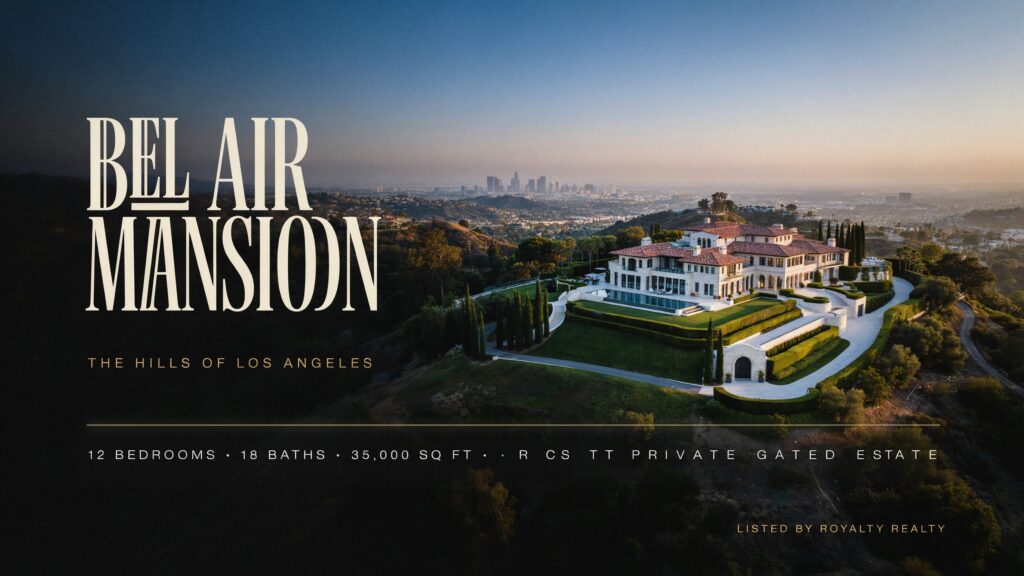
Security and Privacy: The Invisible Architecture
One of the most common questions about Bel Air is whether it is gated. The answer is nuanced.
The neighborhood’s famous stone gates — the East Gate and West Gate — are architectural landmarks visible on Sunset Boulevard, but they are not operational barriers. Instead of serving as genuine checkpoints, they serve as emblems of the neighborhood’s character.
Real security in Bel Air operates at the estate level and through natural geography. Long, private driveways — sometimes several hundred feet — create approach distance before anyone reaches a front door. Mature hedges, planted berms, stone walls, and dense landscaping block sightlines entirely. Canyons and ridgelines separate properties in ways that no fence could replicate.
Technology layers on top of the physical: camera networks, license-plate readers, gate intercom systems, biometric access controls, and remote monitoring are standard in the upper tier. Many owners retain private security firms for on-site and mobile patrol.
The Bel Air Crest enclave takes this further with a staffed entrance gate and homeowners’ association rules governing who enters. For residents of Crest, access control is institutional rather than individual.
For the most expensive properties, security becomes its own architectural program. The $400 million Chalon Road listing includes a dedicated on-site security management office. Safe rooms in various configurations appear across the neighborhood’s top tier.
Fires, Disasters, and the Price of Paradise
Living in the hills has always carried risk, and Bel Air’s history includes two major disasters that shaped the neighborhood permanently.
The 1961 Fire
Under extremely unfavorable circumstances, a brush fire broke out north of UCLA in November 1961: Record-low humidity, Santa Ana winds reaching 50 miles per hour, and the driest season on record. The fire tore through the neighborhood with terrifying speed.
When it was over, 484 homes had been destroyed — more than 20 percent of Bel Air’s residential structures. At the time, it was the seventh most devastating fire in American history, consuming 6,090 acres and causing damage exceeding $25 million. No residents died, but over 200 firefighters were injured.
The homes of Dennis Hopper, Burt Lancaster, Joan Fontaine, Zsa Zsa Gabor, Nobel laureate Willard Libby, and author Aldous Huxley were among the losses. Richard Nixon, then a private citizen, helped fight the flames at his own nearby property before evacuating.
The aftermath changed building rules in Los Angeles permanently. The city banned wood shingle roofs in new construction and adopted one of the country’s strictest brush clearance policies. Much of what people think of as West Gate Bel Air was rebuilt in the fire’s aftermath, which explains why that section tends toward mid-century and contemporary architecture rather than the older period revival styles found in East Gate.
The 2017 Skirball Fire
In December 2017, another fire swept through Bel Air, forcing thousands of residents to evacuate and threatening celebrity homes throughout the neighborhood. Rupert Murdoch’s Moraga vineyard property was among those directly threatened. The fire was later linked to a homeless encampment near a Sepulveda Pass freeway off-ramp, leading to lawsuits against the city.
The ongoing wildfire risk in Bel Air is a constant fact of life. Hillside terrain, dry brush, and Santa Ana wind events mean this is not a question of if but when. Insurance availability has become increasingly complicated and expensive in the hills, and brush clearance requirements affect landscaping choices on every estate in the neighborhood.
The Real Estate Market: Numbers That Rewrite Records
Bel Air’s real estate market operates by different rules than virtually anywhere else.
Properties rarely come to market. When they do, they often trade off-market among a small network of ultra-high-net-worth buyers and their advisors. Published data therefore tends to undercount what actually happens here.
The average home price across Bel Air runs around $4 million as of early 2026 — a figure that includes a wide range of properties. At the entry level for the neighborhood, a four-to-six-bedroom home lists for $6 to $9 million. Mid-level estates range from $20 to $50 million. Top-tier properties run $80 to $150 million. The One, which sold for $141 million at auction, and the current listing on Chalon Road, which is valued at $400 million, are examples of outlier territory.
That $400 million asking price would be the most expensive residential transaction in American history if it closes at asking. It sits against a national record of approximately $238 million for Ken Griffin’s New York purchase and a current California record in Malibu. The ambition in that number is very Bel Air.
Hotel Bel-Air: The Neighborhood’s Living Room
No account of Bel Air is complete without mentioning the Hotel Bel-Air, which has sat at the center of the neighborhood’s social fabric since 1946.
The hotel was built on the site of Alphonzo Bell’s original 1922 sales office. Its signature swans gliding across a front-lawn pond have become one of Los Angeles’s most recognizable images. Twelve acres of gardens surround the property. Grace Kelly, Marilyn Monroe, Cary Grant, and Jackie Gleason were regulars in earlier decades. Oprah Winfrey celebrated her 40th birthday there with a slumber party. U.S. presidents have stayed. British royalty has stayed.
The Presidential Suite runs 6,775 square feet with its own private pool and chef’s kitchen — effectively a private mansion within a hotel. The Wolfgang Puck restaurant on-site has its own devoted following. For the neighborhood’s residents, the hotel functions as an extension of the estate lifestyle — a place to host guests they cannot accommodate at home, or simply to have someone else do the cooking.
Final Words
Bel Air is more than a neighborhood. It is a statement — one that has been a century in the making.
From Alphonzo Bell’s hillside vision in 1921 to the current $400 million listing that might rewrite American real estate history, Bel Air has consistently represented the absolute outer edge of residential ambition. The celebrities, the presidents, the media dynasties, the tech billionaires, the record prices, the heartbreaking fires — all of it layers together into something genuinely unique in the world.
What separates Bel Air from merely expensive neighborhoods elsewhere is the combination: the terrain that creates natural privacy, the century of exclusivity that created cultural cachet, the scale of properties that exists nowhere else in the urban world, and the kind of neighbors who can afford to live there. You can buy expensive properties in many cities. But there is only one Bel Air.
FAQs
1. Is Bel Air actually a gated community?
Not in the traditional sense. The famous stone gates on Sunset Boulevard are landmarks, not active checkpoints. Individual estates have their own security, and Bel Air Crest is a gated sub-enclave, but most of Bel Air’s streets are public. Instead of a neighborhood-wide gate, privacy is achieved through natural terrain and property-level safeguards.
2. What is the most expensive home ever sold in Bel Air?
The Chartwell Estate sold for $150 million to Lachlan Murdoch in December 2019, setting the California residential record at the time. In 2022, The One sold for $141 million at a bankruptcy auction, breaking the previous record for the world. A 70,000-square-foot estate on Chalon Road is currently listed at $400 million.
3. Who founded Bel Air and why was it built?
Bel Air was founded by Alphonzo E. Bell, Sr., an oil magnate, who purchased 1,760 acres of hillside land in 1921. He envisioned an exclusive residential community with underground utilities, Italian-named streets, and strict construction requirements. Development continued through 1952.
4. What amenities do Bel Air mansions typically include?
Standard features in top-tier estates include home theaters, multiple swimming pools, wine cellars, bowling alleys, gymnasium facilities, home spas, staff and guest quarters, motor courts with multi-car garages, and outdoor entertaining spaces. Ultra-high-end properties add helipads, nightclubs, private running tracks, safe rooms, and on-site security offices.
5. What happened to The One megamansion?
Developer Nile Niami built the 105,000-square-foot property with ambitions of selling it for $500 million. He defaulted on $165–190 million in debt, forcing a bankruptcy sale. In March 2022 it sold at auction for $141 million — a world auction record but far below the developer’s projections, with creditors taking significant losses.
6. What is the Platinum Triangle?
The Platinum Triangle refers to Bel Air, Beverly Hills, and Holmby Hills — three adjacent neighborhoods that collectively form the most concentrated zone of ultra-luxury residential real estate in Los Angeles and among the most exclusive addresses anywhere in the world.
7. What caused the 1961 Bel Air Fire, and how bad was it?
The cause was never definitively determined, but it ignited as a brush fire north of UCLA during extreme Santa Ana wind conditions. It destroyed 484 homes — more than 20 percent of the neighborhood — burned 6,090 acres, and ranked as one of the most destructive fires in American history at the time. Notable homes of Burt Lancaster, Dennis Hopper, and Aldous Huxley were destroyed.
8. Which celebrities have lived in Bel Air?
Historically: Ronald Reagan, Elvis Presley, Alfred Hitchcock, Elizabeth Taylor, Judy Garland, Howard Hughes, Johnny Carson, and Quincy Jones, among many others. More recently: a number of tech CEOs and multinational billionaires, including Eric Schmidt and Lachlan Murdoch.
9. What architectural styles are common in Bel Air?
Bel Air spans a remarkable range — French neoclassical chateaux, Spanish Colonial, Tudor, Mediterranean Revival, mid-century modern ranch homes, and contemporary glass-and-steel structures. The hillside terrain creates irregular lot shapes and multilevel floor plans that make each property distinctive.
10. What does a typical Bel Air mansion cost?
Entry-level properties in the neighborhood run $6–9 million. Mid-range estates fall between $20 and $50 million. Top-tier properties list from $80 million to $150 million. The ultra-high end goes substantially beyond that, with active listings reaching $400 million.
11. What is the Hotel Bel-Air?
The Hotel Bel-Air opened in 1946 on the site of the neighborhood founder’s original sales office. It occupies 12 acres of landscaped gardens and is famous for its swan-adorned front pond. It has hosted presidents, royalty, and Hollywood icons throughout its history and remains a center of the neighborhood’s social life.
12. Is Bel Air at risk from wildfires?
Yes. Wildfire risk is significant and ongoing in Bel Air. The neighborhood experienced a devastating fire in 1961 that destroyed nearly a quarter of its homes, and a 2017 fire (the Skirball Fire) forced mass evacuations. Recurrent risk is created by Santa Ana wind episodes and dry hillside brush. Insurance availability in the hills has become increasingly restricted and expensive as a result.
Explore ideas that elevate your thinking with The Elevate Magazine.