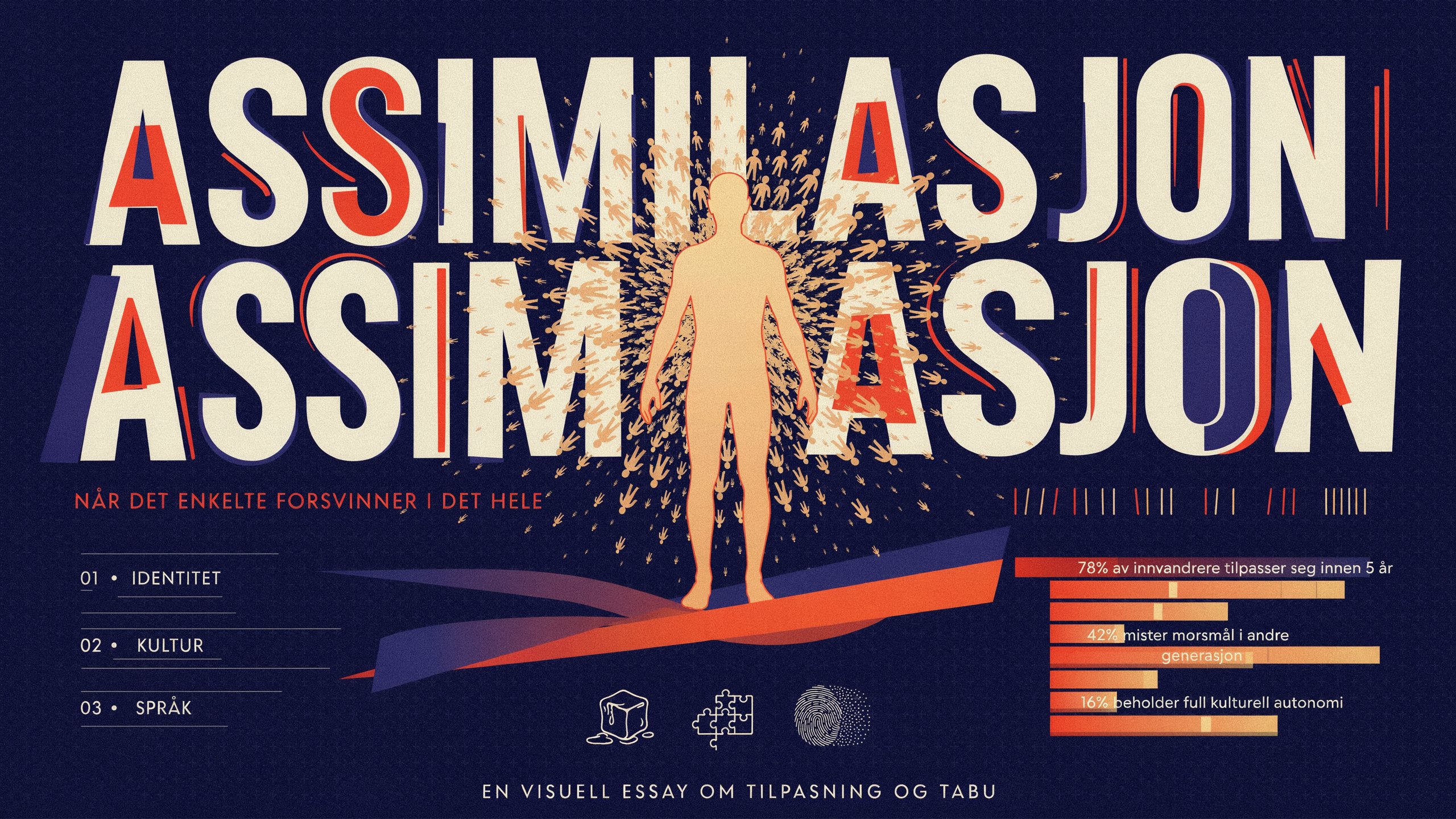
Quick Facts
| Detail | Info |
| Topic | Assimilation (Norwegian: assimilasjon) — the process by which a person or group absorbs the culture of another |
| Core idea | Minority groups adapt to — and eventually merge with — the dominant culture |
| Opposite concept | Multiculturalism; also contrasted with integration |
| Key distinction | Assimilation = one-sided cultural change; integration = mutual adaptation |
| Norway’s historical policy | “Fornorskning” (Norwegianisation) — forced assimilation of Sami, Kven, and Forest Finns |
| Period of active Norwegianisation | Approximately 1850s to 1960s |
| Norway’s parliamentary apology | Issued to Sami, Kven, and Forest Finn communities in recent years |
| Political debate today | Assimilation vs integration remains one of Norway’s most contested policy discussions |
| Main academic lens | Sociology, anthropology, political science, minority studies |
| Global parallel | Assimilation policies have been applied worldwide — from the American “melting pot” to Australia’s Aboriginal policies |
Introduction: A Word That Carries a Lot of Weight
If you sit down with almost anyone in Norway and mention the word “assimilasjon,” watch their reaction. Some people will nod firmly, as if the word names something obvious and necessary. Others will visibly tense up. A few will immediately begin explaining the difference between assimilation and integration — which is itself one of the most politically charged distinctions in Scandinavian public life.
You can learn something significant from that variety of responses. Assimilation is not a neutral concept. It never really was.
At its simplest, assimilation describes what happens when a person or group from one culture gradually takes on the characteristics of another, usually dominant, culture. Language, customs, values, clothing, religion — over time, the differences fade and the newcomer blends in. In theory, this creates social cohesion. In practice, the history of how assimilation has actually been carried out — in Norway and around the world — is far more complicated and far more painful than that tidy definition suggests.
This article tells the full story of assimilation as a concept and as a lived experience: what it means, where it came from, how it was applied as deliberate policy in Norway’s own history, why it fell out of official favour, and why the debate about it is still very much alive today.
See also “What Is the Best Server Hosting for Minecraft on a Budget?“
What Assimilation Actually Means
The word itself comes from the Latin assimilare — to make similar, to absorb. In sociology and political science, assimilation refers to the process through which individuals or groups from one cultural background gradually adopt the language, values, norms, and practices of another group, typically the majority society they’ve entered.
It’s a process that can happen in different ways.
Sometimes it happens slowly and naturally over generations, as children of immigrants grow up speaking the majority language as their first tongue, attending mainstream schools, building social networks outside their parents’ community, and gradually identifying more with their new country than with their family’s country of origin. This kind of organic assimilation doesn’t require anyone to be forced into anything. It simply happens as people navigate their lives.
But assimilation has also been used as an active policy tool — something governments deliberately pursue, sometimes gently, sometimes coercively. This is where the concept moves from a sociological description to a political act with real winners and losers.
In the classic sociological view, particularly from early twentieth-century American scholarship, assimilation was treated as an inevitable and mostly positive process. Diverse newcomers would enter the “melting pot,” shed their differences, and emerge as fully integrated members of the majority society. The institutions of that society — schools, courts, churches, the military — would do the work of smoothing away distinction.
Critics of this view have pointed out what it conveniently ignores: that assimilation, understood this way, places the entire burden of change on the minority group. The dominant culture gives nothing and loses nothing. The newcomer abandons everything. That asymmetry is not neutral. It is a power relationship.
Assimilation vs. Integration: The Crucial Distinction
In Norwegian public debate, the difference between assimilation and integration is fiercely contested and politically significant. Understanding the distinction matters.
Assimilation expects one-directional change. The minority group moves toward the majority. The majority does not move at all. Success is measured by how completely a person leaves their original culture behind. A “successfully assimilated” immigrant would speak the majority language without an accent, hold the majority’s values without reservation, and be indistinguishable from the native-born population in every meaningful way.
Integration, by contrast, is built on a different premise. It assumes that both the incoming group and the receiving society need to adapt — that a genuinely diverse society evolves through mutual accommodation rather than cultural erasure. The immigrant learns the language and respects the laws. The society makes room for different customs, holidays, and beliefs. Neither side absorbs the other completely.
Store Norske Leksikon captures the tension clearly: within frameworks that emphasise assimilation, individuals are expected to adapt one-sidedly to the majority culture over time — whether through a kind of invisible social pressure or through outright compulsion. Assimilation as an active political strategy tends to be perceived as authoritarian.
In Norway, “integration” became the official policy vocabulary after the shift in immigration patterns in the 1970s. The word “assimilation” was deliberately avoided in official documents because it carried the weight of Norway’s own uncomfortable history with forced cultural change — a history that took generations to fully acknowledge.
Norway’s Own Dark Chapter: Fornorskning
To understand why assimilation is such a loaded word in Norway specifically, you have to know the history of what Norwegians call fornorskning — a word that translates literally as “Norwegianisation” but which describes something closer to systematic cultural erasure.
From roughly the mid-1800s through most of the twentieth century, Norwegian authorities pursued a deliberate policy of assimilating the country’s indigenous and minority populations — primarily the Sami people in the north, and the Kven and Forest Finn communities who had their own distinct linguistic and cultural traditions.
The core aim was straightforward: to make these communities Norwegian in every sense. Their languages, their customs, their ways of organising family and community life — all of it was to be replaced with Norwegian equivalents. Schools were the primary instrument. Children were sent to state-run boarding schools where speaking their own language was forbidden, sometimes under threat of punishment. The Norwegian flag flew over institutions built to teach these children that their own heritage was inferior or simply irrelevant.
The 1845 census counted around 1,145 Travellers in Norway — a relatively small number. But the state’s reaction to minorities was shaped by the belief that Norway, as a new nation building its identity in the nineteenth century, needed to be culturally and linguistically unified. Diversity was a problem to be solved, not a condition to be respected.
A private charity organisation working on behalf of the state registered more than 5,000 “itinerant” people in its archives between 1900 and 1959 — people whose lives were monitored, managed, and often disrupted by a system that saw their cultural practices as incompatible with Norwegian society.
For decades, this history was not publicly acknowledged. The policies were treated as well-intentioned if occasionally misguided — the standard logic of “civilising” missions everywhere. It took until the latter part of the twentieth century for a serious reckoning to begin.
The Apology and the Reckoning
Norway’s formal acknowledgment of the harm done by Norwegianisation came through the Storting — the Norwegian parliament — which issued an official apology to the Sami, Kven, and Forest Finn communities for the century-long policy of forced assimilation.
The apology recognised that the Norwegianisation process had aimed to eliminate the languages, cultures, and distinct identities of these communities. Children taken from families and placed in boarding schools designed to strip away their heritage. Families divided. Languages pushed to the edge of extinction. Communities whose members had inhabited the same landscapes for centuries suddenly told that their way of life was incompatible with the Norwegian nation.
The apology was meaningful. But apologies come with questions. What happens next? Can a language be revived after generations of suppression? Can communities rebuild cultural institutions that were deliberately dismantled? Can trust be restored between minority communities and a state apparatus that spent a century working against them?
The answers to those questions are still being worked out. Sami language revitalisation programs have gained support. Legal protections for indigenous rights have been strengthened. But researchers who study these communities note that the impacts of forced assimilation do not disappear simply because the policy ends. They travel through generations, shaping identities, self-images, and family dynamics in ways that take time — sometimes enormous amounts of time — to untangle.
Assimilation in the Modern Immigration Debate
The history of Norwegianisation shaped how Norway thought about immigration when the character of migration to Norway changed dramatically in the late 1960s and 1970s.
When workers from Pakistan, Turkey, Morocco, and other countries began arriving in Norway as labour migrants in the late 1960s, the government needed a policy framework. The word “assimilation” was avoided. Its associations with the Traveller and Sami policies were too recent and too uncomfortable. Instead, the vocabulary of “integration” dominated official documents — along with commitments to equality, participation, and respect for cultural difference.
By the mid-1990s, Norway had roughly 190,000 first-generation immigrants. By 2026, that number had grown enormously as patterns of labour migration, refugee resettlement, and family reunification all contributed to a more diverse population.
But the political debate never fully settled. The distinction between assimilation and integration — which sounds clean on paper — becomes blurry in practice. At what point does a society’s expectation that immigrants learn the language and respect local law shade into an expectation that they abandon their cultural identity entirely? Who decides which elements of a migrant’s culture are acceptable and which must be modified?
These tensions have been visible in Norwegian party politics. Fremskrittspartiet (the Progress Party) has, at various points, openly advocated for what party figures called assimilation rather than integration — arguing that immigrants should adopt Norwegian values, not merely comply with Norwegian law. Carl I. Hagen, a long-serving FrP leader, faced internal party criticism for openly using the word “assimilating” to describe what he wanted for immigrants in Norway. The episode revealed something important: the word itself had become politically radioactive, even for people who were functionally describing assimilationist expectations.
The academic consensus, meanwhile, has generally moved away from assimilation as either a realistic description of what happens or a desirable policy goal. Research from the NMBU and elsewhere suggests that policies described as “integration” often contain hidden assimilationist pressures — expecting minorities to adapt to Norwegian norms while framing the Norwegian side as simply the neutral default that everyone should naturally move toward.
Why the Concept Still Matters
Assimilation as a concept matters today for several reasons that go well beyond the Norwegian context.
Identity and belonging. For individuals caught between two cultures — children of immigrants, members of minority communities within majority societies — the question of assimilation is often felt as a personal question about who you are. Pressure to assimilate can feel like pressure to become someone else entirely. The cost of that pressure, measured in lost languages, severed family ties, and damaged self-esteem, is real and documented.
Social cohesion debates. Across Europe, political debates about immigration often circle back to assimilation without using the word directly. Questions about whether immigrants “share our values,” whether they learn the language quickly enough, whether their cultural practices are compatible with European norms — these are all, structurally, questions about assimilation. Naming the concept clearly helps clarify what’s actually being debated.
Historical accountability. Norway’s experience with Norwegianisation is not unique. Australia’s forced removal of Aboriginal children into white families — the “Stolen Generations” — followed a similar logic. The residential school system in Canada applied the same approach to First Nations communities. The United States attempted to eliminate Native American languages and cultures through boarding school policies. These are not ancient, irrelevant histories. Their effects are still measurable in the communities that experienced them.
Language policy. One of the most concrete ways assimilation plays out is through language. When a government requires immigrants to learn the majority language — which nearly every European country does, to varying degrees — this is a reasonable integration measure. When it actively suppresses or ignores minority languages, it crosses into assimilationist territory. The line between these is real, even if where exactly it falls is contested.
Final Words
Assimilation is one of those concepts that sounds simple until you look at it closely. Then it reveals itself as a question about power, identity, belonging, and what we owe each other in a diverse society.
Norway’s history gives the concept a particular weight. A country that spent a century trying to erase the languages and cultures of its own indigenous and minority communities — and that has now formally apologised for doing so — is a country that has lived through the consequences of assimilation as policy. That experience informs the careful language of contemporary Norwegian integration policy and the genuine discomfort that surrounds the word itself.
But the discomfort shouldn’t lead to avoidance. The questions that assimilation raises — about how much cultural adaptation societies can reasonably expect from newcomers, about what majority cultures owe to minority communities, about how to build genuine social cohesion without requiring cultural uniformity — are not going away. They are some of the defining questions of diverse modern societies.
The difference between assimilation and integration is not merely semantic. It describes two fundamentally different visions of what a society is for. One vision says the goal is sameness. The other says the goal is shared life — with all its genuine complexity, friction, and richness left intact.
Norway is still working out which vision it actually lives by. So is much of the world.
FAQs
1. What does “assimilasjon” mean in English?
Assimilation. It refers to the process by which a person or group from one cultural background gradually takes on the characteristics — language, customs, values, norms — of another, usually dominant, culture.
2. What is the difference between assimilation and integration?
Assimilation is one-directional: the minority group adapts to the majority, which doesn’t change. Integration involves mutual adaptation — both the newcomer and the receiving society adjust to each other. Norwegian official policy has favoured the language of integration since the 1970s specifically to distance itself from the assimilationist approaches used in earlier decades.
3. What was Norway’s Norwegianisation policy?
Fornorskning was a deliberate government policy running roughly from the 1850s through the 1960s that aimed to replace the languages, cultures, and identities of Sami, Kven, and Forest Finn communities with Norwegian equivalents. State-run boarding schools were the primary instrument, where children were forbidden from using their own languages.
4. Has Norway apologised for its assimilation policies?
Yes. The Norwegian Parliament issued a formal apology to the Sami, Kven, and Forest Finn communities for the harm caused by the Norwegianisation policy. The apology acknowledged that children were separated from families, languages were suppressed, and cultural identities were deliberately erased.
5. Is assimilation the same as the American “melting pot”?
The melting pot idea was an early twentieth-century American vision of assimilation in which immigrants from diverse backgrounds would eventually merge into a unified American identity. It reflects a classically assimilationist framework — though American scholars and policymakers have debated and partially abandoned it in favour of more pluralistic models since at least the 1960s.
6. Why did Norway shift from assimilation to integration as official policy language?
The shift came in the 1970s when labour migration from Southern and South Asian countries began significantly changing Norway’s population. Officials deliberately chose “integration” as the policy term partly because “assimilation” was associated with the painful Norwegianisation history and partly because integration better reflected a stated commitment to cultural respect and equality.
7. Does Norway’s integration policy contain assimilationist elements?
Academic researchers have argued yes. Studies of Norway’s Integreringsloven (Integration Act) suggest that while the policy language is about integration, many of its practical requirements — language learning, values courses, participation in Norwegian institutions — reflect expectations that newcomers will adapt significantly to Norwegian norms, which some describe as assimilationist in effect if not in name.
8. Who are the Sami and why were they targeted by Norwegianisation?
The Sami are the indigenous people of northern Scandinavia, including northern Norway, with their own distinct languages, cultures, and traditions. They were targeted because nineteenth-century Norwegian nation-building ideology held that a unified national identity required cultural and linguistic homogeneity. The Sami’s distinctiveness was seen as incompatible with that goal.
9. Is assimilation ever voluntary?
Yes. Gradual, voluntary assimilation is common across history and across the world. Children of immigrants often assimilate naturally over generations — adopting the majority language, building social networks outside the immigrant community, and identifying increasingly with the country they grew up in. This organic process is very different from state-enforced assimilation.
10. What role does language play in assimilation?
Language is the most measurable dimension of assimilation. Acquiring the majority language is generally considered both practically necessary and a signal of integration. Suppressing or ignoring minority languages, by contrast, is one of the most direct instruments of forced assimilation — which is why language revitalisation programs for Sami and other minority languages have been an important part of Norway’s post-Norwegianisation policy response.
11. How do political parties in Norway differ on assimilation?
The debate runs roughly from left to right. Left-leaning parties tend to emphasise cultural rights, multiculturalism, and the importance of preserving minority identities alongside Norwegian identity. Right-leaning parties, particularly Fremskrittspartiet, have been more comfortable with explicit expectations that immigrants adapt significantly to Norwegian norms — with some figures openly advocating assimilation over integration.
12. Is the assimilation debate unique to Norway?
Not at all. Virtually every country receiving significant immigration has versions of the same debate. France’s republican model is arguably the most explicitly assimilationist in Western Europe, requiring newcomers to adopt French civic identity largely without accommodation of difference. The United Kingdom, Germany, and the Netherlands have all debated and revised their integration models repeatedly. The specific history and political context differ by country, but the underlying tension — between diversity and cohesion, between cultural respect and shared norms — is universal.
Explore ideas that elevate your thinking with The Elevate Magazine.