Kurt Warner Net Worth: The Grocery Clerk Who Became a Hall of Famer
Quick Bio
| Detail | Information |
| Full Name | Kurtis Eugene Warner |
| Born | June 22, 1971 |
| Birthplace | Burlington, Iowa, USA |
| Age (2026) | 54 years old |
| Nationality | American |
| Occupation | Retired NFL quarterback; broadcaster; author; philanthropist |
| Known For | Super Bowl champion; two-time NFL MVP; Pro Football Hall of Fame 2017 |
| Teams | Iowa Barnstormers (AFL); St. Louis Rams; New York Giants; Arizona Cardinals |
| NFL Career | 1998–2009 |
| Career Earnings | ~$62.7 million (salary alone) |
| Net Worth | ~$30 million |
| Spouse | Brenda Carney Warner (married October 11, 1997) |
| Children | Seven (two adopted, five biological) |
| Residence | Paradise Valley, Arizona |
| Faith | Devout Christian |
| Charity | First Things First Foundation; Treasure House |
Introduction: The Man Who Should Never Have Made It
There is a version of Kurt Warner’s life story that nobody would believe if it appeared in a screenplay. A quarterback from Iowa gets cut by an NFL team, stacks shelves at a grocery store for minimum wage, moves into his girlfriend’s parents’ basement, watches her parents die in a tornado, and then — within a few years — leads a professional football team to a Super Bowl championship, wins the game’s MVP award, and becomes one of the most celebrated players in league history.
That story is real. Every single part of it.
Kurt Warner’s career is the ultimate proof that extraordinary things can emerge from the most ordinary and discouraging circumstances. He was not a blue-chip recruit. He was not handed anything. He was ignored in the NFL Draft, fired from his first professional training camp, and forced to keep his dream alive through the Arena Football League — a circuit that most football fans barely noticed at the time.
And yet. He is the only undrafted player in NFL history to win both the league MVP award and the Super Bowl MVP award. He is the only undrafted quarterback to lead his team to a Super Bowl victory. He is enshrined in Canton, Ohio, in the Pro Football Hall of Fame, alongside the men who shaped the game’s greatest legacy.
His story does not begin at the top. It begins at the bottom. And that is precisely why it matters so much.
Early Life: Iowa, Divorce, and the Kid Who Wanted to Play Basketball
Kurt Warner was born on June 22, 1971, in Burlington, Iowa — a river city tucked against the Mississippi on the state’s eastern edge. He was the second son of Gene and Sue Warner, and from the very beginning, his childhood carried the weight that family disruption brings to young children.
His parents divorced when Kurt was just four years old. The two boys went to live with their mother in Cedar Rapids, where Sue Warner worked multiple jobs to keep the household functioning. Money was tight. Stability was relative. The kind of predictable, comfortable upbringing that some children take for granted was simply not part of Kurt’s experience.
What he did have was sport. Pickup games in the driveway. Organized teams at school. The particular relief that physical competition offers a kid who needs somewhere to put his energy and his emotion.
And here is the part that surprises most people who only know the football story: Kurt Warner’s first sports love was basketball. He has said it openly — that if he could have chosen his professional sport, he would have chosen the hardcourt over the gridiron without much hesitation. He loved the game, the flow of it, the way practice felt joyful rather than grueling.
A freshman football coach at Regis Catholic High School in Cedar Rapids had other plans. He wanted the tall, athletic young Warner to play quarterback — but Warner had other ideas too, specifically about playing defense and lining up as a hybrid receiver. The coach made a deal: try quarterback, just try it, and see what happens. Warner agreed.
What happened was that he discovered something he was genuinely gifted at. By his junior year, he had earned the starting position and enough confidence in his abilities that his coach occasionally let him call his own plays. By his senior season, he had earned All-State honors and a spot in the Iowa Shrine Bowl — the game that showcases the state’s finest graduating seniors.
He graduated in 1989 having accomplished more in football than anyone had predicted for a kid who would have preferred to be playing basketball.
Education: Northern Iowa and the Long Wait for a Chance
Warner enrolled at the University of Northern Iowa in Cedar Falls — a solid mid-major school with a strong football tradition but nowhere near the recruiting powerhouse programs of the Big Ten or the SEC. It was the kind of place a quarterback from Cedar Rapids ended up when the big Division I schools had not come calling.
The wait at Northern Iowa was genuinely difficult. He spent three full seasons as a backup — watching, practicing, developing, but never playing meaningful snaps in real games. Three years of waiting is a long time in the brief window of a college career. Most players in that position either transfer or quietly redirect their ambitions.
Warner stayed. And in his senior season, when the starting job finally became his, he made every one of those waiting years look worthwhile. He threw for significant yardage, demonstrated the accuracy and intelligence that would eventually define his NFL career, and won the Gateway Conference’s Offensive Player of the Year award.
He graduated with a degree in communications in 1993. The awards were real, the degree was earned, and the NFL Draft was approaching.
Nobody picked him.
The Grocery Store Years: When the Dream Almost Died
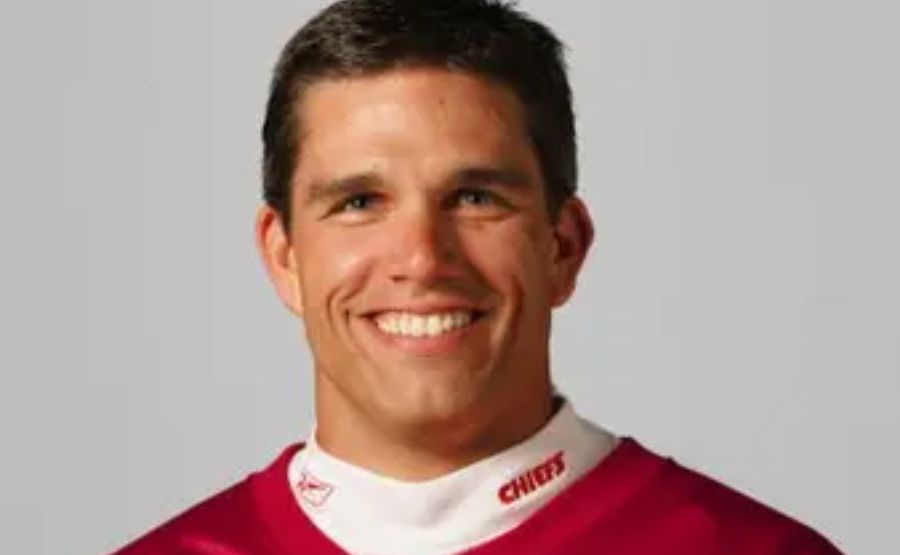
The 1994 NFL Draft came and went without Kurt Warner’s name being called. He signed with the Green Bay Packers as an undrafted free agent and attended their training camp that summer — which meant competing against established professionals for a spot on a roster that had no particular reason to keep him.
He was released. Just like that, the professional football dream had a door slammed in its face.
What Warner did next is the part of the story that people who know football tend to tell with something close to reverence. He went home. He moved into the basement of Brenda Meoni’s parents’ house — Brenda being the woman he was in a relationship with, a divorced mother of two children, one of whom had suffered severe brain damage after a terrible accident. He accepted a job as a stock clerk at a Hy-Vee grocery store in Cedar Falls, working the night shift stocking shelves for $5.50 an hour.
Imagine that specific moment. You are twenty-three years old. You have just been cut from an NFL training camp. Your girlfriend has two children with difficult circumstances. You are living in a basement. You are putting canned goods on shelves at night so that you can keep your body in shape during the day in case — in case — someone calls.
He did not stop believing. That is the remarkable thing. He worked out, stayed ready, and kept waiting for a phone that took a long time to ring.
It rang in 1995, when the Iowa Barnstormers of the Arena Football League offered him a spot. It was not the NFL. It was not even close to the NFL. But it was football, and it was a chance to play, and Warner took it without hesitation.
The Arena Football Years: Learning to Be Brilliant
The Arena Football League in the mid-1990s was a niche operation — smaller venues, faster games, eight players per side, and a level of public attention that ranked somewhere between minor league baseball and professional bowling. It was not where careers were supposed to be made.
Warner made one there anyway.
He played for the Iowa Barnstormers from 1995 through 1997, and the numbers he put up were extraordinary. He was named to the All-Arena team in both 1996 and 1997, leading his team to ArenaBowl appearances and demonstrating, week after week, that his arm and his mind were operating at a level the league had rarely seen.
NFL scouts were watching. They always watch, even at levels most people ignore, because talent at that altitude is visible if you know what you are looking at. Warner got called up to NFL Europe — the developmental league that served as a finishing school for fringe NFL prospects — and performed well enough there to stay on the radar.
In 1998, the St. Louis Rams added him to their roster. He was a third-string quarterback. His job was to watch, hold a clipboard, and stay ready for a situation that might never come.
The 1999 Season: The Most Improbable Explosion in NFL History
The Rams entered the 1999 NFL season with genuine expectations. They had built a high-powered offensive system under coach Dick Vermeil and coordinator Mike Martz, and their starting quarterback, Trent Green, was considered the centerpiece of what promised to be an exciting offense.
Then Green tore his ACL in the preseason. And the centerpiece was gone.
Kurt Warner walked onto the field as the starting quarterback of the St. Louis Rams at twenty-eight years old — an age by which most quarterbacks who are going to make it have long since made it. The football world viewed the situation with something between skepticism and resignation.
What followed across those sixteen games is still discussed in hushed tones by people who study the sport. Warner threw for 4,353 yards. He completed 65.1% of his passes. He threw 41 touchdown passes against only 13 interceptions. The offense he ran — nicknamed “The Greatest Show on Turf” — was the most spectacular thing professional football had produced in years.
The Rams went to the Super Bowl. They played the Tennessee Titans in Super Bowl XXXIV in January 2000. Warner threw for 414 yards and 2 touchdowns in the game. The Rams won 23-16. Warner was named the Super Bowl’s MVP. He had already won the NFL’s regular season MVP award.
From stocking shelves at $5.50 an hour to Super Bowl MVP in five years. Not five seasons. Five years.
Major Achievements: The Record Book Speaks
It is worth laying out what Kurt Warner actually accomplished, because the list is genuinely staggering when you look at it all together.
Two NFL MVP awards — 1999 and 2001. Super Bowl MVP in February 2000. Three Super Bowl appearances, leading three different franchise runs: the Rams’ championship, the Rams’ return trip in 2002, and the Arizona Cardinals’ run to Super Bowl XLIII in the 2008 season. Four Pro Bowl selections. The third-highest career passer rating in NFL history when he retired, trailing only Steve Young and Peyton Manning. A career completion percentage of 65.5% — the most accurate in league history at the time of his retirement.
And the one that ties the whole story together: the only undrafted player to win both the NFL MVP and the Super Bowl MVP. The only undrafted quarterback to lead his team to a championship victory.
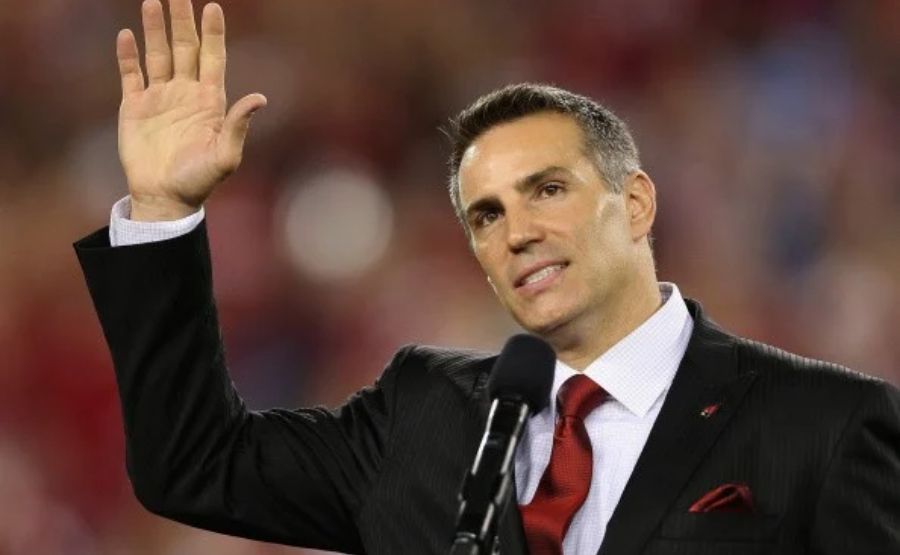
He was inducted into the Pro Football Hall of Fame in 2017, part of a class that included Jerry Jones and LaDainian Tomlinson. When his bust was unveiled in Canton, the grocery store years were part of the story told from the podium. They always are.
He also holds the distinction of being inducted into both the Pro Football Hall of Fame and the Arena Football Hall of Fame — the only player in history to achieve both honors.
Personal Life: Brenda, Seven Children, and a Foundation Built on Faith
The Brenda Warner story deserves its own telling, because she is not simply a supporting character in Kurt’s biography. She is the central human being in it.
Kurt met Brenda Carney Meoni at a country bar in Iowa in 1993, while he was still figuring out what his professional life was going to look like. She was a divorced Marine Corps veteran — she had been discharged on a hardship basis in 1990 — raising two children. Her son Zachary had suffered severe brain damage as an infant after an accident. Her daughter Jesse was her other child. Brenda was managing a genuinely difficult life on food stamps when she and Kurt first connected.
The relationship that developed between them was built on something real and tested. They lived through the grocery store years together. They lived through the basement years together. In 1996, a tornado struck Mountain Home, Arkansas, killing Brenda’s parents — a loss of devastating proportion. They survived that together too.
They married on October 11, 1997, in Cedar Rapids. Kurt formally adopted Zachary and Jesse. In the years that followed, they had five biological children together: Kade, Jada, Elijah, Sienna, and Sierra. Seven children in total. Kade went on to play college football at Kansas State before signing with the Tampa Bay Buccaneers — the family’s athletic genes passing down through another generation.
The Warner family lives in Paradise Valley, Arizona, a community outside of Phoenix. Faith is the constant in their household. Kurt has been openly Christian throughout his public life, crediting his belief as foundational to everything he has built and everything he has survived.
In 2001, Kurt and Brenda founded the First Things First Foundation, a charitable organization dedicated to serving children and families in genuine need — providing access to education, healthcare, and other resources. The foundation has been a consistent and serious philanthropic operation for more than two decades. Brenda separately co-founded Treasure House, which provides housing and support for young adults with intellectual and developmental disabilities.
Challenges: Injuries, Benching, and the Long Comebacks
The Warner story is not a smooth, uninterrupted ascent. The 2002 season was its own test. After his championship and back-to-back MVP years, injuries mounted and his performance declined enough that coach Mike Martz openly questioned whether Warner would keep the starting job. He was eventually supplanted by Marc Bulger, and the years of being the Rams’ clear starter were effectively over.
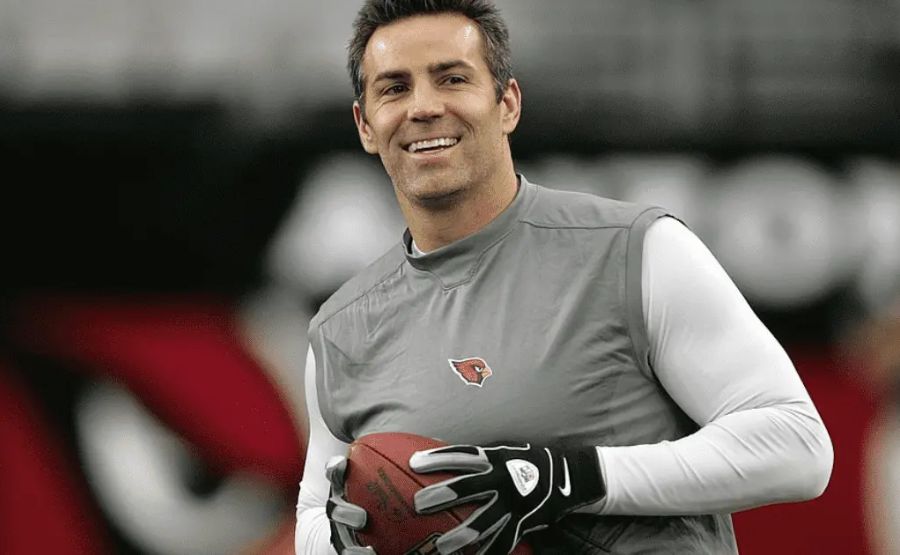
The New York Giants chapter that followed was brief and disappointing. He went to Arizona as a backup behind Matt Leinart in 2005, at an age — thirty-four — when most quarterbacks have already moved on or retired. He became the starter again when Leinart struggled, and in the 2008 season, he orchestrated one of the great late-career performances in the sport’s history — taking the Cardinals to Super Bowl XLIII against the Pittsburgh Steelers in a game that went to the final seconds.
The Cardinals lost that Super Bowl 27-23 in the final moments. Warner scored three touchdowns while throwing for 377 yards.It was not enough. But the performance itself — at thirty-seven years old, in a Super Bowl, against the best defense in the league — was a statement about durability and competitive fire that transcended the loss.
He retired in January 2010, on his own terms, healthy and at peace.
Financial Situation: From $5.50 an Hour to $30 Million
Kurt Warner’s net worth is estimated at approximately $30 million — a figure that feels both extraordinary and entirely earned when you trace how it was built.
During his NFL career, he earned just over $62.7 million in player salary. His contracts across St. Louis, New York, and Arizona spanned the era when NFL quarterback salaries were rising dramatically, and his sustained performance across more than a decade put him in the range of the league’s highest-paid players at various points.
Beyond the playing salary, his income streams have multiplied in retirement. He works as an analyst for NFL Network, providing commentary and analysis across the regular season, playoffs, and Super Bowl coverage. The broadcasting role comes with a meaningful salary and keeps him connected to the sport’s mainstream audience. He earns fees from motivational speaking — a market hungry for someone who can speak authentically about perseverance and faith from first-hand experience as dramatic as his own.
The biographical film American Underdog, released in 2021 and starring Zachary Levi as Warner, brought his story to a new generation of audiences and extended his public profile in ways that carry both cultural and commercial value.
His philanthropic activity — through First Things First and Treasure House — does not add to his personal net worth, but it does add to his marketability, his public credibility, and the kind of legacy that sustains a public figure’s relevance long after their playing days.
The man who once earned minimum wage to keep his football dream alive now has a net worth thirty thousand times the annual salary he made stocking shelves in Cedar Falls. That math is one of the more remarkable calculations in American sports history.
Life Today: Broadcasting, Charity, Family, and Faith
In 2026, Kurt Warner is fifty-four years old and living the life that all those years of struggle were building toward — even when he had no way of knowing it.
He continues to work with NFL Network, appearing regularly during the season and playoffs as one of the network’s prominent analysts. He makes public appearances and gives speeches that draw heavily on his story — not as a performance, but because the story is genuinely useful to people who need to believe that circumstances can change.
His son Kade is building his own NFL career, carrying a Warner name onto professional football fields for a new chapter. The family’s seven children are at various stages of their own adult lives, rooted in the Phoenix, Arizona area where Kurt and Brenda have made their long-term home.
The First Things First Foundation continues its work. Treasure House continues to serve its community. Faith remains the organizing principle of the Warner household, as openly and without apology as it has always been.
He is, by any available account, a man at peace with what he has built — because what he built started from nothing and was constructed entirely by the choices he made when nobody was watching.
Final Words
There is a specific image from Kurt Warner’s early adult life that captures something profound. A twenty-three-year-old former NFL hopeful, working a night shift alone in a grocery store, stacking cans on a shelf at $5.50 an hour, knowing that this was not the life he had imagined and choosing, quietly, to keep preparing for the one he still believed was possible.
No cameras. No audience. No guarantee.
Just the work, and the faith, and the decision — made again every single night — that giving up was not an option.
That is the thing about Kurt Warner’s story that goes beyond football statistics and Super Bowl rings. It is the testimony of what happens when a person refuses to let their circumstances define their ceiling. When every reasonable observer would have told him to find another line of work, he kept throwing. When the NFL said no, the Arena Football League said yes, and he made the most of it. When injuries and age and competition threatened to end things, he kept competing until he had nothing left to prove.
He is the only grocery clerk in the Pro Football Hall of Fame. He is the only undrafted quarterback to win the Super Bowl MVP. He is a husband who adopted children that were not his own and loved them as completely as any parent can love. He is a man of faith who has used his platform not to aggrandize himself but to serve the people around him.
The $30 million is real. The Hall of Fame bust is real. The two NFL MVPs are real.
But the real story is the one that happened before all of that — in a basement in Iowa, in a grocery store at midnight, in the belief that the phone would eventually ring.
It did.
FAQs
1. What is Kurt Warner’s net worth?
His net worth is estimated at approximately $30 million, built from NFL salary earnings totaling more than $62.7 million during his playing career, combined with subsequent income from NFL Network broadcasting, speaking engagements, endorsements, and various public-facing media activities including the biographical film American Underdog released in 2021.
2. Why did Kurt Warner work at a grocery store?
After being released from the Green Bay Packers training camp in 1994 following the NFL Draft, Warner needed income while maintaining his physical conditioning and waiting for another football opportunity. He took a night shift stocking shelves at a Hy-Vee grocery store in Cedar Falls, Iowa, earning $5.50 an hour. Rather than abandon his dream, he used the job as a bridge while staying ready for a chance that eventually came through the Arena Football League.
3. When did Kurt Warner win the Super Bowl?
He led the St. Louis Rams to the Super Bowl championship in February 2000, following the extraordinary 1999 NFL season — his first full season as a starter. He was named the game’s MVP after throwing for 414 yards in the victory over the Tennessee Titans. He led teams to two additional Super Bowl appearances — the Rams in 2002 and the Arizona Cardinals in the 2009 game — though those ended in losses.
4. Was Kurt Warner ever drafted by an NFL team?
No. He went undrafted in the 1994 NFL Draft entirely, signing with the Packers as an undrafted free agent. He was released before the regular season. This makes his subsequent career achievements all the more historically unusual — he is the only undrafted player to win both the NFL MVP and Super Bowl MVP awards, and the only undrafted quarterback to lead his team to a Super Bowl title.
5. Who is Kurt Warner married to?
He is married to Brenda Carney Warner, whom he met at a country bar in Iowa in 1993. Brenda was a divorced Marine Corps veteran with two children when they met. They married on October 11, 1997. Kurt legally adopted her children, and the couple subsequently had five biological children together. They have seven children in total.
6. How many children does Kurt Warner have?
Seven. Their children are Zachary (b. 1989), Jesse (b. 1992), Kade (b. 1998), Jada (b. 2001), Elijah (b. 2003), and twins Sienna and Sierra (b. 2005). Zachary and Jesse were Brenda’s children from her first marriage, formally adopted by Kurt. Kade played college football and signed with an NFL team, continuing the family’s athletic tradition.
7. When was Kurt Warner inducted into the Pro Football Hall of Fame?
He was inducted in August 2017 as part of a class that included Dallas Cowboys owner Jerry Jones and running back LaDainian Tomlinson. Warner is notably the only person to be inducted into both the Pro Football Hall of Fame and the Arena Football Hall of Fame — recognizing his elite performance at both levels of the game.
8. What charity work does Kurt Warner do?
He and Brenda founded the First Things First Foundation in 2001, which supports children and families in need through access to education, healthcare, and other resources, both domestically and internationally. Brenda separately co-founded Treasure House, an Arizona-based nonprofit that provides housing and support services for young adults with intellectual and developmental disabilities. Both organizations represent serious, sustained philanthropic commitments rather than celebrity gestures.
9. What broadcasting work does Kurt Warner do?
Since retiring from football in January 2010, Warner has served as an analyst for NFL Network, appearing regularly during the regular season, playoffs, and Super Bowl coverage. He provides game analysis, player assessments, and commentary drawing on his experience as one of the sport’s most accomplished quarterbacks. He also does motivational speaking and has participated in various media projects.
10. What were Kurt Warner’s most impressive statistical achievements?
He posted a career passer rating of 93.8 — third-highest in NFL history at retirement, behind Steve Young and Peyton Manning. His career completion percentage of 65.5% was the most accurate in league history at the time he retired. He threw for 4,353 yards and 41 touchdowns in his first full starting season (1999), won two NFL MVP awards (1999 and 2001), made four Pro Bowls, and led three teams to Super Bowl appearances across his career.
11. What is the movie American Underdog about?
Released in December 2021, American Underdog is a biographical sports drama starring Zachary Levi as Kurt Warner and Anna Paquin as Brenda. The film tells the story of Warner’s path from the Arena Football League through his first Super Bowl championship with the St. Louis Rams, emphasizing his faith, family, and the perseverance required to make an unlikely dream come true. It was produced with the involvement of Warner himself.
12. Where does Kurt Warner live now?
He and his family live in Paradise Valley, Arizona — an affluent community adjacent to Scottsdale, east of Phoenix. The Warner family relocated to Arizona during Kurt’s years playing for the Cardinals, and they have made it their long-term home. It is a significant distance, geographically and circumstantially, from the basement in Cedar Falls where the story bottomed out before it began to rise.
Explore ideas that elevate your thinking with The Elevate Magazine.