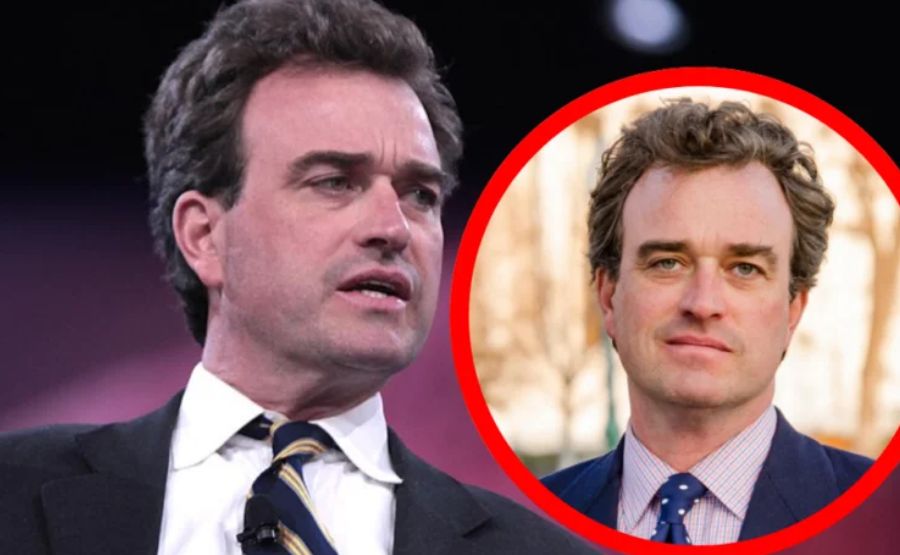
Charles Hurt Net Worth: The Virginia Kid Who Became Washington’s Conservative Voice
Quick Bio
| Detail | Info |
| Full Name | Henry Charles Hurt III |
| Known As | Charlie Hurt |
| Date of Birth | November 3, 1971 |
| Place of Birth | Chatham, Virginia, USA |
| Nationality | American |
| Occupation | Journalist, Political Commentator, Author, Television Host |
| Known For | Opinion Editor, Washington Times; Co-host, Fox & Friends Weekend; Author, Still Winning |
| Education | Hampden-Sydney College |
| Spouse | Stephanie Hurt |
| Children | Three |
| Brother | Robert Hurt (former U.S. Congressman, Virginia) |
| Award | Roy W. Howard Award for Public Service and Reporting |
| Estimated Net Worth | ~$2–5 million |
Introduction
There is a certain kind of journalist who never really stopped being the kid who wanted to tell everybody what was going on. Charles Hurt — Charlie to everyone who knows him — is exactly that kind of person. He grew up in a small Virginia town, started a newspaper as a child, and spent the next four decades building one of the most recognizable voices in American conservative media.
He has covered Congress, the White House, and national politics across more than two decades. He has written for the Detroit News, the Charlotte Observer, the New York Post, and the Washington Times. He edited the Drudge Report. He wrote a book about Donald Trump that captured something about that political phenomenon that a lot of Washington reporters missed. He launched a podcast. And in January 2025, he became a co-host of Fox & Friends Weekend — the most-watched weekend morning show in cable news.
He got there the same way he got everywhere: by showing up, working harder than most people, and saying clearly what he thought.
Growing Up in Chatham, Virginia: A Small Town with Big Ambitions
Chatham, Virginia sits in Pittsylvania County in the southern part of the state — tobacco country, historically speaking, a place with a strong sense of community, a deep connection to the land, and the particular self-reliance that small Southern towns develop out of practical necessity. Charles Hurt was born there on November 3, 1971, the son of a family with roots in that community.
His brother Robert Hurt would grow up to serve Virginia’s 5th Congressional District in the United States House of Representatives — which tells you something about the household they were raised in and the seriousness with which public life and civic responsibility were taken.
Charlie’s own version of that seriousness expressed itself in an unusual way for a child: he started a newspaper. The Gilmer Gazette was his production — written, edited, and presumably distributed by a kid who thought the neighborhood deserved to know what was happening. It was not a school project. It was not something an adult suggested. It was the spontaneous act of someone who already understood, at an age when most children were focused on entirely other things, that information had value and that gathering and sharing it was a worthwhile way to spend your time.
That instinct would define everything that came after.
Hampden-Sydney College: Building the Journalist
After graduating from high school, Charles Hurt enrolled at Hampden-Sydney College in Prince Edward County, Virginia — one of the oldest liberal arts colleges in the country and one of the last remaining all-male institutions of higher education in the United States. Hampden-Sydney has a reputation for producing graduates with strong analytical minds, a serious commitment to written communication, and a comfort with the kind of rigorous intellectual debate that not everyone welcomes.
For a young man who wanted to be a journalist, it was the right environment. Hurt developed his writing during those years and supplemented his academic work with real newspaper experience. He worked at the Danville Register & Bee during his college years — putting his skills to use in an actual newsroom rather than simply in a classroom. He also gained experience at the Richmond Times-Dispatch and the St. Louis Post-Dispatch, building a range of newsroom exposure that most journalism graduates don’t develop until years after they’ve left school.
By the time he left Hampden-Sydney, he had something more valuable than a diploma: a track record.
Early Career: Detroit, Charlotte, and the Road to Washington
Charles Hurt’s professional career began at the Detroit News — a major metropolitan daily with a long history and a serious commitment to investigative and political journalism. His time there happened to coincide with a significant period of labor unrest in the mid-1990s, when the paper was involved in a major strike that reshaped its operations and tested the character of everyone working in its newsroom.
He then moved to the Charlotte Observer, covering the U.S. Congress as a Washington correspondent. The jump from Charlotte to covering Congress is a significant one — it placed him inside the legislative branch of the federal government during a politically consequential period, and it gave him the foundational knowledge of how Capitol Hill actually operates that would inform his reporting and commentary for the next two decades.
In 2003, he joined the Washington Times — the capital’s conservative daily newspaper, which had been a presence in the city’s media landscape since 1982. He covered Congress for the Times across the following four years, building a reputation as a reporter who understood both the mechanics of legislative process and the political theater that surrounded it.
The New York Post Years: White House, Tabloid Energy, and National Politics
In 2007, Charles Hurt left the Washington Times for the New York Post — a move that would give him some of the most formative experiences of his professional career. He became the paper’s DC Bureau Chief and White House correspondent, covering the executive branch during one of the most politically dynamic periods in recent American history.
From his perch in Washington, he reported on the presidential ambitions of figures including Hillary Clinton and Rudy Giuliani during the 2008 campaign cycle. He also covered a relatively unknown Illinois senator named Barack Obama who was building one of the most improbable presidential campaigns in the country’s history. Hurt accompanied Obama on an international tour that included stops throughout the Middle East, Israel, and Germany — the kind of reporting experience that shapes a political journalist’s perspective on the relationship between American politics and the wider world in ways that no amount of Capitol Hill coverage can replicate.
The New York Post gave him something else: an understanding of tabloid journalism’s particular power. The Post has a specific voice — direct, opinionated, unafraid of conflict — and Hurt absorbed that energy into his own developing style as a commentator. The five years he spent there were formative in ways that his subsequent return to the Washington Times would make visible.

The Drudge Report and the Return to the Times
After his time at the Post, Charles Hurt moved to an unusual position: editor at the Drudge Report — the influential link-aggregation site that had become one of the most visited destinations on the internet for political news and commentary. The Drudge Report was, by any measure, one of the most influential platforms in conservative media, and its editorial decisions about which stories to feature and how to frame them shaped the conversation in ways that far outstripped the site’s modest appearance.
Working there gave Hurt a perspective on how political information moves through the media ecosystem — which stories gain traction, which frames resonate with readers, and how the relationship between original reporting and aggregation creates the broader narrative that audiences absorb. It was an education in digital media at a moment when that education was particularly valuable.
In 2011, he rejoined the Washington Times as a political columnist. In December 2016 — the same month Donald Trump was preparing to take the presidency for the first time — he was named the paper’s Opinion Editor, taking editorial responsibility for the conservative daily’s commentary section at a moment of significant national political realignment.
Still Winning: Putting the Trump Phenomenon Into Words
In 2019, Charles Hurt published Still Winning: Why America Went All In on Donald Trump — and Why We Must Do It Again — a book that attempted to do something that a lot of Washington journalists were struggling with: explain Donald Trump’s political appeal to the portion of the American electorate that national media had largely failed to understand.
Hurt came to that subject with credibility that purely coastal journalists didn’t have. He had grown up in rural Virginia. He understood the culture and the economic circumstances and the accumulated frustrations that had made Trump’s message so resonant in places that major media outlets treated as flyover country. The book drew on that understanding to make arguments that his conservative readership found compelling and that gave his political commentary a grounding in specific American experience rather than abstract analysis.
National Review editor Rich Lowry described Hurt as “an early adopter of Donald Trump populism” — a characterization that captures both his early recognition of what Trump represented and the intellectual seriousness with which he engaged that phenomenon rather than simply cheerleading for it.
Fox News, the Roy W. Howard Award, and Growing Influence
Throughout his years at the Washington Times, Charles Hurt became an increasingly visible presence on Fox News as a contributor — appearing regularly on the network’s evening and weekend programming and bringing his combination of reporting background and strong conservative opinion to an audience that valued both.
He received the Roy W. Howard Award for public service and reporting — one of journalism’s recognized honors, named after the influential Scripps-Howard newspaper executive, recognizing the kind of work that demonstrates journalism’s capacity to serve the public interest.
He launched his podcast Politically Unstable in 2019 — a direct-to-audience platform that gave him the ability to speak without the constraints of either newspaper format or television segment length. The podcast built a loyal following of listeners who valued his perspective on the weekly developments in Washington and in American politics more broadly.
His column for the Washington Times — the Nuclear Option — became a recognizable feature of the paper’s opinion section, offering his characteristically direct take on whatever Washington was doing or failing to do in any given week.
January 2025: Fox & Friends Weekend
In January 2025, Charles Hurt stepped into his most prominent media role to date: co-host of Fox & Friends Weekend alongside Rachel Campos-Duffy. He succeeded Will Cain, who moved to a weekday slot following the departure of Neil Cavuto.
The announcement came on January 13, 2025, with the new hosting arrangement beginning January 18 — a timeline that placed the launch of his television hosting career in the same week that Donald Trump was preparing to be inaugurated for his second term. For a journalist whose career had been so closely intertwined with the Trump political phenomenon, the timing was fitting.
He continues to write his regular column for the Washington Times, maintaining the connection to the print journalism institution where he has spent the majority of his career.
Personal Life: Stephanie, Three Children, and the Virginia Roots
Charles Hurt is married to Stephanie Hurt. They have three children together. Beyond that, the specifics of his family life have been kept deliberately private — consistent with the approach of a journalist who understands the value of personal boundaries even as he comments publicly on virtually everything else.
His brother Robert Hurt served in the United States House of Representatives representing Virginia’s 5th Congressional District — the same broadly rural, traditionally conservative part of Virginia where both brothers grew up. The two Hurt brothers represent a household that clearly instilled in both of them a seriousness about public life that expressed itself in different but complementary ways.
Challenges: The Changing Media Landscape
The challenges of Charles Hurt’s professional life are the challenges of anyone who has spent more than two decades in print journalism while the business model of print journalism has been systematically dismantled by the internet and the structural shifts in advertising revenue that the digital age produced.
He navigated those shifts by continuously expanding his platform — from print to online commentary to television to podcast — without abandoning the writing that had been the foundation of his career. The Washington Times itself has faced significant financial challenges across the period of his tenure, as print newspapers broadly have. His ability to maintain his presence there while also building his Fox News profile represented the kind of professional adaptability that the current media landscape requires.
His conservative politics have also made him a target for criticism from left-leaning media and commentators — the normal occupational hazard of being a prominent voice in partisan political commentary. He has handled that criticism with the directness that characterizes his public persona generally.
Net Worth: An Honest Picture
Charles Hurt’s net worth is estimated at approximately $2 to $5 million — a range that reflects the accumulated earnings of a two-decade career in Washington journalism across multiple high-profile outlets, supplemented by his Fox News contributor and now co-host income, book royalties from Still Winning, podcast revenue, and speaking fees.
Print journalism, even at senior editorial levels, does not generate spectacular salaries — particularly at conservative outlets that operate with tighter budgets than the major legacy media institutions. His Fox News income, however, operates at a different scale, and the addition of a hosting role for one of the network’s prominent weekend programs in 2025 represents a significant upgrade in his compensation structure.
The speaking circuit income — bookings through All American Speakers and WWSG — adds additional revenue from appearances before corporate, political, and media audiences who value his perspective and his experience.
Final Words
Charles Hurt’s biography is the story of someone who never lost sight of the instinct that launched him as a child in Chatham, Virginia — the belief that finding out what was happening and telling people about it was genuinely worth doing. The Gilmer Gazette that a kid wrote for his neighborhood and the Nuclear Option column that an opinion editor writes for the Washington Times are expressions of the same impulse, separated by fifty years of accumulated expertise and hard-won professional experience.
He covers Washington from a perspective rooted in rural Virginia and the particular culture of American conservatism that grew there — and that connection to a real place and real community has given his commentary a grounding that a lot of political journalism lacks. He is not performing a character or inhabiting a media niche. He is saying what he actually thinks, which is a quality that audiences in any era recognize and respond to.
The Fox hosting role that launched in January 2025 placed him at the peak of his visibility at 53 years old. For a man who started by self-publishing a neighborhood newspaper as a child, that is a remarkable trajectory. And for the people who have followed his career across the decades — through the Detroit News and the Charlotte Observer and the Washington Times and the New York Post and the Drudge Report and Fox News — it is also the obvious destination for someone who has always been exactly who he is.
FAQs
1. Who is Charles Hurt?
Charles Hurt, full name Henry Charles Hurt III, is an American journalist, political commentator, author, and television host born November 3, 1971, in Chatham, Virginia. He is best known as the former Opinion Editor of the Washington Times and, since January 2025, as co-host of Fox & Friends Weekend on Fox News alongside Rachel Campos-Duffy.
2. Where did Charles Hurt grow up and go to school?
He grew up in Chatham, Virginia, a small town in Pittsylvania County. He attended Hampden-Sydney College in Prince Edward County, Virginia — one of the country’s oldest all-male liberal arts institutions — where he developed his journalism skills alongside real-world experience at the Richmond Times-Dispatch, St., and Danville Register & Bee.Louis Post-Dispatch.
3. How did Charles Hurt get his start in journalism?
He began remarkably early — as a child in Chatham, he published a neighborhood newspaper called the Gilmer Gazette. After college, he joined the Detroit News, then moved to the Charlotte Observer as a Washington correspondent, and joined the Washington Times in 2003.
4. What is Charles Hurt’s relationship to Congress?
He has both professional and family connections to Capitol Hill. Professionally, he covered Congress as a reporter for the Washington Times and the Charlotte Observer. Personally, his brother Robert Hurt served in the United States House of Representatives representing Virginia’s 5th Congressional District.
5. What did Charles Hurt do at the New York Post?
He served as the New York Post‘s DC Bureau Chief and White House correspondent for approximately five years. During that time he covered the presidential campaigns of Hillary Clinton and Rudy Giuliani, and he accompanied Barack Obama on an international tour through the Middle East, Israel, and Germany during the 2008 campaign.
6. Did Charles Hurt work at the Drudge Report?
Yes. After leaving the New York Post, he served as an editor at the Drudge Report — one of the most influential platforms in conservative media and one of the most-visited news aggregation sites on the internet. He then rejoined the Washington Times in 2011 as a political columnist.
7. What is Charles Hurt’s book about?
His 2019 book Still Winning: Why America Went All In on Donald Trump — and Why We Must Do It Again examines the political and cultural forces that drove Donald Trump’s 2016 election victory and makes the case for the continuation of Trump-style conservative populism. National Review editor Rich Lowry called Hurt “an early adopter of Donald Trump populism.”
8. What award did Charles Hurt receive?
He received the Roy W. Howard Award for public service and reporting — a journalism honor named after the influential Scripps-Howard newspaper executive, recognizing work that demonstrates journalism’s capacity to serve the public interest.
9. What is Charles Hurt’s podcast?
He launched Politically Unstable in 2019 — a podcast offering his analysis of weekly political developments in Washington and across the country. It has built a dedicated following among listeners who value his direct, conservative perspective on current events.
10. Who is Charles Hurt’s wife?
He is married to Stephanie Hurt. They have three children together. Beyond those basic facts, Hurt has kept his family life private, consistent with his approach to the boundary between public commentary and personal life.
11. What is Charles Hurt’s estimated net worth?
His net worth is estimated at approximately $2 to $5 million, accumulated through senior editorial positions at major conservative outlets, Fox News contributor and hosting fees, book royalties, podcast revenue, and speaking engagement fees. The January 2025 hosting role at Fox & Friends Weekend represents a significant expansion of his income at a major television network.
12. What is Charles Hurt doing now?
As of early 2025, he is co-hosting Fox & Friends Weekend alongside Rachel Campos-Duffy — the most prominent broadcasting role of his career. He continues to write his Nuclear Option column for the Washington Times. He remains active on the conservative media circuit through speaking engagements and his podcast.
Explore ideas that elevate your thinking with The Elevate Magazine.