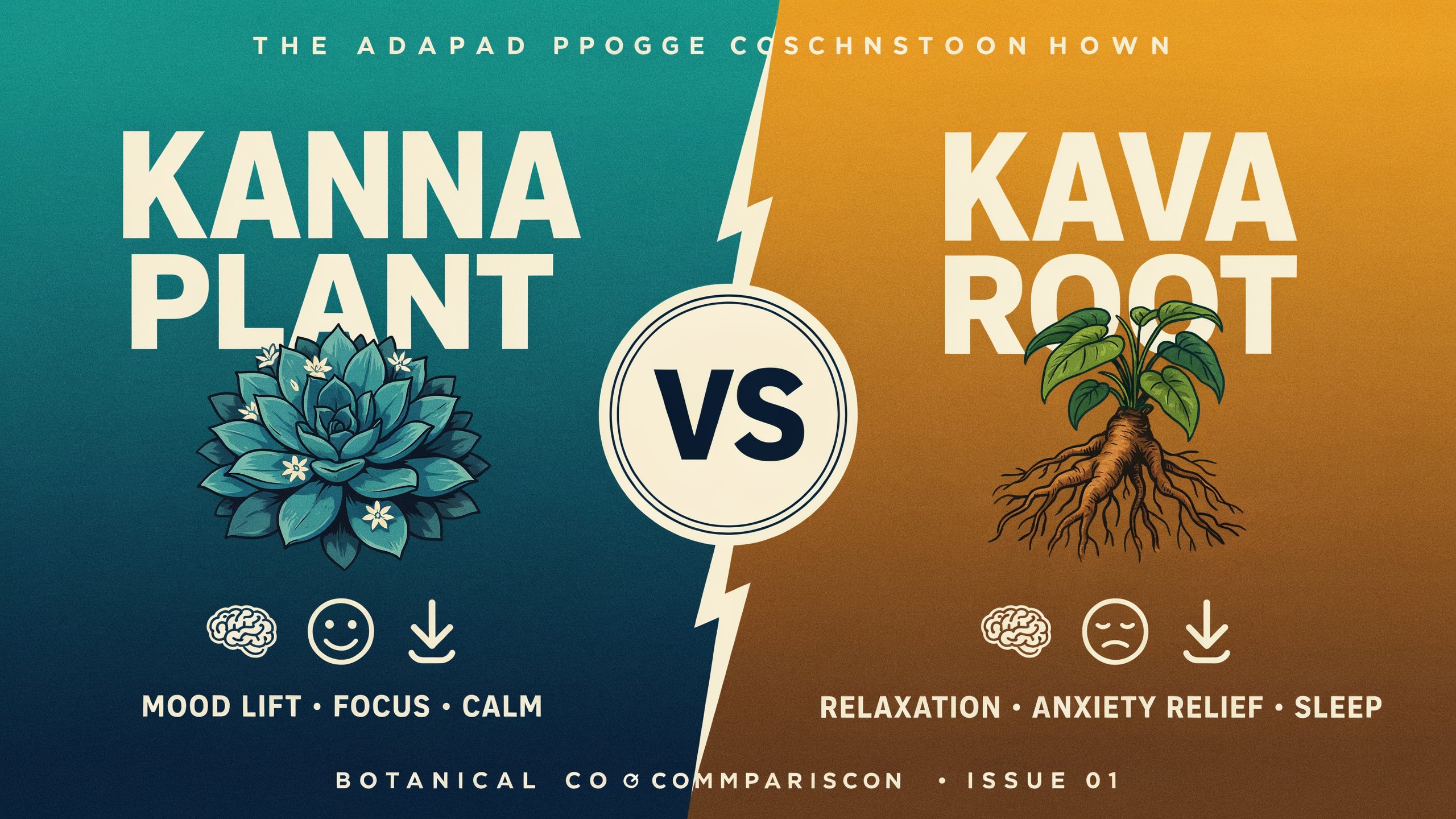
Quick Facts
| Feature | Kanna | Kava |
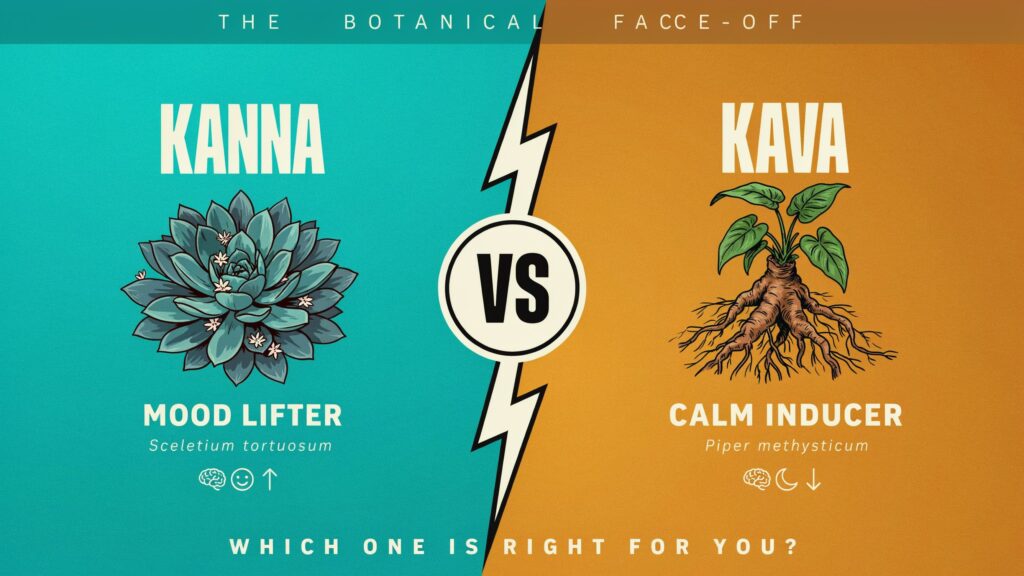
| Scientific Name | Sceletium tortuosum | Piper methysticum |
| Origin | South Africa (Karoo region) | Pacific Islands (Fiji, Vanuatu, Tonga, Hawaii) |
| Plant Type | Succulent flowering plant | Perennial shrub (pepper family) |
| Active Compounds | Mesembrine alkaloids (mesembrine, mesembrenone, mesembrenol) | Kavalactones (kavain, methysticin, yangonin, etc.) |
| Primary Mechanism | Serotonin reuptake inhibition (SRI) + PDE4 inhibition | GABA receptor modulation |
| Main Effects | Mood elevation, anxiety relief, mild euphoria, cognitive clarity | Muscle relaxation, calm euphoria, sedation, social ease |
| Traditional Use | Chewed, snuffed, or smoked by San and Khoikhoi peoples | Drunk ceremonially across Polynesia and Melanesia |
| Common Forms Today | Capsules, tinctures, teas, sublingual extracts, gummies | Traditional powder, instant powder, capsules, kava bars |
| Taste Profile | Earthy, slightly bitter | Strong, peppery, earthy — often described as “muddy” |
| Legal Status | Widely legal globally | Legal in most countries; some regulatory restrictions |
| Liver Risk | Low — no significant adverse reports in traditional use | Possible hepatotoxicity with heavy long-term use |
| Best For | Social anxiety, low mood, focus, emotional resilience | Acute anxiety, stress, insomnia, muscle tension |
Introduction: Two Plants, One Question
Picture two plants — one growing wild across the dry, rocky flats of southern Africa, the other rooted deep in volcanic Pacific soil thousands of miles away. Neither plant knew about the other for most of human history. Yet both were quietly doing something remarkable: helping humans feel better.
That is the story of kanna and kava. And right now, thanks to a growing wave of interest in natural wellness alternatives, millions of people are encountering them both for the first time and asking the same question: which one is right for me?
It is a genuinely interesting question. These two plants are often mentioned in the same breath — both have deep ceremonial roots, both influence the brain and nervous system, both are showing up in wellness shops and functional beverage brands across the world. But their similarities are mostly surface-level. Underneath, they work in completely different ways, come from strikingly different cultures, and suit different kinds of people looking for different kinds of relief.
This article tells the full story of each plant — where it came from, how it works, what it actually feels like, what the risks are, and ultimately how to think about choosing between them.
See also “Tea Checker: A Complete Guide to Its Story and Growing Popularity“
The Origin Stories
Kanna: Africa’s Best-Kept Secret
Long before anyone had a laboratory or a scientific journal, the San people of southern Africa were chewing a small, fleshy succulent to get through the hardest days of their lives. Long desert hunts. Cold nights. Grief. The plant they turned to was kanna — known to botanists as Sceletium tortuosum — and it had probably been in use for thousands of years before any European ever laid eyes on it.
The first written record of kanna dates to 1662, when early Dutch settlers at the Cape made note of the plant and how indigenous communities used it. But those written records were just newcomers catching up to something that had already been woven into the fabric of San and Khoikhoi life for generations. Kanna was not just a plant to these communities — it was a cultural anchor. Hunters chewed it to suppress hunger and fatigue on long expeditions. Healers used it to ease pain. Shamans incorporated it into ritual ceremonies, where fasting and communal dancing combined with kanna’s effects to bring on trance-like states and heightened awareness.
The preparation methods were clever. San communities would pick the plant, bury it to allow fermentation, then dry it. This fermentation process broke down oxalic acid in the plant and likely enhanced the bioavailability of its active alkaloids. From there, kanna could be chewed, dried and snuffed, brewed into a tea, or smoked — often mixed with other plants to modify its effects.
For centuries, kanna stayed mostly within the cultural boundaries of southern Africa. Western science started paying serious attention only in the late 20th century, when ethnobotanist Nigel Gericke began documenting its traditional uses and working to understand the pharmacology behind them. From that research eventually came Zembrin, a patented standardized kanna extract that has since become the subject of several human clinical trials.
Kava: The Pacific’s Social Sacrament
Half a world away, another ancient tradition was forming around another plant. Kava — Piper methysticum, a member of the pepper family — has been central to Pacific Island life for somewhere around 2,000 to 3,000 years. Fiji, Vanuatu, Tonga, Samoa, Hawaii, the Solomon Islands — across this vast sweep of the Pacific, kava was not just consumed but revered.
The word “kava” itself roughly translates to “bitter” in many Polynesian languages, which gives you a fair warning about the taste. The drink is made from the plant’s roots and rootstalk, which are ground or pounded, mixed with water, and then strained into a liquid that ranges in color from tan to muddy brown. It does not look appealing. The taste is famously peppery and earthy. Your mouth goes slightly numb after drinking it. And yet, for thousands of years, people drank it enthusiastically — because the feeling that followed made all of that worthwhile.
Traditional kava ceremonies were elaborate and deeply meaningful. They governed who got served first (the most senior person present), how the bowl was prepared and passed, what prayers or chants accompanied the ritual. Kava was drunk at the inauguration of new chiefs, at peace negotiations between communities, at spiritual gatherings, and at everyday social events. A 18th-century botanist named J.G. Forester, traveling with Captain Cook, was among the first scientists to formally describe the plant — and named it Piper methysticum, loosely meaning “intoxicating pepper.”
Unlike kanna, kava never really disappeared from view. It remained in active daily use across the Pacific throughout modern history. What changed was that it started traveling — first into Western herbal medicine cabinets, then into supplement stores, and most recently into the kava bar scene, a growing cultural phenomenon where customers can sit and drink traditional kava in a social setting, much as they might at a regular bar but without the alcohol.
The Science: What These Plants Actually Do to Your Brain
How Kanna Works
Kanna’s magic is mostly the work of a family of compounds called mesembrine alkaloids. The main players are mesembrine, mesembrenone, and mesembrenol. Together, they act primarily as serotonin reuptake inhibitors — meaning they slow down the brain’s process of clearing serotonin from the gaps between neurons. More serotonin hanging around in those synaptic spaces tends to translate into a lifted mood, reduced anxiety, and a sense of emotional steadiness.
If that mechanism sounds familiar, it is because it is similar — though not identical — to how prescription antidepressants like SSRIs work. The crucial difference is that kanna contains multiple alkaloids working together, and the combined effect appears to produce a gentler, more nuanced experience than isolated pharmaceutical compounds. Mesembrenone, in particular, also inhibits an enzyme called PDE4, which may contribute to cognitive clarity and neuroprotection.
At low doses, kanna tends to feel energizing and clarifying — users often describe it as a subtle mood lift that makes social situations feel less draining and tasks feel more manageable. At higher doses, the effects shift toward something more sedating and introspective. This dose-dependent, two-phase quality is one reason kanna has attracted interest both as a daily supplement and as an occasional emotional support tool.
One study using a 25mg dose of Zembrin found that kanna reduced activity in the amygdala — the brain’s fear-processing center — in response to both neutral and fearful stimuli. That is meaningful because an overactive amygdala is closely associated with anxiety disorders and social anxiety in particular. Kanna was also associated with positive changes in mood and sleep quality in this and related research.
Importantly, because kanna affects serotonin, combining it with SSRIs, MAOIs, or other serotonergic medications carries real risk of serotonin syndrome. That is a firm caution anyone considering kanna should take seriously.
How Kava Works
Kava takes a completely different route. Its active compounds — kavalactones — act primarily on GABA receptors in the brain. GABA is the nervous system’s main inhibitory neurotransmitter, essentially the brake pedal for anxiety, stress, and overactivity. When kavalactones bind to GABA receptors, the overall effect is a kind of full-body relaxation that does not cloud the mind the way alcohol or sedatives can.
There are 18 identified kavalactones in the kava plant, though six account for most of the pharmacological action. Different cultivars of kava — often categorized as “noble” varieties versus stronger “tudei” (two-day) varieties — have different ratios of these kavalactones, which produces meaningfully different experiences. Noble kava, used for daily consumption, is associated with cleaner, more pleasant relaxation. Tudei kava contains compounds that can cause prolonged lethargy, nausea, and unpleasant after-effects, and is generally not recommended for regular recreational use.
The physical sensation of kava is somewhat unique in the plant world. Shortly after drinking, you notice a mild numbness in the mouth and tongue — that is the kavalactones making contact with mucous membranes. Then comes a wave of muscular relaxation, a pleasant warmth, and what many users describe as a sociable, lightly euphoric state. Kava clears from the system relatively quickly, and most people report waking up the next morning without a hangover — a feature that has made it a popular comparison point to alcohol.
Research on kava and anxiety is more robust than for kanna, though still mixed. Several clinical trials found that kava extracts reduced anxiety symptoms more effectively than placebo, and at least one study found it comparable to prescription anxiolytics. A 2003 Cochrane review covering 11 trials was broadly positive about kava’s short-term efficacy. The complication is liver health: there have been case reports of hepatotoxicity — liver damage — associated with kava use, particularly with non-noble varieties, high doses, or extended use. Most experts and guidelines now suggest limiting use to eight weeks at a time and avoiding combination with alcohol or other liver-stressing substances.
Effects Side by Side: What Does Each One Feel Like?
This is the part most people actually want to know. Here is an honest, side-by-side picture:
Kanna tends to feel more cerebral. It softens the internal chatter that drives social anxiety, makes interactions feel more natural and less effortful, and can create a gentle sense of warmth toward others. At low doses it has a slightly energizing quality. At higher doses it leans more sedating and introspective. The onset is relatively quick — typically 15 to 30 minutes. Duration is usually 1 to 3 hours depending on dose and individual metabolism.
Kava tends to feel more physical. The muscular relaxation is noticeable. The mind quiets, but the experience is often less mood-elevating and more calming in a grounded, earthy way. Many people find it easier to sit and converse at a kava bar after a bowl or two — not because they are more outgoing, but because their nervous systems are simply less tense. Effects begin within 20 to 30 minutes and can last 2 to 4 hours.
Neither plant causes the kind of cognitive impairment associated with alcohol at typical doses. Both preserve mental clarity to a degree that users find valuable. But kanna is more commonly described as mood-lifting or “heart-opening,” while kava is more commonly described as a “body relaxer” or muscle de-tensioner.
Traditional Culture and Ceremony
It would be a mistake to reduce either of these plants purely to their pharmacology. Both carry centuries of cultural weight.
Kanna was used in settings that required enormous emotional and physical endurance — long hunts across brutal terrain, community grief rituals, spiritual ceremonies involving altered states. The San people who used it were arguably the world’s most ancient continuous culture, and their relationship with this plant was interwoven with cosmology, identity, and survival.
Kava’s cultural role was different but equally deep. In the Pacific, the kava ceremony was the central organizing ritual of social and political life. Decisions were made at the kava circle. Alliances were sealed with kava. Spirits were consulted through kava. Even today, when heads of state visit Pacific Island nations, they are often formally welcomed with kava — a tradition that continues at the highest levels of diplomacy. There is a communal quality to kava drinking that kanna, used more individually, does not quite replicate.
Both traditions deserve respect, which is one reason the growing commercialization of these plants is a conversation worth having. When you buy a kanna shot or a kava powder off a wellness website, you are accessing something that has a cultural history stretching back thousands of years. That does not mean you should not use it — but knowing that history enriches the experience.
Practical Matters: Forms, Dosage, and Safety
Kanna is available in several forms today. Loose dried herb, standardized extracts in capsules or tinctures, sublingual drops, gummies, and ready-to-drink shots are all on the market. Traditional doses involved chewing 500–1,500mg of raw plant material. Modern supplements typically standardize for mesembrine content, which makes dosing more predictable. Most supplement formulations work in the 25–50mg extract range for daily use.
Kava is most often sold as a powder (from the dried root), which is then mixed with water and strained traditionally. Instant powders and micronized versions that dissolve more easily are also available, along with capsules and liquid extracts. Kava bars have also grown in popularity, particularly in the United States and Australia, where the traditional drinking experience is recreated in a social setting. Dosages are typically discussed in terms of kavalactone content — research suggests 60–250mg of kavalactones per session as a safe range.
On the safety front, kanna appears to be the lower-risk choice for most healthy adults. Traditional long-term use showed no significant adverse effects, and modern research has generally supported a favorable safety profile. The main watchpoints are drug interactions — specifically with SSRIs, MAOIs, and other serotonergic or CNS-depressant medications.
Kava requires slightly more caution. The liver question is real, even if the full picture is contested. The safest approach is to use noble varieties only, avoid combining with alcohol, keep use to short-term periods, and get liver function checked if using regularly for extended stretches.
Neither plant is habit-forming in the classical sense. Neither is considered addictive. But like anything that affects the brain and mood, developing psychological reliance is possible — especially if someone is using either plant to manage underlying anxiety or mood disorders rather than addressing those conditions directly.
Who Should Choose Which?
If you are trying to decide between kanna and kava, here is a simplified way to think about it:
Kanna may be a better fit if:
- You deal with social anxiety or low mood on a day-to-day basis
- You want something that might support focus alongside mood
- You prefer a more subtle, cerebral lift
- You are not on any serotonergic medications
- You want something legal and widely available with minimal regulatory concern
Kava may be a better fit if:
- Your biggest issue is physical tension, muscle tightness, or that buzzing “wired” kind of stress
- You want a more overtly relaxing, body-centered experience
- You are interested in the social ritual aspect — particularly kava bar culture
- You want better-studied short-term anxiety relief with more clinical evidence behind it
- You are not a heavy drinker (kava and alcohol are a combination worth avoiding)
And of course — some people use both, at different times, for different purposes. There is no rule against that, provided the safety cautions are respected.
The Wellness Market and What to Watch For
Both kanna and kava have been swept up into the booming natural wellness industry, and that brings both opportunity and risk. The opportunity is real access to plants with genuine documented benefits. The risk is a poorly regulated market where product quality, standardization, and dosing accuracy vary wildly.
For kava, quality is particularly important. Noble versus non-noble varieties make a meaningful difference in both the experience and the safety profile. Reputable suppliers will specify the cultivar and provide kavalactone content. If a product does not tell you what variety of kava it contains, that is a flag.
For kanna, look for products standardized for mesembrine content — particularly if you are buying a supplement rather than raw herb. Extract products with specified alkaloid percentages are more reliable than generic “kanna powder” offerings.
The ready-to-drink shot market — where kanna and kava both show up — is particularly uneven in quality. Shots are convenient, but many contain doses too small to produce noticeable effects, or use inferior extract forms. Read labels carefully, and look for brands that are transparent about their sourcing and standardization.
Final Words
Here are two plants that humans figured out were worth paying attention to long, long before science had any tools to explain why. The San people of southern Africa and the island communities of the Pacific did not have neurochemistry textbooks — they had generations of observation, trial, and accumulated wisdom. And what they found, in very different landscapes and very different ways, was that these plants could ease the burden of being human.
Now that science is starting to catch up, what it is finding is mostly confirming what those traditions already knew. Kanna works with serotonin. Kava works with GABA. Both can genuinely help with anxiety, stress, and mood. Both have good safety profiles when used respectfully. Neither is a magic fix, and neither should replace medical care when medical care is what is needed.
What makes the kanna versus kava conversation interesting is not really the pharmacology — it is the reminder that human beings have been solving the problem of stress and anxiety with plants for thousands of years. The wellness industry did not invent this. It just rediscovered it. The invitation, for anyone curious about either plant, is to approach them with the same respect their original cultures did: thoughtfully, in the right context, and with realistic expectations.
These are not quick fixes. They are relationships — with plants, with traditions, and with your own nervous system.
FAQs
1. Are kanna and kava the same thing?
No — they are completely different plants from different continents. Kanna is a South African succulent that works through serotonin pathways. Kava is a Pacific Island root plant that works through GABA receptors. They share some overlapping effects (anxiety relief, mood improvement) but achieve them by entirely different mechanisms.
2. Which one is better for anxiety?
Kava has more clinical research behind it for anxiety specifically, and several studies have shown it reduces anxiety symptoms meaningfully in the short term. Kanna is less studied but shows real promise — particularly for social anxiety and emotional regulation — and may suit people who want daily-use support rather than acute relief.
3. Can you take kanna and kava together?
There is no major known interaction between the two, but combining substances that both affect the central nervous system always warrants caution. Some users report taking them together without issue, but this is not well-studied. Start with one at a time and understand how each affects you before combining.
4. Is kava safe for the liver?
This is the biggest safety concern with kava. At high doses, over long periods, particularly with non-noble varieties or combined with alcohol, liver damage has been reported. Using noble kava varieties, staying within recommended dosages, limiting use to short stretches (under eight weeks continuously), and avoiding alcohol significantly reduces this risk.
5. Does kanna show up on drug tests?
Kanna’s alkaloids are not typically included in standard workplace or athletic drug screening panels. There is no guarantee it never will be, but currently it is not a substance these tests look for.
6. Is kanna legal everywhere?
Kanna is legal in most countries and has not triggered significant regulatory concern globally. There are a few exceptions where it falls into a gray area, so checking local regulations is always sensible — but for most users in the US, Europe, and Australia, it is straightforwardly legal.
7. What does kava taste like?
Honestly — like earthy, peppery, muddy water. It is not pleasant. Many people down it quickly (traditional style, from a coconut shell bowl) rather than sipping it. Some commercially prepared kava products use flavorings to mask the taste, with varying success.
8. Can kanna be used daily?
At low doses and with appropriate sourcing, daily kanna use appears to be relatively safe and is the approach taken by many users who incorporate it into a wellness routine. That said, more long-term human research would be helpful, and cycling off periodically is generally considered prudent.
9. Which plant has a longer history of use?
Both have multi-century documented histories. Kava is generally believed to have been in use for around 2,000 to 3,000 years across the Pacific. Kanna’s documented history dates to at least 1662 with European records, but traditional use by San communities almost certainly predates that by a very long time — possibly thousands of years.
10. Can you drink kava every day?
Pacific Island communities have done so for generations without apparent population-level liver problems. The current concern around liver toxicity appears largely tied to non-noble varieties, pharmaceutical extracts using non-aqueous extraction methods, and very heavy use. Traditional aqueous (water-based) preparations of noble kava appear to carry significantly lower risk.
11. What is the difference between kava and kratom?
These are two completely different plants that are sometimes confused because they both come from Southeast Asia / Pacific regions and both have wellness applications. Kava (Piper methysticum) works on GABA receptors and is associated with relaxation and anxiety relief. Kratom (Mitragyna speciosa) works on opioid receptors and is used for pain relief and stimulation at lower doses — it carries significantly higher risk of dependence and adverse effects than kava.
12. Which one is better for sleep?
Kava edges ahead here, largely due to its more pronounced muscle relaxation and sedation effects. Research has found it can reduce sleep disturbances linked to anxiety. Kanna can also support sleep — particularly by reducing the anxious thought patterns that keep people awake — but its mildly energizing quality at lower doses means timing matters more.