Ken Siu: The Invisible Hand Behind Some of Cinema’s Greatest Action Films
Quick Bio
| Detail | Info |
| Full Name | Ken Siu (also credited as Siu Wai-Keung, Kenneth Siu, Wai-Keung Siu) |
| Born | 1955, Hong Kong |
| Died | November 25, 2018 (age 63) |
| Nationality | Hong Kong Chinese |
| Occupation | Assistant director, first assistant director, director, actor |
| Known For | Bloodsport (1988); Kickboxer (1989); Rush Hour (1998); In the Mood for Love (2000); Fearless (2006); The Forbidden Kingdom (2008) |
| Career Span | Approximately 1984–2011 |
| Acting Role | Victor Lin in Bloodsport (1988); Plowboy in Off Limits (1988) |
| Directed | Deadly Deal (1991) |
| Personal Life | Not publicly documented |
| Net Worth | Not publicly disclosed |
Introduction: The Man Who Made It All Work
Every film you have ever loved that felt effortlessly assembled — where scenes appeared in the right order, actors arrived in the right place, and action sequences unfolded with a precision that looked spontaneous — was made possible by someone whose name you will not find on the poster. Sometimes that person was the line producer. Sometimes the script supervisor. And sometimes — on some of the most beloved action films of the late twentieth century — that person was Ken Siu.
Siu Wai-Keung worked under several names across a career that stretched from the bustling Hong Kong film industry of the early 1980s to the international co-productions of the 2000s. Prior to becoming a director, he was an actor. He was an assistant director before he became a first assistant director. He served directors as tonally opposite as Brett Ratner and Wong Kar-wai, managing blockbuster action sequences in one decade and the exquisitely controlled visual poetry of an arthouse masterpiece in the next.
His name did not appear in reviews. He did not give interviews. When Bloodsport became a cult phenomenon, the praise fell on Jean-Claude Van Damme and the colorful tournament fighters surrounding him. When In the Mood for Love became one of the most acclaimed films ever made, the conversation centered on Tony Leung, Maggie Cheung, and Wong Kar-wai’s filmmaking genius. When Rush Hour made Jackie Chan a genuine American box-office star, audiences credited Chan’s physical comedy and Chris Tucker’s energy.
Ken Siu was behind all of them — not as a spectator or a functionary, but as the operational intelligence that made each production possible. His death in November 2018 produced tributes from people who had worked alongside him for decades, tributes that confirmed just how wide and how lasting his influence had been.
See also “Summer Odalis Beckham: Growing Up in America’s Most Athletic Family“
Early Life: Growing Up in Hong Kong
Ken Siu was born in 1955, in Hong Kong — a city that in the middle decades of the twentieth century was undergoing a particular kind of transformation. The British colonial territory was rapidly becoming one of the most densely populated and commercially dynamic cities in Asia. Its cinema industry was expanding, and by the 1970s Hong Kong would develop one of the most prolific and globally influential film cultures in the world.
The specific details of Siu’s childhood — where in Hong Kong he grew up, his family background, his earliest memories — are things the public record does not preserve. He was a filmmaker who kept his private life genuinely separate from his professional one, which means the early biography largely exists in outline rather than detail.
What can be said is that he grew up in a city where cinema was not a distant glamour industry but a local, working, continuously producing commercial enterprise. Shaw Brothers Studio was making dozens of films a year throughout the 1960s and 1970s. Hong Kong’s martial arts cinema was reshaping how the world thought about physical performance on screen. Bruce Lee had already changed everything. Jackie Chan and Sammo Hung were building careers. The environment that surrounded a film-curious young person in 1970s Hong Kong was genuinely extraordinary — alive with the specific energy of an industry finding its global voice.
Early Career: Acting Comes First
Before Ken Siu was an architect of film sets, he was in front of the camera.
His earliest documented professional credits come from Hong Kong film productions in the first half of the 1980s. He appeared in Long Feng Zhi Duo Xing in 1984 — a Jackie Chan production that itself reflects the particular creative ecosystem of Hong Kong cinema at that moment — and followed it with Ji Ren Tian Xiang and Xiao Hu Xian in 1985. These were working actor credits in a working industry, the kind that do not produce celebrity but do produce the practical knowledge of how film productions operate from the inside.
That knowledge proved invaluable when he made the pivot toward production.
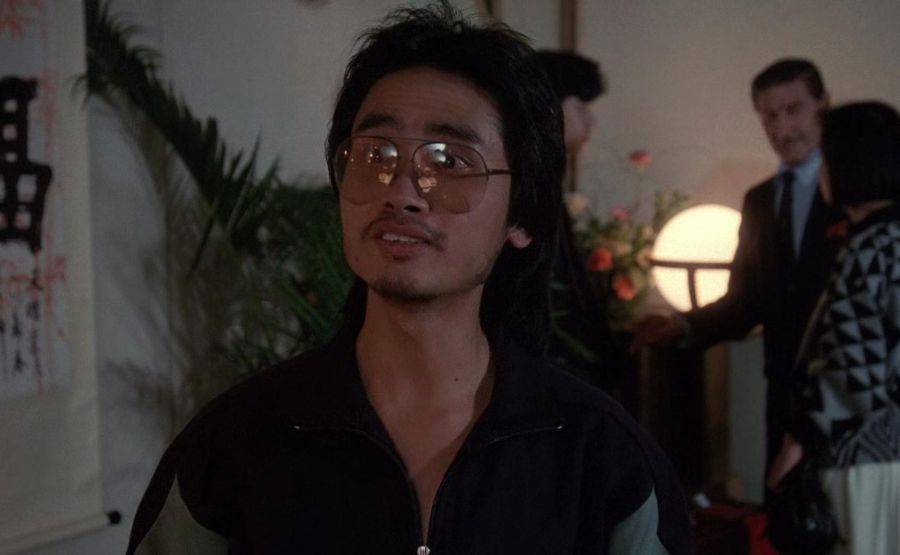
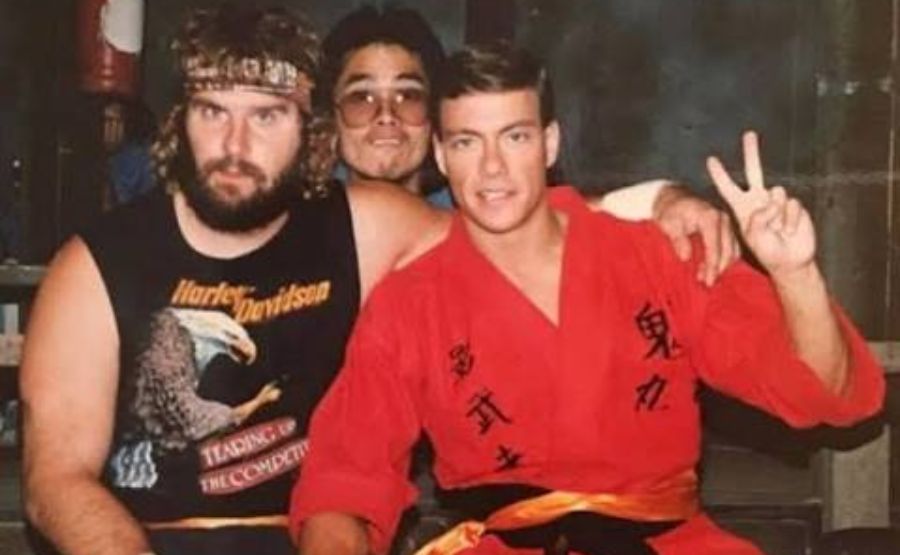
His most visible acting role came in Bloodsport (1988) — the low-budget American martial arts film that launched Jean-Claude Van Damme’s international career and became one of the most beloved cult action films of its era. Siu played Victor Lin, the charismatic Hong Kong figure who serves as guide and liaison for Frank Dux and Ray Jackson during their arrival at the Kumite tournament. It is a supporting role with genuine presence — the kind of character who anchors the film’s Hong Kong setting and gives its American protagonists a human window into an unfamiliar world.
The same year, he appeared in Off Limits — an American thriller set in Vietnam and starring Willem Dafoe and Gregory Hines — where he played a character called Plowboy. Two English-language productions in a single year, both using Hong Kong and Southeast Asian settings and requiring actors comfortable operating across cultural contexts. Siu fit that profile precisely.
The Transition to Assistant Directing
Something shifted for Ken Siu as the late 1980s progressed. The skills that made him valuable as a performer — his understanding of how productions worked, his facility with both Hong Kong and Western filmmaking cultures, his organizational intelligence — apparently pointed toward a different professional role.
He stepped behind the camera and began working as an assistant director.
The role of assistant director is genuinely misunderstood by anyone who has not worked in film production. It is not an apprenticeship for directing, though some people do use it as one. It is its own distinct and demanding discipline — the person responsible for turning a director’s vision into a functional daily production reality. The assistant director manages the schedule. Coordinates the crew. Communicates between departments. Controls the set. Manages safety — particularly crucial in action productions where stunt work and fight choreography create genuine physical risk. And somehow does all of this while keeping a director insulated enough from logistics to focus entirely on the creative work.
On action films, the assistant director’s role becomes even more complex. Fight sequences require careful coordination between stunt coordinators, camera operators, actors, and the director. What looks spontaneous in the final cut was almost certainly rehearsed, blocked, adjusted, rehearsed again, filmed from multiple angles across multiple days, and cut together from dozens of pieces. Managing that process — keeping everyone safe, keeping the schedule intact, keeping the director’s vision coherent across discontinuous filming — is an art form in itself.
Ken Siu became exceptionally good at exactly this kind of work.
Bloodsport and Kickboxer: Building a Reputation
His most significant early work behind the camera came on two films that defined a particular genre of late-1980s martial arts cinema.
Bloodsport (1988) put him in a dual position: as both on-screen actor and production contributor. The film was directed by Newt Arnold and featured a genuine coordination challenge — a multinational cast, extensive fight choreography, a Hong Kong production context, and the specific physical demands of Jean-Claude Van Damme’s emerging action persona. It became a significant commercial success, introduced Van Damme to international audiences, and generated the kind of cult following that sustains films across decades.
Kickboxer (1989) returned him to the production side of a Van Damme film. The story — an American fighter seeking revenge after his brother is paralyzed in a Thai boxing match — required the same blend of international location work, physically demanding action sequences, and careful production management that Bloodsport had demanded.
These two productions established Siu’s professional credibility in exactly the space where it would serve him best: at the intersection of Hong Kong filmmaking expertise and Western action cinema ambitions. He understood both worlds, and in the late 1980s that specific combination was increasingly valuable.
Directing: Deadly Deal
In 1991, Ken Siu directed Deadly Deal — a feature film that placed him in the director’s chair rather than alongside one. The film gave him direct creative authority and demonstrated that his understanding of film production extended beyond the operational management of an assistant director into the storytelling and visual decision-making of a director.
Deadly Deal did not make him a famous director. The film occupies a place in the broader landscape of early 1990s Hong Kong genre cinema — functional, professional, shaped by a filmmaker who clearly understood the conventions of the form. But directing it gave Siu an experience that enhanced everything else he did — you understand what a director needs from an assistant director very differently once you have stood in both positions.
Rush Hour: Jackie Chan Goes Hollywood
The production that brought Ken Siu into contact with the largest mainstream audience of his career arrived in 1998: Rush Hour, the Brett Ratner-directed action-comedy that paired Jackie Chan with Chris Tucker and became one of the year’s biggest commercial hits.
Rush Hour grossed over $240 million worldwide. It made Jackie Chan a genuine box-office name in America — something his Hong Kong career had not quite accomplished despite years of American distribution of his films. Chris Tucker’s explosive comedic energy gave the film a cultural dimension that extended well beyond action audiences.
Siu’s work as part of the production team on Rush Hour placed him inside one of the most commercially successful films of 1998. His Hong Kong credentials were directly relevant here: Rush Hour derived much of its energy from Chan’s physical performance style, which was rooted in the same Hong Kong filmmaking culture Siu had been embedded in for his entire career.
In the Mood for Love: The Pivot Nobody Expected
The career turn that makes Ken Siu’s story genuinely remarkable came in 2000, when he worked as assistant director on In the Mood for Love — Wong Kar-wai’s extraordinary romantic drama set in 1960s Hong Kong, starring Tony Leung Chiu-wai and Maggie Cheung.
In the Mood for Love and Bloodsport exist in entirely different cinematic universes. Wong Kar-wai’s film is slow, formally radical, shot with unusual lenses and a palette of rich, saturated colors that give it the quality of a memory imperfectly recalled. Its emotional content is subtle — desire expressed through near-contact rather than contact, longing that never becomes fulfilment. It earned an 8.0 on IMDb, a Metacritic score of 87, and a place on virtually every serious list of the greatest films ever made.
The fact that the same professional — Ken Siu — contributed meaningfully to both Bloodsport and In the Mood for Love speaks to something genuinely unusual about his abilities. He was not locked into a genre or a register. He could serve the operational needs of a hyperkinetic American action fantasy and the precise, exquisite, deeply controlled visual poetry of one of Hong Kong’s greatest filmmakers. That range is rare.
He also worked with Wong Kar-wai on The Follow (2001), a BMW short film commissioned as part of an art project featuring prominent directors. The collaboration clearly produced mutual respect and trust.
Fearless and The Forbidden Kingdom: Final Major Productions
The 2000s brought two more significant productions to Siu’s resume.
Fearless (2006), directed by Ronny Yu and starring Jet Li, was a biographical martial arts epic about Huo Yuanjia — the Chinese martial artist whose story had become a touchstone of nationalist martial arts mythology. Siu served as first assistant director, credited as Siu Wai Keung. The film grossed over $24 million globally and was promoted as Jet Li’s final martial arts epic.
The Forbidden Kingdom (2008) brought him into the first-ever on-screen pairing of Jackie Chan and Jet Li — a commercial and cultural event for martial arts cinema audiences worldwide. As first assistant director on a production involving two of the most physically demanding action performers in the history of the genre, Siu’s expertise in managing the specific complexities of martial arts film production was essential.
Personal Life: The Private Professional
Ken Siu kept his personal life genuinely private across his entire career. No public documentation of a spouse, partner, or children exists in the available record. No interviews illuminating his home life, his off-set interests, or his personal history have been preserved or published.
He was, in the fullest sense, a professional who allowed his work to be his public identity and asked nothing else of the public’s attention. In an industry that tends to generate personal documentation even for its least famous participants, Siu’s privacy is almost complete.
Financial Picture: Not Publicly Documented
Ken Siu’s financial situation — his career earnings, his net worth at the time of his death — is not something the public record preserves. Assistant directors and first assistant directors on major Hollywood productions earn meaningful professional compensation, and his career spanned productions with significant budgets. But no specific figures are available, and any number placed here would be speculation rather than fact.
Death: November 25, 2018
Ken Siu died on November 25, 2018, at the age of 63. His illness’s nature was kept a secret. His death was noted within the film industry communities that had known his work, and the tributes that followed confirmed how deeply his professional contributions had been felt and how widely he was respected by the people who had worked alongside him across more than two decades of filmmaking.
Final Words
The careers that matter most to cinema are rarely the careers that generate the most attention. Directors become famous. Stars become famous. Cinematographers, when they are very good and very lucky, sometimes earn the recognition their craft deserves. But the people who actually hold productions together — who translate creative vision into daily operational reality — almost never receive public recognition proportional to their contribution.
Ken Siu’s career is a precise illustration of this truth. The films he worked on are among the most watched and most discussed in the action cinema canon. Audiences have returned to Bloodsport and Rush Hour and Fearless across decades, finding in them something that holds up despite and sometimes because of their particular aesthetic signatures. In the Mood for Love has entered the permanent archive of great cinema. The Forbidden Kingdom fulfilled a long-held audience dream.
Siu was present for all of it — not as a spectator, but as the professional intelligence that made each production achievable. He served directors whose temperaments and visions were almost comically opposite. He moved across genres and film cultures with an adaptability that very few production professionals demonstrate across even a fraction of his career span.
He worked from 1984 until at least 2011. He died in 2018. And the films he helped make will outlast the century.
FAQs
1. Who was Ken Siu?
Ken Siu, also credited as Siu Wai-Keung, Kenneth Siu, and Wai-Keung Siu, was a Hong Kong filmmaker born in 1955 who worked primarily as an assistant director and first assistant director across some of the most significant action films of the late twentieth and early twenty-first centuries. He worked on Bloodsport, Kickboxer, Rush Hour, In the Mood for Love, Fearless, and The Forbidden Kingdom, among other productions. He died on November 25, 2018, at the age of 63.
2. What was Ken Siu best known for?
He was best known for his production work on major action films, particularly his roles as assistant director on Bloodsport (1988) and Rush Hour (1998), and as first assistant director on Fearless (2006) and The Forbidden Kingdom (2008). He is also noted for his work on Wong Kar-wai’s In the Mood for Love (2000), which is considered one of the greatest films ever made.
3. Did Ken Siu appear as an actor in any films?
Yes. Before transitioning primarily to production work, he appeared in several Hong Kong films in the early to mid-1980s, including Long Feng Zhi Duo Xing (1984). His most visible acting role was as Victor Lin in Bloodsport (1988), where he played the Hong Kong guide and liaison for the film’s American protagonists. He also played “Plowboy” in Off Limits (1988) alongside Willem Dafoe.
4. What does an assistant director actually do?
An assistant director manages the operational reality of a film production — scheduling, crew coordination, communication between departments, and control of the film set. On action productions particularly, the assistant director plays a critical role in managing fight choreography, stunt sequences, and safety protocols. It is a demanding, logistically complex role that requires both organizational precision and the ability to manage large groups of people under constant time pressure.
5. How did Ken Siu come to work on Rush Hour?
His career in Hong Kong action cinema — spanning the late 1980s and 1990s — gave him expertise directly relevant to Rush Hour, a film that drew heavily on Jackie Chan’s Hong Kong performance style for its action sequences. His familiarity with both Hong Kong filmmaking culture and Western production structures made him a natural fit for a production that required exactly that combination.
6. What was surprising about Ken Siu working on In the Mood for Love?
The tonal distance between In the Mood for Love and the rest of his action cinema work is enormous. Wong Kar-wai’s film is one of the most formally refined and emotionally subtle in cinema history — almost the opposite of the kinetic energy of Bloodsport or Rush Hour. That Siu worked skillfully across both registers demonstrates a professional adaptability that transcended genre.
7. Did Ken Siu ever direct feature films?
Yes. He directed Deadly Deal in 1991, giving him experience in the director’s role rather than purely in production support. He also served as second unit director on Hui Lu (2007) and as executive director on Deep Gold (2011).
8. What films did Ken Siu work on with Jean-Claude Van Damme?
He appeared as an actor in Bloodsport (1988) and worked on Kickboxer (1989) in a production capacity. Both films were central to Van Damme’s emergence as an international action star in the late 1980s.
9. What films did he work on with Jackie Chan?
He worked on Rush Hour (1998) and The Forbidden Kingdom (2008). Rush Hour marked Jackie Chan’s definitive breakthrough into mainstream American audiences, while The Forbidden Kingdom fulfilled audience hopes for an on-screen pairing of Jackie Chan and Jet Li.
10. When and how did Ken Siu die?
He died on November 25, 2018, at the age of 63. His illness’s nature was kept a secret.His illness’s nature was kept a secret. His passing was noted with tributes from colleagues across the film industry who had worked with him during his more than quarter-century career.
11. What is Ken Siu’s net worth?
His personal financial details were never publicly disclosed. First assistant directors on major studio productions earn meaningful professional compensation, and his career spanned multiple decades on significant international productions. No specific figure can be responsibly stated.
12. Why isn’t Ken Siu more widely known?
His professional role — assistant director and first assistant director — is one of the most consequential and least publicly recognized in cinema. The work he did was essential to the productions he contributed to, but it operates beneath the level of directorial credit or performance visibility. His name does not appear on posters or in most mainstream reviews, despite his contributions to films that have been watched by hundreds of millions of people worldwide.
Explore ideas that elevate your thinking with The Elevate Magazine.