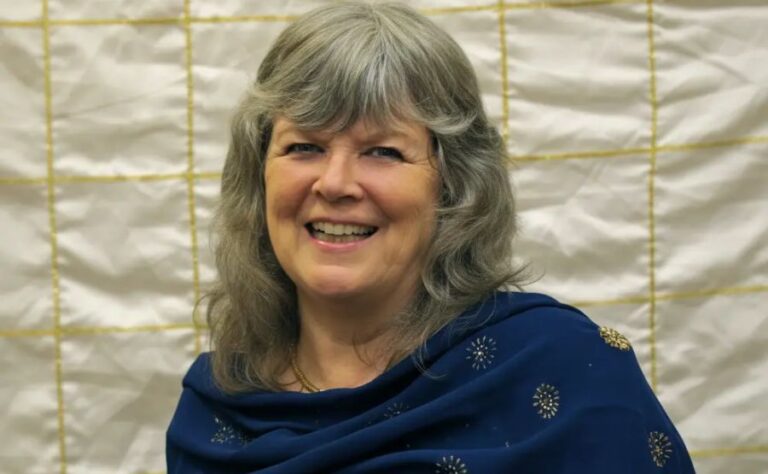
Lois Denhard: The Rock-Solid Heart of a Baseball Family
Quick Bio
| Detail | Information |
| Full Name | Lois Marjorie Johnson (née Denhard) |
| Born | 1928 — Chicago, Illinois, USA |
| Died | January 17, 2023 — Roswell, Georgia, USA (aged 94) |
| Nationality | American |
| Occupation | Homemaker; tour guide; community and faith volunteer |
| Known For | Wife of Atlanta Braves broadcaster Ernie Johnson Sr.; mother of TNT sportscaster Ernie Johnson Jr. |
| Marriage | Ernie Johnson Sr. (married 1947; his death 2011 — 63 years together) |
| Children | Three: son Ernie Johnson Jr. (b. 1956); daughters Dawn and Chris |
| Grandchildren | Rebecca, Eric, Maggie, Carmen, Allison, Ashley |
| Great-Grandchildren | Katie, Amy, Everett, Bennett |
| Buried | Green Lawn Cemetery, Roswell, Georgia (beside her husband) |
| Family Nickname | “Lolo” |
| Estimated Net Worth | $1–2 million (family assets; unverified) |
Introduction: The Woman Behind Two Legends
Ask most sports fans to name a great Atlanta Braves broadcaster and they’ll say Ernie Johnson. Ask which Ernie Johnson — the father or the son — and you might get a moment of pleasant confusion, because both men earned that distinction in their own time and in their own right.
Behind both of them stood the same woman.
Lois Marjorie Denhard — who became Lois Marjorie Johnson when she married in 1947 — was not a broadcaster, not an athlete, not a public figure in any conventional sense. She gave exactly one interview that most people can point to, and that was the kind of interview that happens through a family’s words in an obituary. She was the one at home when her husband was on the road. She was the one managing the household, raising the children, keeping everything steady while the men in her family built careers under bright stadium lights.
She was also, it turns out, a woman who survived cancer twice, played piano beautifully, worked as a tour guide for years, and was described by everyone who knew her as someone who made the people around her feel both seen and loved.
When she died on January 17, 2023, at the age of 94, NBA on TNT — the show her son Ernie Jr. has hosted for decades — paused its broadcast to pay tribute. Charles Barkley, Kenny Smith, and Shaquille O’Neal offered condolences. Her grandchildren shared photographs and stories that stopped a national sports audience in its tracks.
A woman who never sought the spotlight managed to fill it completely, just for a moment, at the end.
That is Lois Denhard’s story. It is worth telling properly.
See also “Dorothy Bowles Ford: The Quiet Matriarch Behind Tennessee’s Most Influential Political Family“
Early Life: Born in the Big City, Raised by the Small Town
Chicago in 1928 was a city in full roar. Jazz clubs, stockyards, architecture that seemed to be trying to outrun the sky. It was also, just a year later, a city that would be knocked flat by the Great Depression — an event that shaped every family that lived through it, especially families without a great deal of cushion between themselves and hardship.
Lois was born into that Chicago, though the specific details of her family background are not part of the public record. Her parents’ names, her siblings if any existed, the neighborhood she grew up in — these are things Lois never made a point of broadcasting, and they were not captured in the documentation that survived her.
What is known is that at some point during her youth, her family moved north and east, out of Chicago and into Vermont. Specifically into Brattleboro — a small, quiet city on the Connecticut River in the southeastern corner of the state, as far from Chicago in spirit as it is possible to get within the continental United States. Where Chicago was loud and dense and relentless, Brattleboro was measured and community-oriented, the kind of place where you knew your neighbors and where the rhythms of daily life moved at a speed that allowed for actual conversation.
It was in Brattleboro that Lois’s character took its full shape. She attended Brattleboro High School, where she was a cheerleader — an activity that placed her at the center of community spirit, at Friday night games and weekend competitions, exactly the kind of role that suited someone with warmth, energy, and a natural gift for making the people around her feel like they were part of something worth celebrating.
She was, by every account, a young woman who made an impression. And it was in Brattleboro, at some point after the end of World War II, that she made the impression that would define the rest of her life.

Education: Learning What Matters
The specifics of Lois’s formal education beyond Brattleboro High School are not documented in the public record. No college enrollment, no degree, no professional credential appears in the accounts of her life that survive her.
This is worth putting in context. In the late 1940s, the expectation for most young women from working-class and middle-class American families was not a university education followed by a professional career. The GI Bill was sending men back to campus in enormous numbers. Women were being encouraged back into homes. The cultural machinery of the postwar period was pointed firmly toward domesticity for women, and most women of Lois’s generation and background navigated their lives within that current rather than against it.
What Lois’s life demonstrates is that formal credentialing is one form of education, and the one she actually pursued was broader. She became a person of deep faith, practical intelligence, and extraordinary emotional acuity — the kind of person who could manage a household through an MLB career and a long broadcasting run, raise three children who turned out to be kind and grounded adults, volunteer in her church and community, work as a tour guide, survive cancer twice, and be described as the moral compass of everyone around her.
None of that shows up on a transcript. All of it is education.
Meeting Ernie: A Veteran, a Cheerleader, and a Beginning
The story of how Lois Denhard became Lois Johnson is one of the oldest and simplest stories in American life, and it is no less beautiful for being familiar.
Ernest Thorwald Johnson Sr. — known to everyone as Ernie — was born on June 16, 1924, in Brattleboro, Vermont. He grew up there, played baseball there, and then left to serve in the United States Marine Corps during World War II. When the war ended and he came home, he returned to the town he had grown up in — and that is where he met the Chicago girl who had moved to his hometown.
Lois was a cheerleader at Brattleboro High School. Ernie had just finished his military service. The exact moment they met, the precise circumstances of how a conversation became a courtship, are not recorded anywhere. What is recorded is the outcome: they married in 1947, two years after the war ended, and they did not spend a single subsequent year apart.
The 1947 wedding marked the beginning of one of the longest and most quietly celebrated marriages in the history of American sports families. Sixty-three years. Three children. A basebal career. A broadcasting career. Seasons on the road and seasons at home. Cancer scares and recovery. The deaths of friends and the births of grandchildren and great-grandchildren. All of it, from beginning to end, together.
A magnet on the kitchen refrigerator in the Johnson household captured the reality of what that life actually looked like, with gentle and affectionate humor. It read: We interrupt this marriage to bring you the baseball season.
That magnet tells you everything you need to know about Lois’s sense of humor and her willingness to acknowledge, without bitterness, the particular shape of the life she had chosen.
Career and Life During the Baseball Years
Ernie Johnson Sr. was a professional baseball pitcher. He played for the Boston Braves, followed the team to Milwaukee when it relocated, and pitched there through the late 1950s. His professional playing career covered roughly a decade, and during the 1957 World Series — the year the Milwaukee Braves defeated the New York Yankees to win the championship — Ernie appeared in three games and posted a 1.29 ERA. He had a World Series ring. He contributed to something historic.
While all of that was happening, Lois was home.
That is not a diminishment. It is simply the truth of what a baseball family’s life looked like during that era. The schedule of a major league player during a full season is almost incomprehensibly consuming. Spring training begins in February. The regular season runs through September. Playoffs extend into October. The road trips — long series in distant cities, weeks away from home — meant that Lois was managing the household, managing the children, making every practical decision about daily life largely on her own for months at a time every year.
She was, in the family’s own words, the rock-solid foundation. Not a passive presence waiting for her husband to come home, but an active, capable, fully present manager of a family that needed managing. She handled the logistics that kept the household running, made the decisions that couldn’t wait for Ernie to return, and created a home environment stable enough that their children — particularly Ernie Jr., who was born in 1956 — could grow up with enough security to dream their own large dreams.
Her work as a tour guide is one of the details most people overlook when they encounter Lois’s story. At some point during her adult life — the exact period is not specified in available records — she worked professionally as a tour guide. This is not a trivial fact. Being a tour guide requires knowledge, articulate communication, the ability to read a crowd, and genuine enthusiasm for sharing information with strangers. It suggests a woman with intellectual curiosity and interpersonal skill that extended well beyond the domestic sphere she is most often associated with.
When Ernie’s playing career ended, he moved into the Braves front office — first as the organization’s public relations director in 1960, then into the broadcast booth in 1962. He became the play-by-play voice of the Atlanta Braves on radio and television, holding that position for decades and becoming one of the most recognized voices in the American South’s sporting life. The family relocated with the team to Atlanta when the Braves moved there in 1966.
Through all of it, Lois continued to be exactly what she had always been: the person who made it possible for the public-facing member of her family to do his public-facing work without the domestic world falling apart.
Ernie Jr.: Raising a Broadcasting Legend
If Lois’s most visible legacy is her son, it is worth spending a moment on what that legacy actually represents.
Ernie Johnson Jr. was born on August 7, 1956, in Milwaukee, Wisconsin, during his father’s playing career. He grew up in an Atlanta Braves household — literally, given that his father’s voice was the sound of Braves baseball for most of his childhood and adolescence. He attended the University of Georgia, entered broadcasting, and built a career that has made him one of the most respected names in American sports television.
He has hosted Inside the NBA on TNT for decades, working alongside Charles Barkley, Kenny Smith, and Shaquille O’Neal in what is widely considered the most entertaining studio show in sports television. He has won Emmy Awards. He has been named one of the best sports broadcasters in the country. He and his wife Cheryl have six children, four of whom are adopted, and Ernie Jr. has been open and public about his Christian faith and about his son Michael’s battle with muscular dystrophy.
The values visible in Ernie Jr.’s public life — his decency, his faith, his commitment to family, his warmth on camera — were planted and tended by his mother. Lois and Ernie Sr. created the household that produced him. Lois specifically, given the amount of time she spent as the primary parent while Ernie Sr. was on the road, shaped the daily texture of his upbringing in ways that cannot be overstated.
Daughters Dawn and Chris were raised the same way. Dawn has since passed, and Chris survived her mother. The family that Lois built was the kind that held together across decades and across loss.
Faith and Community: The Other Dimension
One of the things that gets mentioned consistently in accounts of Lois’s life is her faith. She was a Catholic, devout and active throughout her life. The funeral mass was celebrated at St. Brendan the Navigator Catholic Church in Cumming, Georgia — a church she had been connected to through her years in the Atlanta area.
Her faith was not passive or ornamental. It was functional. It shaped how she thought about her responsibilities to other people, how she approached difficulty, and how she understood the purpose of a life. The church community was a genuine community for her — a network of relationships and commitments that gave her life texture and meaning beyond the household.
She was also involved in her broader local community in ways that are less specifically documented but consistently noted by people who knew her. She was a giver of time and attention, the kind of person who showed up for neighbors and friends and fellow church members with the same consistency she brought to everything else.
She played piano. This detail, mentioned in her obituary, is worth pausing on. Playing piano is something you do because it brings you genuine pleasure, and continuing to play across a long lifetime suggests a private inner life that was nourished by beauty and music in ways that had nothing to do with anyone else’s career or anyone else’s needs. Lois had a life of her own inside the life she built for her family.
Challenges: Cancer, Loss, and Endurance
Lois faced two of the most difficult things a human body can face — cancer diagnoses — and she beat both of them. Her family’s obituary described her as a fighter, and the phrase carries the specific weight of someone who has faced mortal illness not once but twice and come through it.
The timing and types of her cancer diagnoses are not part of the public record. What is known is that she survived both. She lived to 94, which is itself a form of victory — but it is a victory that was preceded by serious illness and genuine fear, and it was won through treatment and will and the support of the people around her.
The loss of her husband in 2011 was the other great challenge of her later years. Ernie Sr. died on August 12, 2011, at the age of 87, following a long illness. They had been wed for sixty-three years. When you have been with someone for six decades, the absence they leave is not just emotional — it is structural. Everything about daily life was built around and with that person, and when they are gone, the architecture of your days has to be rebuilt from scratch.
Lois survived that too. She lived for another twelve years after her husband’s death, remaining close to her family, supported by her son and daughter and by grandchildren and great-grandchildren who clearly adored her. The woman who had spent decades being the foundation for everyone else found, in her final years, that she had built people strong enough to hold her up in return.
The Meme, the Moment, and the Wider Attention
Something unexpected happened to Lois Denhard’s name in the years before and around her death. It went viral.
Her name began appearing in internet memes — largely on platforms like TikTok and Twitter — in a way that introduced her to an entirely new generation that had no particular connection to Atlanta Braves baseball or to the Johnson family’s history. Some of this was affectionate and genuinely curious. Some of it was simply the way internet culture works: a name with an interesting sound, attached to a wholesome story, gets picked up and passed around.
The viral attention, however superficial in its origins, had a genuine side effect: it sent a lot of people looking for the real story of who Lois Denhard actually was. And the real story, as it turns out, is considerably more interesting than a meme.
Financial Situation
Lois Denhard’s personal finances were never part of the public record, and she never discussed them. What can be said with reasonable confidence is that her family accumulated assets through Ernie Sr.’s long dual career as a professional baseball player and a television and radio broadcaster spanning more than four decades. The Atlanta Braves acknowledged him as a figure of historic significance to the franchise, and the family lived comfortably in the Atlanta area.
Various sources estimate a net worth in the range of $1 million to $2 million, which likely reflects family assets accumulated across a long career rather than any specific personal wealth Lois earned independently. These figures are not confirmed and should be understood as rough approximations. What matters more — and what is better documented — is that Lois lived her final years in comfort and died surrounded by the family she had spent her entire adult life building.
Final Years and the Tribute That Said Everything
Lois Marjorie Johnson died on Tuesday, January 17, 2023, at her home in Roswell, Georgia. She was 94 years old. Her family was with her.
On Thursday, January 19 — two days later — Inside the NBA on TNT opened with a tribute to her. Photographs from her long life appeared on screen while her grandchildren’s memories were shared with the audience. Charles Barkley, who has sat beside Ernie Jr. on that set for years and who has become something like an extended member of the broadcasting family in that time, offered his condolences. Kenny Smith and Shaquille O’Neal did the same.
The moment was brief by television standards. But it was real, and it was watched by millions of people who had never heard the name Lois Denhard before and who, in those few minutes, understood exactly what kind of woman she had been.
Her Mass was held on January 23, 2023, at St. Brendan from Cumming, Georgia’s Navigator Catholic Church. She was buried at Green Lawn Cemetery in Roswell, beside Ernie Sr. — together again, exactly as she would have wanted.
Final Words
Lois Denhard lived the kind of life that American culture often struggles to properly honor. She was not a public figure. She did not have a career that generated headlines or awards. She did not make decisions that affected large numbers of people in any recorded or traceable way.
What she did was harder and more lasting than most of those things.
She kept a family intact through decades of professional baseball and broadcasting, through seasons on the road and seasons at home, through illness and loss and the inevitable frictions of a long shared life. She raised a son who became one of the most respected sports broadcasters in America and who has been publicly open about the faith and values his parents instilled in him. She survived cancer twice. She played piano. She worked as a tour guide. She served her church and her neighbors. She was called — by the people who loved her most and knew her best — their matriarch, their moral compass, their inspiration.
She was also, simply, “Lolo.” The grandmother who left one-of-a-kind memories. The woman who made people feel, just by being present, that they were in a safe and loving place.
There is a particular kind of strength that doesn’t need to be loud to be real. Lois Denhard had that kind of strength in abundance, and she spent every year of her ninety-four-year life putting it to use for the people she loved.
That is a life worth remembering.
FAQs
1. Who was Lois Denhard?
Lois Marjorie Denhard — who became Lois Marjorie Johnson upon her marriage — was an American woman born in Chicago in 1928 who is best known as the wife of Atlanta Braves broadcaster and former MLB pitcher Ernie Johnson Sr., and as the mother of TNT sportscaster Ernie Johnson Jr. She was widely described by her family as the emotional and moral foundation of the Johnson household. She died on January 17, 2023, at the age of 94, in Roswell, Georgia.
2. Where was Lois Denhard born and where did she grow up?
She was born in Chicago, Illinois, in 1928. At some point during her youth, her family relocated to Brattleboro, Vermont — a small city in the southeastern corner of the state — where she attended Brattleboro High School and where she eventually met Ernie Johnson Sr. after his return from World War II.
3. How did Lois Denhard meet Ernie Johnson Sr.?
Ernie Johnson Sr. grew up in Brattleboro, Vermont, and served in the U.S. Marine Corps during World War II. When he returned home after the war, he crossed paths with Lois, who had moved to Brattleboro from Chicago. She was a cheerleader at Brattleboro High School at the time. The two began a courtship and married in 1947, going on to build a partnership that lasted 63 years until Ernie’s death in 2011.
4. When did Lois Denhard and Ernie Johnson Sr. marry?
They married in 1947, two years after the end of World War II. Their marriage lasted 63 years, ending only with Ernie Sr.’s death on August 12, 2011, at the age of 87. Lois never remarried and lived for another twelve years after losing him.
5. Who were Lois Denhard’s children?
Lois and Ernie Sr. had three children: a son, Ernie Johnson Jr., born on August 7, 1956, in Milwaukee, Wisconsin; and two daughters, Dawn and Chris. Ernie Jr. went on to become a celebrated sports broadcaster, hosting Inside the NBA on TNT for decades and winning Emmy Awards. Dawn preceded her mother in death; Chris survived Lois.
6. What was Lois Denhard’s role during her husband’s baseball and broadcasting career?
While Ernie Sr. played professional baseball and later spent decades as the voice of the Atlanta Braves on radio and television, Lois managed the household and raised their three children. Her family’s obituary described her as the “rock-solid foundation” of the Johnson household during years when Ernie’s career kept him on the road for extended periods. A magnet on their kitchen refrigerator captured the reality of their life together: We interrupt this marriage to bring you the baseball season.
7. Did Lois Denhard have a professional career of her own?
Yes, though it is less documented than her family life. At some point during her adult years, she worked professionally as a tour guide. She was also actively involved in her Catholic church community and in local volunteer work for many years. She was an avid piano player throughout her life.
8. Did Lois Denhard face serious health challenges?
Yes. Her family described her in her obituary as “a fighter” who survived two separate cancer diagnoses during her lifetime. The specific timing and types of cancer are not part of the public record. She lived to 94 despite those serious illnesses, and her resilience was consistently noted by everyone who spoke about her.
9. How is Lois Denhard connected to Ernie Johnson Jr. and the NBA on TNT show?
Ernie Johnson Jr. is her son. He has hosted Inside the NBA on TNT alongside Charles Barkley, Kenny Smith, and Shaquille O’Neal for decades, and is considered one of the premier sports broadcasters in America. When Lois died in January 2023, the Inside the NBA broadcast paused to pay tribute to her with photographs and family memories, and the show’s cast offered their public condolences. It was a rare and moving moment of personal acknowledgment on a nationally broadcast sports program.
10. What does “Lolo” mean in the context of Lois Denhard’s life?
“Lolo” was the nickname given to Lois by her grandchildren and used by the broader family. It appears in her official obituary alongside words like “matriarch,” “moral compass,” and “inspiration.” The nickname reflected the warmth and intimacy of her relationship with her grandchildren — she was not a formal or distant grandmother figure, but someone close, affectionate, and deeply embedded in the daily lives of the people who called her that.
11. Where is Lois Denhard buried?
She was buried at Green Lawn Cemetery in Roswell, Georgia, beside her husband Ernie Johnson Sr. Her funeral Mass was held on January 23, 2023, at St. Brendan the Navigator Catholic Church in Cumming, Georgia. The family requested that memorial donations be directed to Agape Hospice of Northeast Georgia in her name.
12. Why did Lois Denhard’s name become popular online?
In the years before and around her death, the name “Lois Denhard” began circulating in internet memes on platforms like TikTok and Twitter, introducing her to a new generation of people who had no prior connection to the Johnson family or Atlanta Braves history. The viral attention, while largely lighthearted, prompted many people to search for her actual biography — and to discover the genuine story of a remarkable woman who spent her life building something far more lasting than internet fame.
Explore ideas that elevate your thinking with The Elevate Magazine.