Quick Facts
| Detail | Information |
| Title | Goonierne 2 (Danish) / The Goonies 2 (English) |
| Original Film | The Goonies (1985) |
| Danish Title | Goonierne (official DFI title) |
| Danish Release | October 11, 1985 |
| Original Director | Richard Donner |
| Original Screenplay | Chris Columbus |
| Story By | Steven Spielberg |
| Original Cast | Sean Astin, Josh Brolin, Jeff Cohen, Corey Feldman, Martha Plimpton |
| Sequel Status | In development — writer confirmed, no production date set |
| Current Writer | Ponciroli (replaced Chris Columbus) |
| Producers Attached | Steven Spielberg, Chris Columbus |
| Rumored Title | Goonies Are Good Enough |
Introduction: The Sequel That Has Been “Coming Soon” for Four Decades
Some films don’t just succeed. They become part of the furniture of childhood — something so embedded in the emotional memory of a generation that the word “sequel” attached to them triggers an almost Pavlovian excitement.
The Goonies is one of those films. And Goonierne 2 — to use the Danish title of the original, which translates directly as “The Goonies 2” — is one of Hollywood’s most enduring, most discussed, most teased, and most persistently unrealized sequels in the history of cinema.
For four decades, the conversation has never fully stopped. Richard Donner announced a sequel was happening. The cast expressed surprise. Fan scripts circulated. Viral posters emerged claiming the film was real. Spielberg occasionally hinted. Columbus occasionally commented. And then nothing. For years at a time — nothing.
Until recently. Because as of 2025–2026, something genuinely new has happened in the development of The Goonies 2. A new writer has been brought in. Spielberg and Columbus are attached as producers. The project, for the first time in its forty-year gestational history, appears to be moving.
This article tells the full story — where the original came from, why it captured the world, why the sequel proved so impossible to make, what the content farm sites got completely wrong about a film they invented, and what the actual current status of Goonierne 2 really is.
See also “FancyAI Skills: A Complete Guide to the Open-Source AI Workflow Collection Reshaping Visual Commerce“
The Original: Why “Goonierne” Became a Cultural Monument
To understand why a sequel is so difficult to make, you have to understand what made the original so extraordinary.
The Goonies arrived in American cinemas in June 1985 and reached Danish audiences on October 11 of the same year — when it opened under the title Goonierne at cinemas including Palads and Palladium in Copenhagen, BioTrio, Lyngby Teatret, and multiple provincial screens. The Danish Film Institute’s official records document this release precisely: 35mm, 2.35:1 scope format, Technicolor, Dolby stereo. A children’s film rated appropriate for viewers over 12.
The film was directed by Richard Donner — the same director who had given the world Superman (1978) — from a screenplay by Chris Columbus, based on a story conceived by Steven Spielberg. That creative combination alone was remarkable. Spielberg’s instinct for childhood wonder, Columbus’s ear for how kids actually talk to each other, and Donner’s ability to orchestrate large-scale set pieces while keeping emotional stakes intimate — these three contributions created something that functioned on multiple levels simultaneously.
On the surface, it was a treasure hunt adventure. A group of young friends from the coastal town of Astoria, Oregon — facing the imminent loss of their homes to a country club developer — discover an old treasure map and follow it into underground caverns in search of the legendary pirate One-Eyed Willy’s hidden fortune. They are chased by the Fratelli crime family. They encounter booby traps, waterslides carved into rock, and a giant pipe organ wired to destroy anyone who hits a wrong note.
Underneath all of that, it was about something more universal. The Goonies — the name the children give themselves — are explicitly the kids who don’t fit in. They’re not athletes or class presidents. They’re weird, awkward, too loud, too nervous, too smart in the wrong ways. Their friendship is the kind that forms when everyone else has excluded you. The treasure hunt matters, but what the film is really about is these particular children choosing to face something terrifying together rather than face the loss of their neighborhood alone.
That theme — belonging, loyalty, the specific courage of people who have no obvious reason to be brave — is what embedded the film in the emotional memory of an entire generation. Children who saw it at the right age didn’t just enjoy it. They felt recognized by it.

The Sequel Conversation Begins: 1985 to the 2000s
Almost immediately after The Goonies became a hit, the natural Hollywood question arose: when is part two?
The honest answer, in those early years, was that nobody could agree on what it should be. The original story resolved completely. The treasure was found. The house was saved. The Fratelli family was arrested. The marble bag that Mikey Walsh had carried throughout the film turned out to contain the jewels that funded everything. The adventure had a genuine ending — not a cliffhanger, not a setup for more, but a satisfying conclusion.
A sequel required either ignoring that completeness or finding a genuinely new premise. Neither option was straightforward, and the people involved in the original — Spielberg, Columbus, Donner, and the cast — were all honest about their uncertainty regarding which direction made sense.
Throughout the late 1980s and 1990s, the sequel idea floated in that indeterminate Hollywood space where nothing is confirmed and nothing is officially dead. Donner spoke publicly about wanting to make it. Columbus had ideas. The cast, as they grew up and built their own careers — Sean Astin becoming Samwise Gamgee in The Lord of the Rings, Josh Brolin becoming one of his generation’s most respected dramatic actors — maintained a nostalgic affection for the project without any clear path toward it.
The 1990s brought a Goonies video game and various merchandise that kept the brand alive. But the film itself remained in suspended animation.
The Director’s Announcement and the Cast’s Confusion
One of the most revealing moments in the entire Goonies 2 saga came when Richard Donner publicly declared that a sequel was happening — and several members of the original cast expressed genuine surprise.
Sean Astin and Corey Feldman, in separate public statements, made clear they had not been consulted or informed before Donner’s announcement. Feldman was particularly direct, posting publicly that the sequel was simply not real and that he could confirm this definitively.
This kind of disconnect — a director announcing a project that the people who would need to star in it hadn’t agreed to — illustrates something important about Hollywood development culture. Projects get announced. Enthusiasm is expressed. And then the actual complexity of making something happen — aligning schedules, scripts, studios, creative vision, and the genuine question of whether a sequel serves the original rather than undermining it — reveals itself to be considerably harder than the announcement suggested.
The pattern repeated itself over the following decade. Reports of Goonies 2 being in development emerged, generated excitement, and then faded. Fan scripts circulated online — SlashFilm notably reported reading one that picked up immediately after the first film and found it genuinely compelling, which made the absence of any official version more frustrating. The demand clearly existed. The creative solution remained elusive.
Richard Donner’s Death and What It Meant for the Project
Richard Donner died in July 2021 at the age of 91. He had directed The Goonies, Superman, Lethal Weapon, and a remarkable range of other films across five decades of filmmaking. His death removed the central creative advocate who had most consistently pushed for the sequel’s existence.
In a livestreamed cast reunion that had occurred the previous year — marking roughly 35 years since the original — Spielberg had spoken about why a sequel had never materialized. The conversation revealed the genuine creative difficulty: how do you recapture the specific magic of a film that worked because of the ages its characters were, the particular innocence of that moment, and the unselfconscious performances of young actors who weren’t yet aware of what they were creating?
Spielberg’s reflections were honest about the challenge. The Goonies worked partly because it was made without the weight of expectation. A sequel would arrive carrying the full burden of what the original became — beloved, idealized, almost sacred to the people who grew up with it. That’s a creatively paralyzing starting point.

The 2024 Viral Moment and What Was Real
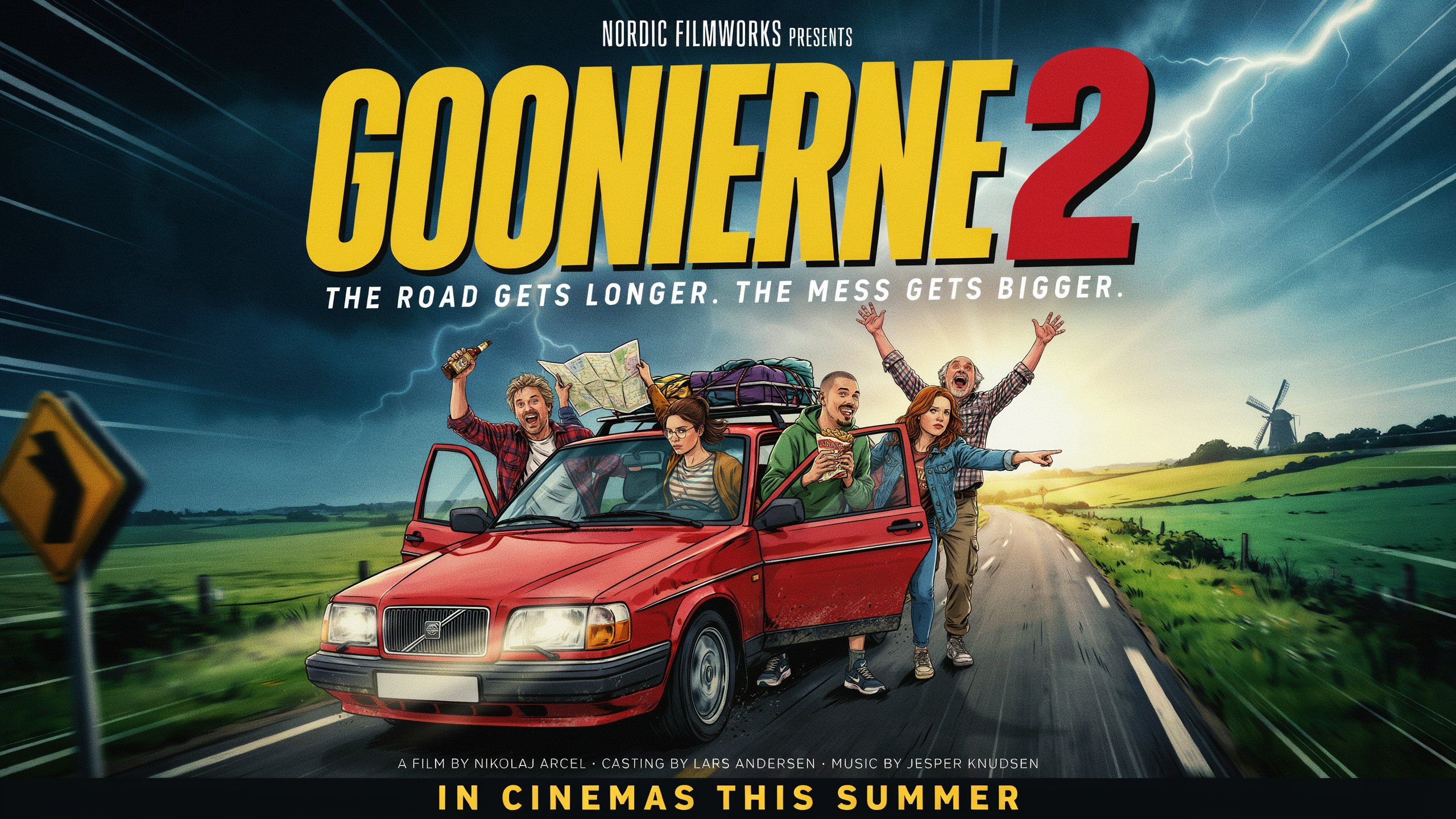
In 2024, something happened that briefly set the internet on fire. A poster appeared online claiming that The Goonies 2 was real and would be titled Goonies Are Good Enough — a reference to the Cyndi Lauper song from the original film’s soundtrack. The poster spread rapidly across social media, particularly after appearing on a RuPaul’s Drag Race fan community Facebook page. It featured cinematic imagery, a suggestive tagline, and looked convincing enough that many viewers took it as genuine.
It was fan-made. Created imaginatively, but entirely unofficial. No studio had announced anything. No production was in progress.
The episode was instructive for two reasons. First, it demonstrated how completely the appetite for this sequel had never faded — a single convincing fan poster generated the kind of viral enthusiasm that most actual studio marketing campaigns struggle to achieve. Second, it illustrated how the internet’s misinformation ecosystem had been generating fake Goonies 2 content for years, to the point where content farm sites were writing fictional “reviews” of a film that didn’t exist.
What Is Actually Happening in 2025–2026
Here is where the genuine, verifiable, credible news begins — and it’s more encouraging than anything the content farms invented.
As reported by Games Radar and sourced from Deadline — both credible entertainment journalism outlets — a real development milestone occurred. A new writer named Ponciroli was brought onto The Goonies 2 project, replacing Chris Columbus who had been attached as the sequel’s screenwriter. Crucially, Columbus was not removed from the project entirely — he and Steven Spielberg are both attached as producers.
This distinction matters. Having the original film’s screenwriter and the original story’s creator both involved as producers means the sequel has genuine creative continuity with what came before. Ponciroli, as the new writer, reportedly expressed his enthusiasm for the assignment in terms that suggested genuine personal investment — describing it as the film he wanted to see as one of its biggest fans.
This is a meaningfully different situation from previous Goonies 2 development cycles. Previous iterations often involved announcements without attached creative personnel, or creative interest without studio momentum. The current configuration — a new writer actively working, original creative voices involved as producers, and apparent studio interest — represents the most substantive development the project has seen.
Whether it ultimately produces a film that gets made and released is a question only time will answer. Hollywood development has a long history of projects that advance through every encouraging stage and still don’t reach production. But the current state of Goonierne 2 is genuinely the most promising it has been in forty years.
The Danish Connection: Why “Goonierne” Specifically
It’s worth taking a moment to explain why the Danish title matters here. The Danish Film Institute’s official database documents the original film as Goonierne — the definite plural form in Danish, meaning “The Goonies.” This is consistent with the Danish grammatical pattern explored in the earlier Fascisterne article in this series: the -erne suffix creates a definite plural that groups and identifies a collective.
Goonierne is therefore an exact translation carrying the same meaning as the English title — these specific, identified kids, this group, this gang. The name has the same warmth in Danish as in English, which partly explains why the film resonated so strongly with Scandinavian audiences when it arrived in October 1985.
The term Goonierne 2 circulates in Danish-language entertainment discussions exactly as The Goonies 2 does in English — as shorthand for the long-awaited sequel to a beloved childhood film. The Danish film community has the same nostalgic relationship with the original as their American and British counterparts.
What a Good Sequel Would Need to Accomplish
Since the sequel is now in active development, the creative questions deserve honest examination.
The fundamental challenge is generational. The original Goonies were children. The actors who played them are now in their 40s and 50s. Any sequel that simply reassembles the original cast picks up with middle-aged people, which is a fundamentally different emotional register from the childhood adventure that made the original special.
Fan theories have consistently converged on the same solution: a next-generation storyline where the children of the original Goonies discover their parents’ adventure and face their own. This approach preserves the thematic core — young people on the margins, facing something bigger than themselves together — while allowing the original cast to appear in roles appropriate to their ages.
The risk is obvious: diluting what made the original special by turning it into a franchise mythology rather than a contained story. The Goonies works because it’s complete. Adding generations and lore and expanded universes turns something intimate into something industrial.
The best version of Goonierne 2 would understand that the original film wasn’t ultimately about treasure or pirates or adventure. It was about being twelve years old and having friends who would follow you into the dark. Any sequel that holds onto that truth — that makes you feel something real about loyalty and belonging and the specific courage of kids who have no particular reason to be brave — has a chance of earning its place alongside the original rather than merely trading on its name.
Final Words
Goonierne 2 has been a dream for forty years. It has been announced and denied, written and unwritten, teased and withdrawn, faked by fans and ignored by studios — and through all of it, the appetite for it has never diminished, because the original film touched something in its audience that doesn’t fade with time.
The current development situation is the most genuinely promising the project has known. A new writer working with active producer involvement from Spielberg and Columbus represents real creative momentum. Whether that momentum produces a film worthy of the original is the question that matters — and it’s a question that only the finished work can answer.
What the forty-year saga of Goonierne 2 demonstrates most clearly is something simple and enduring: some stories matter enough to people that no amount of time, disappointment, or false starts can make them stop caring. That kind of loyalty from an audience is not something a studio creates. It’s something a great film earns — and The Goonies earned it completely.
The Goonies never say die. And after forty years, neither does the hope for their return.
FAQs
1. What does “Goonierne” mean and where does the name come from?
Goonierne is the official Danish title of The Goonies, the 1985 American adventure film. It is the definite plural form of “goonie” in Danish — grammatically equivalent to “the goonies” in English. The Danish Film Institute officially lists the film under this title, noting its theatrical release in Denmark on October 11, 1985.
2. Has The Goonies 2 / Goonierne 2 actually been made?
No. As of November 2026, no Goonies 2 film has been produced or released. Content farm websites have published fictional reviews of an invented sequel, but these are entirely fabricated. The sequel is in development with a new writer and producers attached, but no production has begun.
3. Who is working on The Goonies 2 right now?
Writer Ponciroli is currently developing the screenplay, having replaced original Goonies screenwriter Chris Columbus in that role. Columbus and Steven Spielberg are both attached as producers. This represents the most substantive creative configuration the project has had.
4. Why has it taken 40 years to make a Goonies sequel?
Multiple factors have combined: the original film ends completely with no obvious continuation; the cast aged out of the roles that made the original work; creative disagreements about approach went unresolved; director Richard Donner died in 2021; and the burden of matching an idealized childhood classic proved creatively paralyzing for everyone involved.
5. What was the “Goonies Are Good Enough” poster in 2024?
A convincing fan-made poster claiming The Goonies 2 would be titled Goonies Are Good Enough (a reference to the Cyndi Lauper song from the original soundtrack) went viral in 2024 after appearing on social media. It was entirely unofficial — no studio released it and no such film was in production at that time.
6. What did Richard Donner say about a sequel before his death?
Donner was the most consistent public advocate for a Goonies sequel over the decades. At various points he announced it was happening, surprising cast members who had not been consulted. His death in July 2021 removed the project’s primary creative champion, though development has continued under Spielberg and Columbus’s producer involvement.
7. Where was The Goonies originally filmed?
The film was shot primarily in Astoria, Oregon, which remains a destination for fans. Key locations include the house used for the Walsh family home, now preserved and visited by tourists. Astoria, Oregon also houses the Oregon Film Museum in a former county jail that appeared in the film’s opening sequence.
8. What would a good Goonies sequel need to do?
Most thoughtful analysis suggests a good sequel needs to find a way to honor the original’s emotional core — belonging, friendship, the courage of outsiders — without simply recreating it. A next-generation storyline following the original characters’ children is the most commonly discussed approach, allowing original cast members to appear in age-appropriate roles while preserving the thematic heart.
9. How did The Goonies perform when it was originally released?
The film was a significant commercial success, performing well both in the United States and internationally. In Denmark it opened across multiple cinemas simultaneously, reflecting strong distributor confidence. Its cultural impact far exceeded its box office performance, growing through home video into a generational touchstone across multiple countries.
10. What is the connection between Chris Columbus and The Goonies?
Chris Columbus wrote the screenplay for The Goonies from Steven Spielberg’s story. He went on to direct Home Alone, Mrs. Doubtfire and the initial Harry Potter movies. He was originally attached to write the sequel screenplay before being replaced by Ponciroli, though he remains involved as a producer.
11. Why do content farm sites write fake reviews of Goonierne 2?
“Goonies 2” and “Goonierne 2” are high-search-volume keywords that attract significant internet traffic from fans hoping for news about the sequel. Content farms generate AI-written promotional articles with fictional plots, cast lists, and reviews to capture that search traffic for advertising revenue, regardless of whether the film they describe actually exists.
12. When could The Goonies 2 realistically come out?
No production timeline has been announced. With a writer actively working and producers attached, the next milestone would be a completed screenplay, followed by studio greenlighting, casting, and production. Given Hollywood development timelines, even an optimistic scenario would likely place the film several years away from release. Any specific date cited without studio confirmation should be treated as speculation.