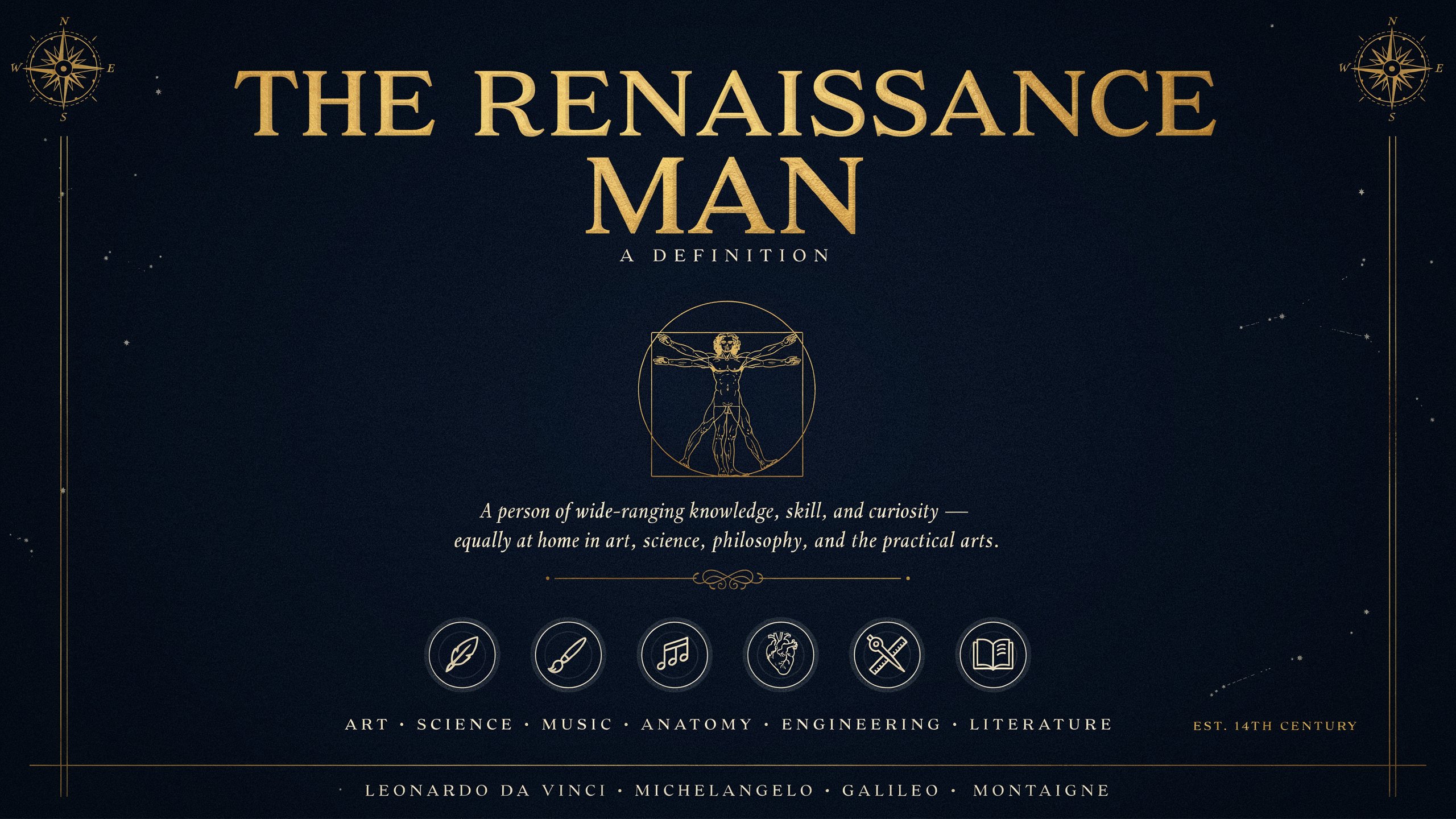
Renaissance Man Definition: A Complete Guide to the Concept That Changed How We Think About Human Potential
Quick Facts
| Detail | Information |
| Concept Name | Renaissance Man (also: Uomo Universale, Homo Universalis, Universal Man) |
| Origin Period | 14th–17th century, Italian Renaissance |
| Geographic Origin | Italian city-states, primarily Florence and Genoa |
| Primary Founding Figure | Leon Battista Alberti (1404–1472) |
| Most Famous Example | Leonardo da Vinci (1452–1519) |
| Related Terms | Polymath, Universal Genius, Jack of all trades |
| First Recorded in English | Early 20th century |
| Core Philosophy | A human being can master arts, sciences, athletics, and social graces simultaneously |
| Status Today | Still used widely; debated as increasingly rare in a specialized world |
Introduction: Why This Idea Still Matters
Here is a question worth sitting with: Can one person genuinely master painting, architecture, mathematics, anatomy, music, and engineering all at once — not dabbling in them, but truly excelling?
Most people today would say no. Focus is rewarded in the world we live in. Pick your lane, go deep, and specialize. That is the modern formula for success.
But there was a time — a remarkable window in European history — when an entirely different belief took hold. A belief that the human mind was not meant to be caged in a single discipline. A belief that curiosity was not a distraction but the highest expression of what it meant to be alive. A belief that a person could, and should, reach across every field of knowledge and become something astonishing.
That belief gave birth to the idea of the Renaissance Man — one of the most powerful intellectual concepts ever to emerge from Western civilization. It is a concept that shaped how entire generations thought about education, ambition, creativity, and the purpose of a human life. And even today, nearly six centuries after it first appeared, it continues to spark debate, inspire individuals, and challenge a world that has drifted very far from its original vision.
This is the full story of what the Renaissance Man is, where it came from, who gave it shape, and whether it still makes sense in the world we live in now.
Early Life of an Idea: Where It All Began
To understand the Renaissance Man, you have to understand the world it grew out of.
For most of the medieval period in Europe, the Catholic Church sat at the center of intellectual and cultural life. Knowledge was largely filtered through religious doctrine. Questions about the natural world, about human nature, about art and science — all of them were answered, first and foremost, through a theological lens. The individual human being, in this framework, was a fairly small thing. What mattered was salvation. What mattered was God.
Then, roughly in the 14th century, something began to shift. Starting in the wealthy, bustling city-states of the Italian peninsula — places like Florence, Venice, Genoa, and Rome — a new way of thinking began to stir. Scholars and artists started pulling ancient Greek and Roman texts back out of obscurity. They rediscovered Cicero, Plato, Aristotle, and Vitruvius. They noticed that these ancient thinkers had placed human beings — not God alone — at the center of intellectual inquiry. They noticed that the ancients had celebrated physical beauty, civic virtue, mathematical precision, and artistic excellence all at once, without feeling those pursuits were in conflict.
This reawakening became known as the Renaissance — literally, a “rebirth.” And from it grew a whole philosophy called Renaissance Humanism: the radical idea that human beings were not passive creatures waiting for heaven, but active, capable, magnificent ones who could shape their own destiny through reason, effort, and education.
In that fertile intellectual soil, the concept of the Renaissance Man took root.
Education: The Philosophy Behind the Ideal
The Renaissance Man was not just a personality type. It was a formal educational philosophy — a vision of what the ideal human being should look like, and how that person should be produced.
The thinkers of Renaissance Italy argued that a truly educated person could not afford to be narrow. A man — and yes, at that time, the concept was explicitly gendered toward men, a limitation that later thinkers would gradually push back against — ought to cultivate himself in every meaningful direction simultaneously. He should be physically fit and graceful. He should know mathematics and science. He should read and write beautifully in Latin and his native tongue. He should appreciate music, understand architecture, and be capable in the visual arts. He should also know how to navigate social situations — how to carry himself in the company of princes, how to speak persuasively, and how to conduct himself with dignity and charm.
This vision found early expression in the teachings of Vittorino da Feltre, an Italian humanist educator born in 1378 in the Republic of Venice. Vittorino ran one of the first schools in Europe explicitly dedicated to this rounded ideal. He called it La Giocosa — the House of Joy. There, noble boys studied classical literature and mathematics alongside vigorous physical training. It was, in many ways, the first attempt to turn the Renaissance Man ideal into an actual curriculum. In Vittorino’s formulation, the complete person embodied three things at once: a healthy body, a strong character, and a richly furnished mind.
Career and Rise: The Man Who Gave It Its Name
If Vittorino da Feltre planted the educational seed, it was Leon Battista Alberti who gave the Renaissance Man ideal its most famous articulation.
Born in Genoa on February 14, 1404, Alberti came from a wealthy Florentine merchant family that had been exiled from their home city. His early years were spent moving between Genoa and Venice, following his father’s business interests. When he was around ten years old, he was sent to boarding school in Padua, where he received a rigorous classical Latin education under the humanist scholar Gasparino Barzizza. He later completed formal studies at the University of Bologna, earning a degree in canon law — a field he reportedly found joyless and uninspiring.
But law was just the scaffolding. What Alberti was actually building was something far broader. By the time he reached his thirties, he had become a practicing architect, a painter, a sculptor, a classicist, a poet, a mathematician, a philosopher, and an accomplished horseman. He designed churches and palaces that still stand in Italy today. He wrote treatises on painting, sculpture, and architecture that became foundational texts of Renaissance art theory. He composed plays, wrote philosophy, and even published what is believed to be the first Italian-language grammar.
His famous motto — “a man can do all things if he will” — was not just an optimistic slogan. It was the thesis statement of an entire way of life, lived out through decades of relentless, joyful effort across every field he could reach.
The German historian Jakob Burckhardt, writing in 1860, formally identified Alberti as the prototype of the Renaissance Man. For Burckhardt, Alberti was the figure who made the concept real — not as an abstract aspiration, but as a demonstrated, documented reality.
Major Achievements: Leonardo and the Archetype Perfected
If Alberti gave the Renaissance Man its philosophical backbone, Leonardo da Vinci gave it its immortal face.
Born in the small Tuscan village of Vinci on April 15, 1452, Leonardo was the illegitimate son of a local notary and a peasant woman. He received no formal university education — the classical Latin training that Alberti had enjoyed was denied to him because of his birth circumstances. What he had instead was an apprenticeship in Florence under Andrea del Verrocchio, one of the city’s leading artists.
Under Verrocchio’s roof, Leonardo did not just learn to paint. He learned metallurgy, engineering principles, and the mathematics of form and perspective. He absorbed everything he could from everyone around him. And then he surpassed them all.
By the time he was a young man, Leonardo was already being recognized as something extraordinary. Over the course of his life, he produced paintings that have never been equaled — the Mona Lisa, The Last Supper, The Virgin of the Rocks — while simultaneously filling thousands of notebook pages with observations about anatomy, geology, hydraulics, optics, botany, and mechanics.
He designed machines that would not be built for centuries: a flying device resembling a helicopter, a rudimentary tank, a solar power concentrator, a robot. He dissected human corpses to understand muscles and bones with a precision that rivaled trained physicians. He studied birds in flight to figure out how wings could carry weight. He mapped river systems and designed canals.
He also played music, composed songs, and was reportedly a gifted improviser on the lyre. He was known to be physically strong and remarkably handsome. He spoke multiple languages and moved easily through the courts of princes and patrons.
No single person before or since has ranged so widely, so deeply, and so creatively across such a staggering number of fields. Leonardo da Vinci became — and remains — the gold standard by which all claims to the Renaissance Man title are measured.
Personal Life: The Human Behind the Legend
Both Alberti and Leonardo — the two figures who most completely embodied the Renaissance Man ideal — led personal lives marked by a kind of restless solitude.
Alberti never married. Much of his early adult life was shaped by the difficulties of illegitimacy, which initially prevented him from taking holy orders in the church until a special papal dispensation removed that barrier. He spent decades moving between the great courts and cities of Italy, always somewhat on the outside of established institutions, building his extraordinary body of work from a position of independent, self-directed ambition.
Leonardo, too, never married and had no known children. He lived much of his life in the service of powerful patrons — the Sforza family in Milan, the Medici, and ultimately King Francis I of France, who invited him to live out his final years at the Château du Clos Lucé near Amboise. He died there on May 2, 1519, aged 67, reportedly with the king at his side.
The Renaissance Man ideal, in its most intense manifestations, seemed to demand a kind of singular devotion — a willingness to give everything to the pursuit of knowledge and creation, leaving little room for the ordinary anchors of domestic life. There is something both inspiring and melancholy in that.
Challenges: The Difficulty of Being Everything
The Renaissance Man ideal was not without its critics, even in its own time.
The sheer breadth it demanded was, in practical terms, nearly impossible for most people to achieve. It required extraordinary wealth, extraordinary privilege, and extraordinary freedom from the ordinary pressures of survival. The peasant farmer, the merchant’s apprentice, the working artisan — none of them had the leisure to cultivate themselves across a dozen disciplines. The Renaissance Man was, in many ways, an aristocratic fantasy as much as a universal human possibility.
There was also the persistent charge of superficiality. Knowing a lot about many things is not the same as mastering any of them. The worry — articulated by critics across many centuries — was that the polymath ideal could produce brilliant dilettantes rather than genuine experts: people who knew just enough about everything to seem impressive but not enough about anything to push a field genuinely forward.
And then there was the question of relevance. As the centuries passed and human knowledge expanded at exponential rates, the gap between “knowing about” a field and truly contributing to it grew wider and wider. By the 18th and 19th centuries, the sciences had become so complex and specialized that even a brilliant polymath could only scratch the surface of most of them. By the 20th century, the specialization trend had intensified to the point where an entire scientific career might be spent on a single narrow problem.
Financial Situation: What Did It Cost to Be a Renaissance Man?
The financial dimension of the Renaissance Man story is worth examining honestly, because it reveals something important about who the ideal was actually available to.
Alberti came from a wealthy merchant family. Even in exile, the Albertis had money, connections, and resources. His education at elite schools in Padua and Bologna was expensive. His decades of work as an architect and humanist scholar were supported by church patronage and the generosity of wealthy families like the Rucellai of Florence, who funded some of his most important architectural projects, including the famous façade of Santa Maria Novella.
Leonardo spent most of his adult life dependent on the patronage of powerful rulers — Ludovico Sforza, the Duke of Milan; Cesare Borgia; the Medici; and finally the French king. Artists and intellectuals in the Renaissance did not typically accumulate private wealth. They traded skill and brilliance for room, board, and the freedom to work. Leonardo’s notebooks suggest a man perpetually fascinated by problems and perpetually short of the resources to build his more ambitious ideas.
In today’s terms, neither man would be considered wealthy in the conventional sense. What they possessed was something harder to quantify: access, reputation, and the patronage relationships that made sustained intellectual work possible. The Renaissance Man was not a self-made entrepreneur in the modern mold — he was something closer to what we might now call a sponsored creative, dependent on the goodwill of powerful benefactors.
Current Activities and the Ideal Today
The Renaissance Man as a historical figure belongs, of course, to the past. But the concept has had a surprisingly durable afterlife.
In the 21st century, the phrase is thrown around generously. We call musicians who also write books Renaissance men. We call tech entrepreneurs who also paint Renaissance men. We call athletes who also run businesses Renaissance men. The bar has, arguably, slipped a bit from the days of Alberti and Leonardo.
But something genuine is also happening. In a world that has been dominated for over a century by the cult of specialization — by the idea that depth is always better than breadth, that the expert is more valuable than the generalist — there is a growing counter-movement. Thinkers, educators, and researchers are beginning to argue that the hyperspecialized model has real costs. That the best solutions to complex problems often require connecting ideas across disciplines. That creativity frequently lives at the borders between fields, not in their centers.
The concept of the polymath — the modern word most often used where “Renaissance Man” once was — is experiencing a genuine revival. Researchers studying cognitive flexibility, educators pushing for interdisciplinary curricula, and innovators building companies that deliberately hire people with wide-ranging skills are all, in their own way, drawing on the spirit of what those Italian humanists argued five centuries ago.
The specific conditions of 15th-century Florence cannot be recreated. But the animating belief — that curiosity should not be artificially constrained, that knowledge in one field lights up knowledge in others, that a human life is diminished when it is reduced to a single function — is as alive and contested today as it ever was.
Final Words
There is something genuinely moving about the Renaissance Man ideal when you sit with it long enough.
It emerged in a specific time and place — the Italian city-states of the 14th through 17th centuries — shaped by a particular set of historical forces: the rediscovery of ancient learning, the explosion of new wealth, the loosening of medieval religious constraints, and the emergence of a class of patrons willing to fund intellectual and artistic ambition.
But the belief at its core was not parochial or time-bound. It was a bet on human possibility. A bet that the mind is not fundamentally limited, that the boundaries between disciplines are not walls but fences, and that a person who refuses to be contained by a single category will see the world in ways that narrower people simply cannot.
Leon Battista Alberti lived that bet. He built churches and wrote philosophy and composed poetry and studied horses and mapped cities — and in doing so, he showed what “a man can do all things if he will” actually looks like when someone takes it seriously.
Leonardo da Vinci took the bet even further. He looked at a bird and thought about mathematics. He looked at a human face and thought about light and shadow and emotion and anatomy simultaneously. He designed war machines and drew flowers and studied water currents and made the most recognizable painting in human history — all while filling notebooks that future generations would spend centuries trying to decode.
Neither of them was a comfortable fit for the world they lived in. Both were restless, driven, and somehow always exceeding the categories available to describe them.
That is perhaps the truest definition of the Renaissance Man: not a person who has done many things, but a person who cannot stop themselves from being curious about everything — and who has the discipline and the courage to follow that curiosity wherever it leads, regardless of what anyone else thinks it means to be an expert.
In a world that keeps trying to put us in smaller and smaller boxes, that idea feels not like a relic but like a radical act.
FAQs
1. What exactly does “Renaissance Man” mean?
It refers to a person who has developed genuine knowledge, skill, and proficiency across multiple fields — not just a hobbyist in several areas, but someone with real depth and accomplishment in more than one discipline. The phrase comes from the Renaissance period in Europe, when this breadth of development was considered the highest human ideal.
2. Who coined the term “Renaissance Man”?
The phrase was first recorded in written English in the early 20th century, though the concept it describes is centuries older. The underlying Italian idea — Uomo Universale, or Universal Man — goes back to 15th-century Italy, where it was articulated most clearly by Leon Battista Alberti.
3. Why is Leon Battista Alberti important to this concept?
Alberti is considered the first person to fully embody and articulate the Renaissance Man ideal. He was simultaneously an architect, painter, sculptor, poet, philosopher, mathematician, and linguist — and he explicitly argued that human beings have no natural ceiling on what they can achieve if they commit themselves to growth and learning.
4. Is Leonardo da Vinci really the best example of a Renaissance Man?
Most historians and scholars would say yes. Da Vinci is unique not just in how many fields he engaged but in how deeply and seriously he engaged each one. His anatomical drawings were genuinely advanced medical illustrations. His inventions anticipated technologies that wouldn’t exist for centuries. His paintings remain among the most analyzed artworks in history. He didn’t just dabble — he transformed each field he touched.
5. What is the difference between a Renaissance Man and a polymath?
They are very closely related terms, used almost interchangeably by many people today. “Polymath” (from Greek, meaning “having learned much”) is sometimes preferred because it’s gender-neutral and not tied specifically to the European Renaissance period. “Renaissance Man” carries more cultural and historical connotation, evoking the specific values of humanist Italy.
6. Were there Renaissance Women too?
Yes, though they faced far greater social and institutional barriers. Women in Renaissance Italy were generally excluded from formal education, public intellectual life, and the patronage networks that enabled figures like Alberti and Leonardo to flourish. Nevertheless, some remarkable women did achieve polymathic breadth — figures like Isabella d’Este, who was a patron, scholar, musician, and political strategist. Today, the concept is increasingly applied without gendered restriction.
7. Is it still possible to be a Renaissance Man in today’s world?
This is genuinely debated. The argument against it is that human knowledge has expanded so enormously that true mastery of multiple fields is impossible — a person who spent a lifetime studying just one subfield of modern physics would likely run out of time before reaching the frontier. The argument for it is that meaningful interdisciplinary contribution is still possible, and that the spirit of broad curiosity and cross-field thinking remains valuable even if it looks different from what Alberti or Leonardo achieved.
8. What is the connection between the Renaissance Man ideal and Renaissance Humanism?
They are deeply intertwined. Renaissance Humanism was the broader philosophical movement that placed human beings — their reason, their potential, their dignity — at the center of intellectual and cultural life. The Renaissance Man ideal was essentially the educational and personal expression of that philosophy: it described what a human being could become when those humanist beliefs were taken seriously.
9. What were the characteristics of the ideal Renaissance Man?
The classical description includes: intellectual curiosity and breadth of learning; artistic skill and aesthetic sensitivity; proficiency in mathematics and science; physical fitness and athletic grace; social polish and the ability to navigate courtly or civic environments; and a quality often called virtù in Italian — a combination of excellence, vitality, and moral seriousness that drove a person toward their best possible self.
10. Why did specialization eventually replace the Renaissance Man ideal?
The industrial revolution, the explosion of scientific knowledge in the 18th and 19th centuries, and the rise of research universities that rewarded deep expertise all pushed culture toward specialization. As each field became more technically demanding, it became harder to justify the time needed for breadth. By the 20th century, the specialist had largely replaced the generalist as the cultural ideal in professional and academic life.
11. Are there any modern examples of Renaissance Men or Women?
Various thinkers have been offered as candidates — figures who have achieved genuine distinction in more than one major field. Benjamin Franklin (statesman, scientist, writer, inventor) is often cited from American history. In more recent times, figures like Richard Feynman (physicist, artist, writer, musician) and Elon Musk (engineer, entrepreneur, designer) are mentioned, though not without debate. The difficulty is that the bar today is genuinely higher in each individual field.
12. What is the lasting legacy of the Renaissance Man concept?
Its deepest legacy is the argument it makes about human potential — that growth is not naturally bounded, that curiosity is productive rather than frivolous, and that the connections between disciplines are worth cultivating rather than suppressing. Even in a highly specialized world, the Renaissance Man ideal keeps surfacing in conversations about education reform, creativity research, and organizational design. It remains, at its core, one of history’s most optimistic bets on what a human being is capable of.
Explore ideas that elevate your thinking with The Elevate Magazine.