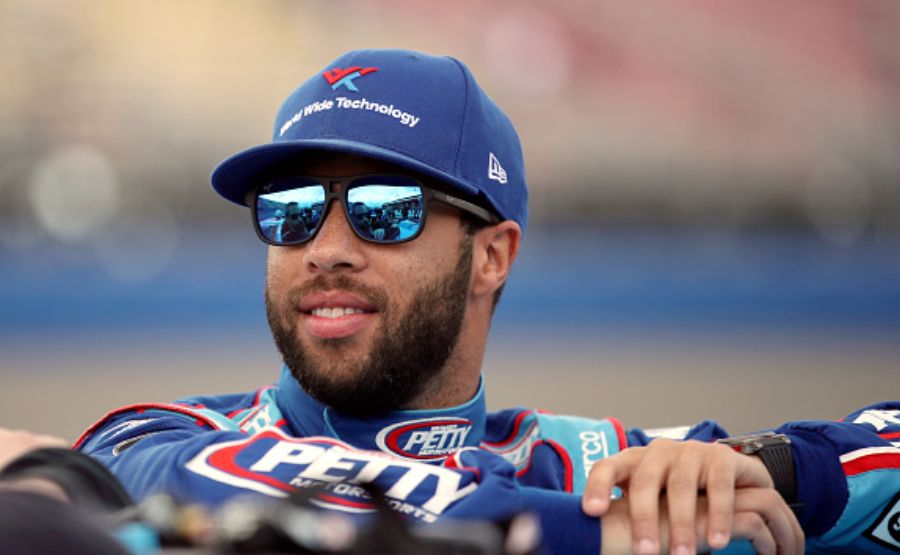
Bubba Wallace Net Worth: Inside His Racing Career and Fortune
Quick Bio
| Detail | Information |
| Full Name | Darrell “Bubba” Wallace Jr. |
| Born | October 8, 1993 |
| Age | 32 (as of 2026) |
| Birthplace | Concord, North Carolina, USA |
| Raised In | Mobile, Alabama, USA |
| Nationality | American |
| Height | 6 ft 0 in (183 cm) |
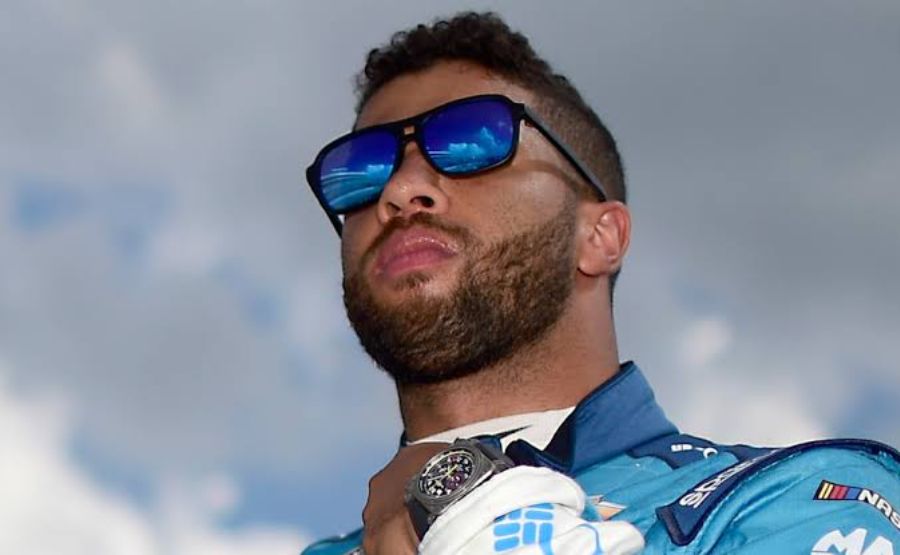
| Occupation | NASCAR Cup Series driver |
| Car Number | #23 |
| Team | 23XI Racing |
| Team Co-Owners | Michael Jordan; Denny Hamlin |
| Sponsor | McDonald’s (primary) |
| Known For | First Black driver to win in NASCAR’s top series since Wendell Scott (1963); social justice advocacy; noose incident |
| Wife | Amanda Carter Wallace (m. 2023) |
| Children | Revealed expecting first child in 2023 |
| Estimated Net Worth | Approximately $5–8 million |
| Residence | Charlotte, North Carolina |
Introduction: Racing at 200 MPH Through Every Barrier
If you follow NASCAR at all, you know the name Bubba Wallace. And if you don’t follow NASCAR, you probably still heard his name somewhere in 2020 — because he was at the center of one of the most controversial and emotionally charged moments in American sports that year.
But Bubba Wallace is more than a single news cycle. He is more than the noose. He is more than the most visible Black face in a sport that has spent most of its history as the whitest major professional league in the country.
He is a genuinely talented racing driver who started working his way through stock car ranks before he was old enough to vote. He is the man who finally integrated the winner’s circle at the Cup Series level for the first time in sixty years. He is someone who has publicly wrestled with depression and anxiety in a culture that discourages vulnerability, and who came out the other side more honest and more grounded than before.
Bubba Wallace’s story matters on the racetrack. It also matters everywhere else.
Early Life and Childhood: Concord to Mobile, Alabama
Darrell Wallace Jr. was born on October 8, 1993, in Concord, North Carolina — which is essentially the heartland of American stock car racing. Concord sits in the greater Charlotte area, where NASCAR teams park their haulers and mechanics tune engines year-round. Being born there was not a coincidence of career destiny, but it didn’t hurt.
He grew up primarily in Mobile, Alabama, though, where he was raised by his father, Darrell Wallace Sr. His parents divorced when he was young, and his father — known for his entrepreneurial drive and serious commitment to Bubba’s racing ambitions — became the central organizing force in his son’s pursuit of a professional career. His mother, Desiree, remained part of his life, and the blended family dynamic shaped him in ways he has spoken about over the years.
Mobile is not a racetrack town the way Charlotte is. But it gave Bubba something else: a grounding in the South’s complicated history that would eventually make him one of the most credible voices in conversations about race and identity in American sport.
As a child, Bubba was essentially living inside a race car program. His father invested significant time and resources into getting his son onto tracks as early as possible. Bubba began competing in go-karts before most kids his age were thinking about anything more complex than video games. He was eight years old when he started, and from the beginning, people who watched him noted that the car responded to him differently than it responded to other young drivers. There was a comfort there. A naturalness.
His sister Brittany was also part of the household, and the Wallaces built a close family dynamic despite the challenges of divorce and the financial strain that serious youth motorsport places on any family.
See also “Marshall Coben Net Worth: The Executive Who Chose to Stay Behind the Camera“
Education: Racing as the Real Classroom
Bubba Wallace attended schools in Mobile, Alabama, but his education was always secondary in practical terms to his racing development. This is not unusual in youth motorsport — the logistics of karting, then stock cars, then regional series involvement demands enormous time, travel, and family commitment that competes directly with the rhythms of ordinary schooling.
He graduated high school and did not pursue formal higher education. By the time graduation came around, his racing career had already progressed far enough that the path forward was clear. He was competing in the NASCAR K&N Pro Series East, and his performance suggested that going to college would not be the next step. The racetrack was.
That trajectory — intensely focused professional development in a specific craft from a very young age, with formal education handled but not prioritized — is common in motorsport, in the same way it is common in professional tennis or gymnastics. What matters in those paths is not what you learn in a classroom. It is what you learn from thousands of hours of practice in the specific environment where you will eventually compete.
Career Beginnings: The Truck Series and Proving a Point
Bubba broke into NASCAR in a serious way through the Camping World Truck Series, where he competed beginning in his mid-teens. He joined Kyle Busch Motorsports, which was then and remains one of the stronger Truck Series programs. Having that organizational infrastructure behind him accelerated his development.
He won the youngest victor in the K&N Pro Series East in 2010 at the age of sixteen, a feat that made him instantly noteworthy. The win wasn’t a fluke — he followed it with consistent results that demonstrated genuine racecraft rather than lucky timing.
The Truck Series gave him room to develop over several seasons. He was fast. He also crashed. He made mistakes that smart young drivers make and that the people watching him expected, because the process of becoming excellent at high-speed motorsport involves learning exactly what the consequences of errors look like. He absorbed those lessons.
His performance continued building through 2014 and 2015. He took wins in the Truck Series. He made his Xfinity Series starts. He accumulated the race experience that fills out a driver’s skillset in ways that raw speed alone never can.
The Daytona 500 and Richard Petty Motorsports
The opportunity that changed Bubba’s career trajectory came when he joined Richard Petty Motorsports to drive in the NASCAR Cup Series. He made his Cup Series debut and immediately showed that he belonged at the top level — the speed translated, the composure was there under pressure, and the racecraft was real.
The 2018 Daytona 500 became the defining early moment of his Cup career. Running second in the final laps, with the rain coming down and NASCAR eventually red-flagging the race, Bubba Wallace crossed the line second at Daytona — the most prestigious race on the NASCAR calendar. It was a remarkable result. The effort was clear. The emotion in his face afterward was clear. The sport paid attention.
He continued with Richard Petty Motorsports through subsequent seasons, building a reputation as a competitive driver in middle-tier equipment — someone who consistently extracted more from his car than the resources behind it should have allowed.
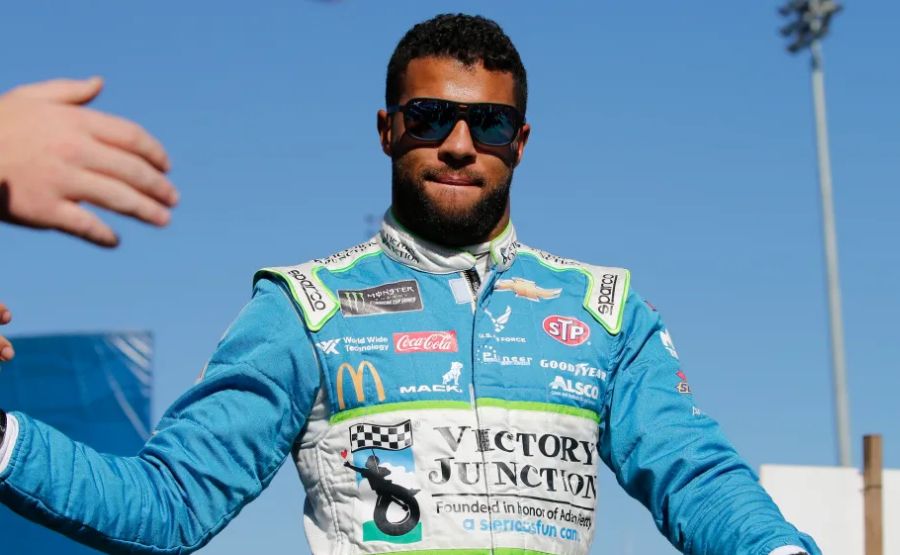
23XI Racing and the Michael Jordan Partnership
The creation of 23XI Racing — pronounced “twenty-three eleven” — represented a genuinely historic moment in American motorsport.
Michael Jordan and Denny Hamlin announced in September 2020 that they were forming a NASCAR Cup Series team, with Bubba Wallace as the driver. Jordan would be the principal co-owner, making him only the second Black principal owner of a full-time Cup Series team in the sport’s history — the first being Hall of Famer Wendell Scott, who briefly fielded his own car decades earlier.
The partnership made sense beyond symbolism. Jordan is a competitor in every fiber of his being. Hamlin is an active Cup Series driver with the credibility of someone still performing at the highest level. And Bubba was a driver who had demonstrated pace and toughness without ever having truly elite resources behind him. Put them together, and you had the foundation of something real.
In 2021, the team began competing with the #23 McDonald’s Toyota. Results came gradually, as they always do for new organizations building their systems from scratch.
Major Achievements: Wins, History, and Breaking Barriers
The moment everyone had been waiting for — or rather, the moment most people didn’t realize they were waiting for until it happened — came on October 4, 2021.
At Talladega Superspeedway, Bubba Wallace drove his 23XI Racing Toyota to the front in the final laps and held on for a NASCAR Cup Series victory. The win was dramatic in the manner of all Talladega finishes — chaos and strategy and physics combining in ways that reward the driver who makes the fewest errors at the most critical moments.
But the significance went beyond the drama. Bubba Wallace became the first Black driver to win in NASCAR’s premier series since Wendell Scott’s win in 1963 — a gap of fifty-eight years. Six decades. The longest such gap in a major American professional sport.
He wept. His crew wept. Michael Jordan came to the track and embraced him. The moment was broadcast nationally and covered internationally. For people who followed NASCAR closely, it validated the resource investment and the talent evaluation that had brought Bubba to this point. For people outside the sport who knew Bubba primarily from social justice coverage, it established him as someone with genuine athletic credentials to match his cultural visibility.
He added more wins in subsequent seasons, demonstrating that Talladega was a beginning rather than a peak. 23XI Racing expanded to multiple cars, signing additional drivers and growing into a legitimate multi-car operation — exactly what Jordan and Hamlin had said they intended to build when they launched.
The Noose Incident: 2020 and Everything That Followed
In June 2020, at Talladega Superspeedway, a noose was found hanging in Bubba Wallace’s garage stall. The report spread immediately. NASCAR called in the FBI. The racing community rallied around Wallace with a show of solidarity that included drivers pushing his car to the front of pit road before the race.
The FBI investigation concluded that the noose — which turned out to be a garage pull rope tied in a loop — had been in that stall since October 2019, before Bubba was assigned it. The conclusion was that no hate crime had been directed at Bubba specifically.
The controversy became enormous. Critics argued the response had been disproportionate. Supporters argued that the initial concern was legitimate given the context — a Black driver in a sport with a complex racial history, at a moment when the country was processing the death of George Floyd and the racial reckoning that followed.
Bubba was at the center of it all, without having asked to be. He maintained his position: the noose was a threat regardless of when it was placed. Others disagreed sharply.
What the incident did, whatever its precise meaning, was make Bubba Wallace one of the most talked-about athletes in America in 2020. It also contributed to his depression that year — a difficult mental health period he was candid about in subsequent interviews.
Advocacy and Social Justice: Beyond the Racetrack
In 2020, Bubba Wallace became the most visible driver in NASCAR’s response to the racial justice protests that followed George Floyd’s death. He publicly called on NASCAR to ban the Confederate flag from race events and properties — a request the sanctioning body granted, announcing the ban in June 2020.
The decision was significant. The Confederate flag had been a presence at NASCAR events for decades, connected in many fans’ minds to Southern heritage and racing culture. Removing it was a meaningful and contested act. Bubba was the public face of the push for that change, and it generated both support and intense backlash.
He has spoken openly about mental health — his own anxiety and depression, the specific pressure of being one of the few Black drivers in a predominantly white sport, and the difficulty of carrying cultural expectations while also trying to win races. That vulnerability, expressed publicly by a professional athlete in a sport that does not encourage such honesty, has resonated with many people beyond the racing community.
He also launched a merchandise initiative that directed portions of proceeds to charitable causes, reflecting a commitment to using his platform for something more than personal promotion.
Personal Life: Amanda, Marriage, and New Chapters
Bubba Wallace and Amanda Carter dated for several years before getting engaged in 2022. They married in 2023 in a ceremony that, true to Bubba’s approach to his personal life, was celebrated warmly but kept private in its details.
The couple announced they were expecting their first child in 2023. The news came during a period when Bubba was also expanding professionally with 23XI Racing’s growth, meaning the personal and professional chapters of his life were developing simultaneously in genuinely exciting ways.
Amanda has been a supportive presence through the most difficult periods Bubba has navigated publicly — including the 2020 noose controversy and the mental health struggles he described from that year. The stability of that relationship has been visible in how Bubba has described it in public contexts.
His father Darrell Sr. remains an influential figure in his professional world. The investment and sacrifice that made Bubba’s early racing career possible was enormous, and Bubba has consistently acknowledged it publicly.
Financial Situation: Building Wealth Through Competition and Visibility
Bubba Wallace’s estimated net worth sits at approximately $5 million to $8 million, based on estimates from multiple industry sources. No official disclosure exists, and these are informed estimates rather than confirmed figures.
His income comes from multiple directions at once. NASCAR driver salaries at the Cup Series level for a driver in his competitive position — with a well-funded team and multiple sponsors — are estimated in the range of several million dollars annually. His primary sponsor is McDonald’s, a relationship that reflects his commercial value beyond pure racing results.
He also generates income through merchandise, public appearances, social media brand partnerships, and the specific commercial appeal of being one of the most recognized names in American motorsport. His profile is large enough that those supplementary income streams are real and meaningful.
The co-ownership structure of 23XI Racing means that his relationship to the team’s financial future is more complex than a simple driver salary. As the team’s flagship driver and one of its most visible representatives, his personal success and the team’s commercial success are intertwined.
He and Amanda own a home in the Charlotte area, which is standard for NASCAR drivers given the concentration of teams and facilities in that region. His lifestyle reflects financial comfort without the ostentatious display that sometimes accompanies athlete wealth at his level.
Life Today: 23XI Racing and a Larger Stage
At 32 years old, Bubba Wallace is competing actively in the NASCAR Cup Series with 23XI Racing. The team has grown from a single-car operation to a multi-car enterprise with additional drivers, reflecting the organizational ambition that Jordan and Hamlin established from the beginning.
He is a husband and a father, navigating the specific balance that professional athletes who travel constantly for their sport have to find between career demands and family presence. The Charlotte base makes that balance slightly more manageable than it would be for drivers whose teams are based elsewhere.
He continues to be one of the most followed NASCAR drivers on social media — not just within the sport’s traditional fanbase but among broader audiences drawn to his story, his advocacy, and his willingness to engage with questions beyond tire compounds and pit strategy.
Final Words
Bubba Wallace’s career is, in the most literal sense, a story about breaking through at 200 miles per hour.
He broke through as a young driver who showed enough in limited resources to attract the attention of the most famous basketball player alive. He broke through at Talladega in October 2021, ending a sixty-year gap in the sport’s most important category. He broke through in 2020 when he called for the removal of a symbol that had defined NASCAR’s relationship to its racial history for decades.
None of those breakthroughs were easy. All of them came with costs — in energy, in controversy, in the specific psychological weight of being a symbol for something larger than any individual athlete should have to carry alone.
He is not the finished version of himself yet. He is still racing, still growing, still figuring out what the next chapters look like. But the chapters he has already written — the wins, the advocacy, the honesty about mental health, the family he is building — describe a person who has faced genuinely hard things and come through them with more clarity rather than less.
That is worth something. In racing and everywhere else.
See also “Marshall Coben Net Worth: The Executive Who Chose to Stay Behind the Camera“
FAQs
1. How much will Bubba Wallace be worth in 2026?
Estimated at approximately $5 million to $8 million, based on consistent industry estimates. Income comes from his NASCAR Cup Series salary, primary sponsorship from McDonald’s, merchandise, brand partnerships, and the commercial value of his high public profile. No official disclosure exists.
2. What is Bubba Wallace’s real name?
His full name is Darrell Wallace Jr. “Bubba” is the nickname he has gone by throughout his life and career.
3. Who owns 23XI Racing?
The team is co-owned by Michael Jordan and Denny Hamlin. Jordan is one of the most famous athletes in American history, and his involvement was a landmark moment for NASCAR’s relationship to race and representation.
4. When did Bubba Wallace win his first NASCAR Cup Series race?
On October 4, 2021, at Talladega Superspeedway. The victory made him the first Black driver to win in NASCAR’s premier series since Wendell Scott’s 1963 win — a gap of fifty-eight years.
5. What happened with the noose at Talladega in 2020?
A noose-style rope was found in Bubba Wallace’s garage stall. The FBI investigated and concluded it was a garage pull rope that had been there since October 2019, before Bubba’s assignment to that stall. The investigation found no targeted hate crime. The incident generated enormous national controversy.
6. What did Bubba Wallace do regarding the Confederate flag?
In 2020, he publicly called on NASCAR to ban the Confederate flag from its events and properties. NASCAR announced the ban shortly after. The decision was historically significant and generated both strong support and significant backlash.
7. Is Bubba Wallace married?
Yes. He married Amanda Carter in 2023. The couple had been together for several years before their engagement in 2022.
8. Does Bubba Wallace have children?
In 2023, the couple declared that they were expecting their first child. Details have been kept private consistent with their approach to personal life.
9. Where was Bubba Wallace born and raised?
He was born in Concord, North Carolina, but grew up primarily in Mobile, Alabama, where he was raised by his father after his parents divorced.
10. How did Bubba Wallace start in racing?
He began karting at age eight. His father invested heavily in his development, and he competed in the K&N Pro Series East while still a teenager, becoming its youngest winner at age sixteen in 2010.
11. What car number does Bubba Wallace drive?
He drives an automobile with the number 23, which is a reference to Michael Jordan’s iconic NBA jersey number.
12. Has Bubba Wallace spoken publicly about mental health?
Yes. He has spoken openly about anxiety and depression, particularly regarding the difficult period he experienced in 2020 during the noose controversy and the broader racial justice climate of that year. His willingness to discuss mental health publicly, in a sport that rarely encourages such honesty, has been recognized as meaningful beyond the racing community.